Friday, January 8, 2016

Last Visit to Mount Scott

Just a couple of the remaining pictures from Medicine Park and
Mount Scott.


These boulders do roll down the mountain.  There were thousands
we saw that had already made the trip, and some of them leave
you with the impression that they could rain down at any minute.


Some more yellow and orange lichens, and trees in crevices but
determine to survive the best they can.

Thursday, January 7, 2016

The Computer is Shaking

Credit: U.S. Geodetic Survey

Yesterday, in a single day, there were 19 earthquakes in Fairview according to the USGS.  The larger ones were 3.7, 4.0, 4.7, and 4.8.  Yet the injection wells in this area last night were going full-bore with lines of trucks waiting to unload more fluids at the injection wells at the same time that the earth was trembling beneath their feet.  There have been another eleven so far today.  We get news warnings about the impending “big one”, and advice from experts and scientists about how the home owner can mitigate their damage.  How damned stupid is that?  Why concentrate on how to mitigate damage and totally ignore the cause of the earthquakes?  Why are we not hearing anything about what the state is doing to prevent the quakes, namely shutting down the injection wells and fracking so as to prevent the big one, rather than advice about securing TV’s and bookcases.  Wells in affluent neighborhoods around Edmund have been ordered to stop injection, while wells operated around Fairview are being told that the same measures are a ‘suggestion’, which they openly state they fully intend to ignore.  France and Bulgaria have outlawed fracking because of the risks.  Pennsylvania has stopped fracking statewide because of the hazards.  Florida has already unanimously passed a ban on fracking in one house of their legislature and anticipate its passage.  Michigan passed a liability presumption law that holds any company or person injecting a single, repeat, single, hazardous chemical near public water liable for all damages.  In the last five years, over 100 bills have been introduced in 19 states dealing with hazards posed by fracking and injection.  What progress have we made in Oklahoma to deal with potential threats to public health or earthquake causation or promotion?  Are we really so bound and intimidated by oil and gas companies and lobbyists that all of our legislators, the governor, and regulatory agencies are willing to follow blindly into disaster and widespread financial loss just to appease oil and gas companies?  Yes, I know drilling interests say earthquakes are not related to fracking and injection, and their spin machines rave about how devoted they are to environmental protections, and we are in the position we find ourselves because too many uninformed people blindly and unquestioning swallow whatever they dish out.  The media just parrots what they say word for word.  We are in the position we are in because financial interests have been allowed to operate in the shadows with no challenges to what they say.  

Sunday, January 3, 2016

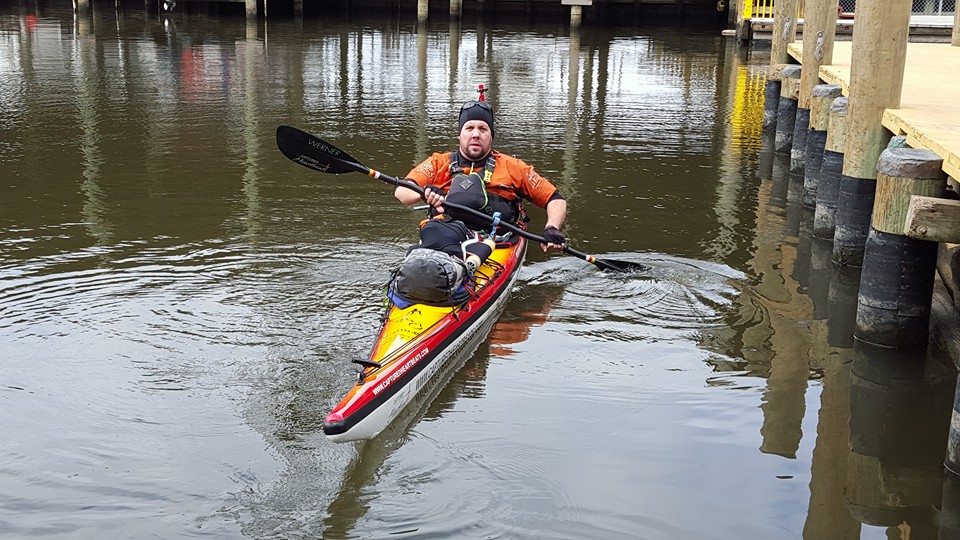
Captured Heartbeats


Photo credit: from Rich's Facebook page

If you haven’t caught up with Rich Brand yet, this trip will be an interesting one to watch.  This will be a circumnavigation of the Eastern United States that will total roughly 7,300 miles.  Those that have done the trip before ran about 6,000 miles.  The difference is that this trip is planned to run around the Gaspe Peninsula and up the St. Lawrence Seaway rather than the normal course through the Hudson River and Erie Barge Canal.

The paddler is Rich Brand from Denver, CO.  He pushed off from north of New Orleans at 11:03 this morning (Sunday, the 3rd).  
The map for tracking his progress may be found at: https://capturedheartbeats.maprogress.com/expeditioninspire
His Facebook page is at: https://www.facebook.com/Captured-Heartbeats-1389455564651776/?fref=ts
And his blog is at: http://blog.capturedheartbeats.com/

For your convenience, so they can be accessed directly from here, the tracker map has been added in the right margin under Favorite Links, and the blog is under it at Favorite Blogs.


A Trip to the Top

From the top of Mount Scott, you can look down the chain of 
mountains that, one behind the other, line up to look like the
teeth of a saw.

Mount Scott was named for General Winfield Scott (1786-1866), the longest serving army general in U. S. history.  He was commissioned a captain of the Army’s Light Artillery in 1808, shortly before his 22nd birthday.  Serving as a commissioned officer for 53 years, he held a general’s rank for 20 years.  You can name any conflict between the War of 1812 and the Civil War, and Scott was either there or otherwise involved.  He campaigned for the Presidency in 1852, but was defeated by Franklin Pierce.


It is amazing that delicate flowers can persevere to grow in the
most hostile and uninviting places.  Maybe there's a lesson
about life here.

A road corkscrews around the mountain to its top.  It has several overview pull-outs where motorists can stop for photography, but the view of the plains and mountains from the summit is worth the wait.  The road was opened in 1938.  A private company was given the contract to build the road in 150 days.  They went bankrupt and destroyed all their equipment when they faced solid granite walls 20 to 60 feet thick.  Engineering was obviously new in the area, as they were surprised by how hard granite was to drill and break, even with explosives.  Ironically, the boulders are broken up by lichen, a symbiotic combination of algae and fungi, which sends its roots into the granite, making it more and more porous over time and susceptible to weathering.  The mountains become smaller boulders, rocks, stones, gravel, sand, and ultimately the ubiquitous blowing Oklahoma dust.


Unlike most mountains where earth settles into the crevices to help
settle boulders in place. these just remain in place out of habit and
some fine and seemingly insecure balancing acts.

Leaving Mount Scott, we continued into the Wichita Mountains National Wildlife Refuge.  Elk were reported to be in the area, as well as buffalo.  The 59,000 acre wildlife area runs along the north boundary of the Fort Sill Military Reservation.  The artillery explosions continued all day, every day, and signs along the roadway, reading “Caution, Impact Area”, warned against getting out and wandering about.  Also, this is still a wild area in spite of the presence of humans passing through, and an artillery officer had been struck and killed by a rattle snake just before our visit.  We saw buffalo, properly called bison, but elk are best spotted at sunrise and sunset, and we missed out there.

I found the orange and yellow lichen interesting.  You can see 
the orange here, with a touch of yellow, but a lot of yellow around
the pictures purple flowers.

Friday, January 1, 2016

Happy New Year!

Credit: Celebrate the Seasons


Happy New Year
Happy New Resolutions
Happily Achieve with Small, CONSISTENT Steps
Happy New Attitude, even in the Worst of Times
Happy New Canoe, Kayak, or SUP
Happy New Paddle
Happy New Destinations
Happy New Campsites
Many Happy Returns from Trips due to Constant Thoughts of Safety First
Happy New Year

Thursday, December 31, 2015

Mount Scott

Mount Scott is a marvel of rock formations, and is the source
of all the red rocks used in the building of Medicine Park.

Mount Scott forms most of the west shore of Lake Lawtonka.  It rises 2,464 feet and is part of the Wichita Mountains.  The published height of the mountain is deceptive.  Like the top of an iceberg, it is only the tip of the mountain range that was thrust by volcanic uplift above the earth’s crust, and has since partially sunk, or subsided, as well as eroded.  The Wichita Mountains are part of a range that runs from Lawton, OK, to Amarillo, Texas, 215 miles to the west.  They were created during four distinct geologic periods dating back 595-million years, making them the oldest mountains in North America.  The Appalachians are often said to be among the oldest mountains, but the Wichitas have them beat by a mere 100-million years, give or take a year or two. 


View of the countryside from the top of Mount Scott
with Lake Lawtonka in the center.

Monday, December 28, 2015

Winter Blunderland

Sunset at Bahia Honda, Florida Keys, a few years ago.


Everything is covered with ice.  The blizzard stayed west of us.  What snow we did get was so weighed down by sleet and freezing rain, it is hard to identify what layer is snow.  After giving the sun and wind hours to work a bit, (it actually hit 32.5 degrees in the sun) I was able to use a steel scrapper to break enough ice loose from the concrete patio so we can get to the garage door.  Then the door was frozen to the jam so we had to beat on the door until we could break the ice enough to open the door, and then it wouldn’t close.  Bahia Honda does have a sound and feel to it, doesn’t it?

Sunday, December 27, 2015

It is Time for Home


Arcadia Lake was rimmed with ice, but now everything is
covered by hard, white water.

Edith Sitwell spoke well about the atmosphere today.  “Winter is the time for comfort, for good food and warmth, for the touch of a friendly hand and for a talk beside the fire; it is the time for home.”  It was 70 degrees about 48-hours ago.  It is now in the mid-20’s, the wind is blowing 40-50 mph, causing blizzard conditions where it has already started to snow.  We were awakened by the noise of sleet being driven against the windows, and it is sleet that has covered the yard in white.  As I type, it is finally switching over to horizontal snow.  The normal time for rising had come and gone, and I thought the only justification for getting up would be when I was driven from under the covers by hunger.  But, hunger was also what was on Jean’s mind as she crawled out, slipped into her shoes, and went out the door to spread feed for the wild birds.  The garage door was frozen to the jam, and she had to shoulder the door a few times before it cracked the ice bond and finally opened.  We now have a hundred or so small birds hopping about the patio to pick up the seed scattered there for them.

My GPS odometer for the month sits at 81.34 miles.  Until now, I had no doubt about making the 100 miles for the month, but now that sits in some doubt.  Half that distance was accomplished while picking up aluminum cans for Canton Lake.  While they were able to get the funding to rebuild the campground’s infrastructure damaged by a tornado, there was no money for replacing the trees.  Collecting and recycling aluminum helps with reforestation, shrubs, and flowers.  Besides falling on the ice and breaking an old bone or two, all the cans are now covered in white, so walking will be on hold until the dead grass reappears, so yes, “it is the time for home.”

Wednesday, December 23, 2015

Wishing you a Great Holiday Season

Credit: conversationsforabetterworld.com


Merry Christmas, y’all.  Let images of paddling scenes dance in your heads.

Sunday, December 20, 2015

Meet the Next President

Credit: google images and formyfem.com
This one looks Presidential.

If you haven’t seen this story yet, it’s too good to let pass.  This could well be the solution to our cast of Republican presidential candidates.  Indeed, it could answer for 99.9% of all positions in Congress.  I don’t say 100%, because I hold the constant hope that hiding somewhere in the shadows of those hallowed halls in Washington (or Tulsa) is at least a solitary statesman, rather than politician.

From the Associated Press comes a story out of Siberia.  In the next week, the council for the city of Barnaul, Russia, will need to choose a new mayor from a field of seven candidates.   Barnaul is a town 1,800 miles east of Moscow.  Their 650,000 residents were asked to vote in an online poll to express their preferences among the six human candidates and one Siamese cat named Barsik.  The voters are so tired of political corruption and incompetence that Barsik nabbed ninety percent of the vote.  In our local paper, this appeared in section ‘B’, page 10.  There’s a message here that’s strong enough to require that it be on page one.

Saturday, December 19, 2015

Medicine Park - 4

We walked through town, walked the length of the Bath Lake Park, and then had lunch at the Old Plantation and dined in the dance hall.  The Plantation is still famous for their steak and fish dinners where the meat may hang off both edges of the plate.   In 1960, Rex and Ruby Leath purchased the Old Plantation from the Texas Land Company.  Rex was usually found in the kitchen, and Ruby, known to everyone as Grandma, would either be found at a table talking with guests, or sitting in her rocking chair by the fireplace.  Her rocking chair still sits where she left it.  This refers to the picture of the fireplace and rockers in Medicine Park – 3.  The Old Plantation was placed on the National Register of Historic Places in 1970.


This caught my eye right away.  It is not only a beautiful home, but
what a nice way to have the canoe ready to quickly drop in the creek.
I do hope they spray it with 303 Aerospace UV Protectant.  This
Oklahoma sun can be murder.  


Our standards for proper language have been under such constant attack,
I didn't think anyone maintained any propriety any more, making me happy
to see this sign.

There were several nice pieces of metal sculpture in town, like this
peace pipe.  Notice the nice mural in the background.


A sunfish swimming among some cattails.


Jean particularly likes this one---a copper mountain lion on a copper
boulder.  It is also called a puma, cougar, panther, or catamount
depending on locale and the indigenous language its name comes from.

Thursday, December 17, 2015

Be Realistic!

Credit:  Aaron Gray

Being realistic is the most commonly traveled road to mediocrity.

Wednesday, December 16, 2015

Rehab Owl


I haven't processed the last of the Medicine Park photos, so here's a diversion.  Jean received a call from a farm manager right after a two-day ice storm.  He had seen a great horned owl that had flown into a fence near Okeene and gotten its wing entangled.  The bird was smart enough to know that its weight couldn't be held by its wing alone without damaging the wing further or even severing it, so it had reached up with one foot to grasp the fence and take most of its weight.  The man felt confident the owl would get itself free, so he went on.

While making his rounds the following day, the manager realized that the owl was still hanging from the fence wire.  The ice storm had completely frozen birds over in half to 3/4-inches of ice, and most of the local population of big birds has disappeared, so it's amazing that the owl had survived the cold, the ice, two days with no nourishment or water, and hanging upside down from a wire.  It was after dark when Jean and the farm manager got back to the field to retrieve the bird and bring it home.

The bird was in bad shape.  It took a lot of water infused with Pedialyte immediately, and Jean went to the store to get chicken livers and steak to cut up and feed the owl.  The foot and leg were so sore and cramped up from being locked on a wire for two days that it couldn't stand or roost even the next day, and just crouched in a bed of straw in the bottom of the cage.  Jean fed it with long kitchen tongs.  It would hiss and snap at her, but after the first bite, settled down to be fed.

When it healed enough that its wild, aggressive personality and strength had returned, it made it clear that it wanted out of the cage.  Since owls are very territorial, we returned it to the same spot where it had been picked up.  When the cage was opened, it just sat there.  Jean finally had to roll the cage over slowly to force it out through the open door.  It just sat for the longest time, but finally hobbled over and got under a piece of farm machinery.  It had been moving its wing, but in the confines of the cage couldn't stretch it fully or exercise it.  We watched it for awhile, but it made no move to leave.  It was obvious that it was sore and stiff, so we left it to give it time to stretch and limber up.  

It was a restless night, wondering how the bird was doing.  The next day, we headed 22 miles back out to the farm as we wondered if we'd find just a pile of feathers where something had been able to catch it.  As we approached the farm, a huge great horned owl took off from a utility pole diagonally across the road from where Jean had found it.  It flew strongly, circled, and glided until it disappeared over a line of trees.  It had to be the same bird.  Another owl's territory would be at least a mile to six miles away. To be sure, we checked all around the farm equipment and looked through the grass and cedar trees. There was no sign of an owl.  Jean's rescued bird was back on the hunt for rodents, but I can't help but think it was wondering, "Hey, when is that woman supposed to show up again with the steak."

An ironic twist to the ways of nature revealed itself on our return home.  After saving and treating the owl, we got back home to find another owl in the tree in our yard trying to catch one of Jean's rescued and hand-raised squirrels.  


Tuesday, December 15, 2015

Visitors in the Dark


This is Piper.  She looks demonic with her red eyes glowing in the camera, but she is one of the sweetest cats ever owned by a dog person.  I was off on the ship when Jean decided to adopt Piper and her sister.  She was supposed to be a surprise.  Mission accomplished.  They had been raised in a goat barn, and like the goats, could go straight up any wall and perch on any supposedly unattainable perch.  Until we accomplished some behavior modification, we had some vexing times as we accumulated claw marks on walls near the ceilings.  The farm had had a large population of cats until they were discovered by a pack of coyotes.  The canines had cleaned house.  These two kittens were the last survivors.  True, she's worthless as a paddling partner or camp watch cat, but she's a good companion when she curls up of an evening in the crook of my arm and purrs a thank you for us saving her from certain death.  Unlike with a dog, there's no knowing that she will be at the window or door waiting for my footsteps, but I know that as soon as I head for my recliner, Piper will race me to the chair and wait for me to pick her up and put her in my lap.  The softer the sweatshirt or flannel, the faster she will nestle in and begin to sing.  We don't always get to choose our friends and companions, but love is pricelss regardless of whose heart it comes from. 

Sunday, December 13, 2015

Medicine Park - 3

The Old Plantation Restaurant.  We had lunch here after walking the length
of the Medicine Creek Park.  History here is sometimes hard to comprehend, 
like having lunch only a matter of yards above the creek where Geronimo
was baptized.


This is the Old Plantation's dining area, the same famed restaurant
and dance hall.  While awaiting our lunch order, we walked around
the room looking at old black and white photographs from just after
the turn of the last century.  We ate lunch in the same room as my childhood
heroes, Roy Rogers and Dale Evans, as well as all the other famous people.


At the end of the hall is a large fireplace with Grandma's rocking
chair (on the left) still sitting where she left it.  Grandma would have
been happy with my reaction when I saw our order coming out of the
kitchen.  One look at that plate, and I couldn't help chuckle and whisper
"Holy crap."  The fish protruded from all sides of the sandwich's bun, and
the bun was 5-inches square.  With the fries, tomato, lettuce, and condiments,
the plate all but disappeared.  It was not only filling, but delicious.


Cabins have traditionally also been available for lodging.  A hotel
has been added as many of the cabins have been taken over by
businesses.  I wonder how tall Mount Scott would be if all the rocks
where still up there where they started.

Friday, December 11, 2015

Medicine Park - 2

Some more pictures from Medicine Park.  This is another dam
across Medicine Creek.  A winding sidewalk follows the creek.

This is more modern construction, but it is the same red cobblestones
that were the building materials from day one.

This is a terraced wall that is of very early construction.  There
were pictures in town of Model-T's and horse-drawn carriages
parked and standing here.

We now have Lowe's and Home Depot for building materials, but the 
River of Rock flowing down from Mount Scott is much closer, 
and the prices are much better.

Tuesday, December 8, 2015

Medicine Park

Below the large dam that creates Lake Lawtonka, Medicine Creek
spills over a few other dams forming beautiful pools, this one for
fishing, others for swimming.

Medicine Park was opened officially as Oklahoma’s first planned resort on the 4th of July, 1908, by future senator, Elmer Thomas.  As a young lawyer in 1906, he decided that while the new lake provided a reliable source of water for the new town of Lawton, the surrounding thousands of square miles of prairie needed a recreational area.  The new resort started with a swimming hole in the creek below the dam, a few campsites, and a large surplus army tent with a wood floor where meals could be served.  In four years, it grew to include two inns for meals, lodging and dancing, a health sanitarium, tennis courts, spa, bath house, petting zoo, general store, a school, bait shop, electric plant, and the Dam Café.  The army tent was replaced by the Outside Inn, a three-story red cobblestone building erected in 1910.  It would be the focal point of the town, had a couple other names during its history, and would later be renamed the Old Plantation.  Medicine Park was billed as the “Jewel of the Southwest.” The area along the creek became the Bath Lake Park with landscaped walkways, gardens, swimming and sunbathing area, and bridges across the creek.  Crowds flocked to the community from throughout Oklahoma and North Texas.

A cluster of wild aster defy logic to find a home among large
red boulders.

After his surrender in 1886, Geronimo and his band of Apache braves were shipped by boxcar to Florida, where they were imprisoned for eight years.  Geronimo was held at Fort Pickens, Pensacola, and his followers and their families were sent on to Fort Marion at St. Augustine.  Geronimo later joined the others at Fort Marion as well.  In 1894, Geronimo was relocated to Fort Sill, and was baptized in the Methodist faith in Medicine Creek on July 1st, 1903.  He died of pneumonia on Feb., 17, 1909, and is buried in the Apache cemetery at Fort Sill.   


The red cobblestones from Mount Scott provide a seemingly
endless supply of building materials.  A beautiful, new home
across Medicine Creek uses just a sampling of the rocks.

While Elmer Thomas operated his resources in Medicine Park with strict guidelines, he decided to sell the lodge to finance his campaign for senator.  The main floor of the Outside Inn remained a restaurant and dance hall, but the upstairs became where the ‘pretty girls’ conducted business, and a whiskey still and gambling room found their way to the basement.  It was even rumored that tunnels were built for the escape of those that didn’t want to be found.  Everyone came to Medicine Park throughout the Roaring 20’s and into the 1930’s.  It became the playground for the elite, the rich, famous, the notorious, and for outlaws, horse thieves, and politicians alike.  Some of the names of those known to visit were Frank Phillips, founder of Phillips Petroleum; Will Rogers; Wiley Post; Bob Wills, the King of Western Swing and the Texas Playboys; Al Capone; Bonnie and Clyde; Pretty Boy Floyd; Lil Hardin, the 2nd wife of Louis Armstrong, and Her Swing Orchestra; Jack Abernathy, the nation’s youngest U.S. Marshal; Les Brown; and Roy Rogers and Dale Evans.


Many different ducks and geese find a home in the 
beautiful surroundings.

Saturday, December 5, 2015

Lawton Campground on Lake Lawtonka

The full moon rises over Lawton Campground in SW Oklahoma.

I wanted to get to Lake Lawtonka for some paddling, while Jean wanted to visit Medicine Park.  With the help of Mother Nature’s vagaries, we ended up doing both.

Lake Lawtonka was created in 1905 with the damming of Medicine Creek.    It has a 19-mile shoreline, and a map can be found on P.109 of the Oklahoma Water Resources Board’s book of maps titled “Lakes of Oklahoma.”  It can also be found in the DeLorme Atlas and Gazetteer for Oklahoma, P.50, grid F-4.  It is on the east end of the Wichita Mountains National Wildlife Refuge, one of the first refuges created by President Theodore Roosevelt in 1901, and the second-most visited wildlife refuge in the country with over 1.5-million visitors annually.  It also is located on the north edge of Fort Sill, the only one of the original forts created during the Indian Wars that is still operated as a military fort.  It is now the home of the Army Field Artillery School.


As the sun sets, a lone sailboat drifts south along the foot
of Mount Scott.

The forecast was for three days of winds below 10mph, which in Oklahoma is as rare as finding the pot of gold at the end of a rainbow.  We loaded up the RV and headed south.  It was a great trip but for the blown tire on the trailer trying to be a spoiler.  I wrote about that on the 5 November post, “Highway Angels.”  Between the trip and dealing with the tire, it was 4 p.m. by the time we settled in the campground operated by the City of Lawton, so we just enjoyed the quiet and the sunset.

Thursday, December 3, 2015

Oops!

Credit: Allan Welsh

I need to make a correction.  The initial text in the post has been changed for those that may not have read it yet, but for those who have, I need to make a revision.  I indicated (believed) that Keen shoes are American Made.  Keen is indeed a US company, located in Portland, OR.  However, when my shoes arrived today, I checked the tongue to confirm the shoe size, and there before my eyes was "Made in China."  With the outstanding reputation the shoes have, I have to believe (hope) that quality control in fact controls the quality.

Wednesday, December 2, 2015

November 3-P-100 and Keen's Help

Credit: Scott Hite

November was a disappointing month for getting outdoors for exercise.  I managed 59 miles for the month, but did have a higher than normal percentage of paddling within those miles.  Like most of you, the multi-day ice event put a kink in outdoor activity, and the holiday didn’t help either.  Anticipating that getting out on the ice could end with me laid up for weeks, I opted for spending time with a book by Cliff Jacobson.

I’ve resolved to correct this backsliding, so started December off with an 8.7 mile walk while collecting aluminum cans for Canton Lake.  The Corps of Engineers got funding to rebuild the campground that had been destroyed by a tornado, but had no funds remaining for replanting trees.  They have asked the public to help them collect recyclable aluminum to fund tree purchases.

I have UPS bringing me two pair of mid-height hiking shoes to also help with my 3-P-100.  I’ve wanted Keen shoes for a long time.   Keen Shoes is located in Portland, Oregon, and have a good reputation.  The Keen Durand was recommended by Kevin Callan, but when I started reading reviews, I discovered two things.  One, the Keen Siskiyou is rated higher by consumers, and two, since that model is being discontinued, they are on sale by Cabelas’.  They are now 50% off, but my Cabela points helped by covering that remaining cost.  You can’t beat two free pairs of shoes.  One reviewer said that due to them being discontinued, he has purchased three pairs.  I settled for two.

I turned to Keen to get an answer as to why Siskiyou was discontinued.  They said that any time retailers fail to step up and make purchases of any style, and they thus fail to meet manufacturing minimums, that style is chopped.  There was nothing wrong with the shoe, as witnessed by them being rated very high by consumers.  Cabelas’, however, had ordered a large dedicated run of the Siskiyou, and that explains why they still have some in stock.  If you want a good hiking shoe at a sale price, get to Cabelas’ before they are gone.

Sunday, November 29, 2015

Barkcamp State Park, OH

The pioneer village general store is also used by the park staff
for registering campers.

Barkcamp State Park is in Eastern Ohio a short distance before reaching the West Virginia state line on I-70.  The interstate, originally called the National Road, was the first federally funded highway in America.  If you exit I-70 at Exit 208 and go south a short distance, near Belmont, OH, you will reach Barkcamp.  It has a small lake, Belmont Lake, with a 4.5-mi shoreline for a relaxing afternoon paddle, hiking and bridle trails, and 123 large, treed campsites.

The original orchard barn built nearly 200 years ago.

The lake is fed by Barkcamp Creek, and the name for both comes from the fact that there was actually a barking camp here.  During the great logging days, crews that stayed in this work camp stripped felled trees of their bark before the logs were delivered to the sawmill.  This was the first part of Ohio that was settled, with many Revolutionary soldiers from the East pausing here to await receipt of their land grants in return for their military service.  

Shed and livery.

At that time, this area just west of the Ohio River was called “The West.”  This beautiful area of rolling, wooded hills was valued by Native Americans and pioneers alike, which led to several battles in the area.  A reconstructed pioneer village is here, but the barn is original.  It was built in the 1800’s by Solomon Bentley, an orchard owner, and is still utilized at the park for nature and conservation programs.  Lewis Wetzel, (1752-1808) the infamous guerilla-style Indian fighter from what is now Wheeling, WV, frequented the area, and is said to have inscribed a stone located near the barn. Wetzel died in Mississippi, but his remains were returned and interred at McCreary Cemetery, Cameron, WV, only 34 miles from Barkcamp.   

The reverse side of the general store and camp office.

On the topic of conservation, Pres. Teddy Roosevelt, a Republican, was one of this nation’s greatest conservationists, even being called the conservationist president.  Upon coming to office in 1901, he created the U.S. Forest Service, and led the way toward creating 150 national forests, 4 federal bird reserves, 5 national game preserves, 5 National Parks, and set 230 million acres aside under public land protection, along with protection of 18 National Monuments, like the Petrified Forest and the Grand Canyon.  Roosevelt felt this nation was blessed and made great by its gift of natural resources, but he cautioned that “to show that this nation is worthy of its good fortune,” we must practice sustainable usage of its resources.  He would turn over in his grave now to see that his Republican party endorses rampant stripping of all resources, even on protected federal lands, through oil and gas drilling, fracking, clear-cut logging, strip-mining in wildlife areas, and mining for metals and coal on protected lands, even privately-owned lands.  Last year, Ohio Valley Coal Co. filed for a permit to run a coal mine directly under Barkcamp State Park, a move resisted by the Sierra Club.  The Columbus Dispatch reports that in Ohio alone mineral rights have been applied for in 18 state forests, 24 state parks, and 53 natural areas, all endorsed by Republicans who have forgotten their own heritage.


Thursday, November 26, 2015

The Coyle House

Curiosity creates wonderful things, and curiosity is easy to satisfy.  People seldom get an opportunity to talk about themselves and share their lives, so it is a rare occasion when people don’t take advantage of the opportunity to share of themselves.  Charles Kuralt made a career out of following his curiosity, and it helped him build “A Life on the Road,” which was also the title of his autobiography.    It’s a principle I’ve seldom had the chance to pursue, but here’s one small example of the idea at work, which gave me a chance to meet some nice people.

I love the colors and the great attention to detail.

We were on our way with the family to visit Kings Gap Mansion and state park, near Carlisle, PA.  We were just riding down the road when we passed a house that riveted my attention.  It was an old home, but it had been beautifully and tastefully preserved.  I wanted a picture of it, but when we returned that afternoon, the sun was in the west and the house was covered with the shade of a large tree.  I was determined to return the next morning and ask permission of the owners to take a picture of their home.


I found the owner in the driveway when I returned the next day.  He introduced himself as Clyde Widener.  A bit suspicious at first as to why I was there and what I wanted, he warmed quickly when he understood that my interest was in something that he had dedicated a lot of himself to.   Their home was the Coyle House, built in 1901, as part of the Coyle Lumber and Millworks.  The millworks, still operating diagonally across Old York Road from the Widener’s, was started in 1879 and originally ran off the water power created by Yellow Breeches Creek, which runs directly behind Widener’s home.  (I have paddled the Yellow Breeches.  Well, I paddled most of it, and swam the last bit while upside down.)  The millworks was operated by four generations of Coyles for over a hundred years, being sold after the death of William Coyle in 1992.  They still make solid wood windows, doors, and cabinetry, in addition to special custom jobs.


The cooking house still stands directly behind the Wideners’ home.  Meals were prepared there to both reduce fire risk in the house, and also keep the house cooler during the summer.  A hand pump by the back porch was used to pump water up from the cold creek so they could bathe right there on the porch.  There was a lot less traffic by the house in those days.  Mr. Widener took special delight in showing me the moldings around the eaves and windows.  When they bought the house, many of those custom-made moldings were in bad condition, and several sections were missing entirely.  On a lark, he went over to the millworks to see if there was any way they could make a molding that would come close to matching.  To his amazement, they still had the original handmade molding cutter blades from a century before.  It’s refreshing to find that there are indeed still a few places in America where everything isn’t thrown out with the release of the newest catalog.

Wednesday, November 25, 2015

Handmade by Jean

This is just one design of dozens of Jean's handmade gift
enclosure cards for weddings, births, graduations, or any
other occasion you can think of.  She really does beautiful
work, if I do say so, but you're welcome to agree.  Many
are hand-painted, making them real collector's items.