Friday, February 10, 2012

From the Age of Sail

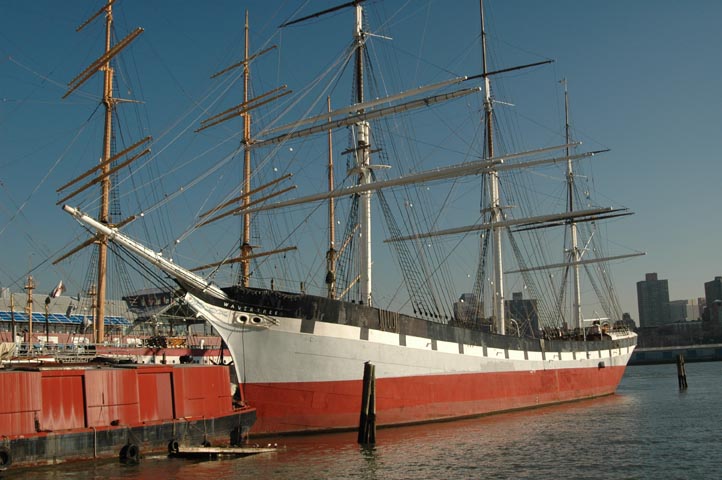
The Wavertree.  Behind her are the buff-colored spars of the Peking.
Credit: victorianweb.org

The first bit of news is that I should have my computer back tonight or tomorrow, which means we will once more have access to our materials on the Florida Keys Challenge.
Back on board the Harvey Gamage on Sunday, 7 Oct., the wind was very light, but we got into Oyster Bay for our first anchorage outside of New York City.  Monday brought us decent wind, but it was right on the nose for our trip back to the city.  In order to catch the current at Hell’s Gate, we finally had to start the engine to save the time lost in beating to weather. 

Hell’s Gate is a narrow strait that connects the East River and Long Island Sound.  The current races through fast enough to make headway difficult for low-powered vessels, and steering even more dangerous.  Most vessels try to arrive at the strait close to slack water (when there is no current) or just after a foul current begins, as it is easier to steer against a current than with one.
As we passed through Hell’s Gate, a dozen or more cars were pulled up on the banks.  Hell’s Gate had been found to be a Mafia graveyard, and police divers had been working for days locating and pulling cars from the river bottom.  With current running at five knots, and slack water lasting just a few minutes, divers had a very short period in which to grope about in the zero-visibility water.  One car contained the body of a New York state trooper that had been handcuffed to his car before it was forced into the river.  Another still contained a skeleton.  With others, the bodies had undoubtedly been washed out of the cars by the strong current.

This will be a sudden shift in topics, but the other reason that time was critical was we had a wedding scheduled on board in the evening.  It was a very casual affair, with the bride wearing blue jeans.  The ceremony was followed by a cruise of the harbor under power as a catered dinner was served for the wedding party.

With 115-feet of painted wood, varnish, tarred rigging, greased spars, dozens of pumps, and brass that was polished daily, work never stopped.  Whenever the schooner wasn’t moving with charterers on board, the tools were pulled from beneath the cockpit and everyone got to work.  We did get a couple breaks over the next two days, however.  On Wednesday we got a chance to go into the city to see the previewing of the Citibank commercial we had done.  On Thursday, 
once the day’s work was done, we got a chance to tour a couple famous ships.

Anyone who has sailed, of course, knows of Irving Johnson and the film he did aboard the Peking as it rounded Cape Horn in 1929.  The film can still be seen, and gives a great understanding of the power of these ships under sail.  Built in 1911, this 377-ft., 3,100-ton ship worked the wheat and nitrate trade around Cape Horn until the Panama Canal was in operation.  By 1932, the much shorter route through the canal by steamships finally made it impossible for this square-rigger to compete.  She served in both World Wars, was even moored and used as a training vessel and a children’s home before being bought by the U.S.  She has been berthed at South Street Seaport as a maritime museum since 1975.  A couple of her other impressive measurements are 170-ft. spars, 16-ft. draft, and 44,132 sq.ft. of sail.
With us berthed on the opposite side of the pier from the Peking, we had constant contact with her workers.  As fellow seamen, it was inevitable that we’d be given access to her interior.  The public tour only gave access to the decks and deck houses, but we were given open access to her from stem to stern and to the very bilges.  They were doing some beautiful work on her, and the effort to maintain such a vessel has to be a constant and arduous effort.

We also had the same access to Wavertree, which was berthed alongside the Peking.  Built in 1885 in Southhampton, England, the Wavertree was one of the last large sailing ships built in wrought iron rather than steel, and at 325-ft., is the largest vessel of that material still afloat.  In 1910, she was dismasted off Cape Horn and barely survived to make it into the Falkland Islands.  She was acquired by South Street Seaport in 1968.

I made note in my log of the conversation the Gamage’s skipper and I had about how sad it was that such vessels were disappearing forever.  Since then, however, there has been a huge resurgence in preserving, sailing, and even building new large sailing ships around the world.  The American Sail Training Association (part of the International Sail Training Assoc.) now has over 200 sailing vessels from schooners to square-riggers on which people can find a berth as a volunteer crew member or paying guest.  What a great maturing opportunity for a young adult to experience life at sea as it was during the age of sail rather than spending time and money in the artificiality of some large theme park!  See http://www.sailtraining.org/

Thursday, February 9, 2012

Between Glass and a Hard Place

The schooner worked the summer season in Maine.  It then moved to New York and Long Island Sound once the cold had killed off any interest in sailing further north.  It spent the remainder of the hurricane season chartering there and completing any major refit jobs before jumping off for Bermuda and the Virgin Islands. 
For my first charter, we boarded only three passengers for a three-day cruise.  The good news was that it was great sailing.  We sailed through New York Harbor and up the Hudson River closehauled as we punched into four-foot waves and threw water  everywhere.  It was my first chance to see the Gamage working and start to get a feel for the helm.  On the down side, it was unseasonably cold and hard to keep warn.
The day after the charter, we starred in a commercial for Citibank Corp.  We really worked---tacking again and again,  jibing, changing sails.  We did a full day’s work in about three hours.  The theme was that Citibank conquered the world of business.  It started with “in the beginning, commerce was accomplished under sail.”  Gamage sailed into the viewfinder and filled the screen.  Then the filming helicopter descended lower as the story unfolded.  Citibank took its place in the modern world of commerce and finance as the camera’s view drew back to view the schooner before the New York skyline.
During that day I also made my first trip aloft to the mast truck (the very top).  I had used ratlines before, so this was just a higher version of the same.  The truck would eventually begin to feel like home.  Later, when every cabin was full with charterers, as well as the deck and saloon, the crosstrees far above the deck would become my escape for a few minutes of personal time.  Besides that, the charterers enjoyed watching someone scaling the heights.
That evening, following the commercial filming, we did a charter for the Girl Scouts.  By that time the wind had blown itself out, and we had to settle for a motor cruise around the Statue of Liberty and the harbor.  As soon as the Girl Scouts stepped off, another group boarded for a weekend charter.
One problem with carrying passengers who have no nautical experience is they have no concept of how to manage utilities aboard that they are accustomed to taking for granted.  At home, they take 45-minute showers and leave the sink water running all the time they brush their teeth, wash hands, or rinse dishes.  So, in spite of the little talk on the use of water and the head that I gave every group, by dinner time Saturday, in one day, they had emptied every fresh water tank aboard.  This was a quantity that should normally last up to a couple weeks!
We headed for Greenwich, CT, in search of water.  Being October, and after 5 pm, we found the first marina we stopped at closed.  Hoping to find a place to lie alongside and take on fuel and water, we continued until we reached the head of the harbor.  Boats were moored beam-on to the quays on both sides leaving hardly a hundred feet in which to maneuver a 115-ft. vessel.  Feeling trapped, the skipper decided he’d have to launch the tender, tie it into the bobstay and whisker stays under the bowsprit, and use its engine as a bow thruster so he could back the schooner out.  Since this was an operation that took a fair amount of time and effort, I suggested, “Why don’t you just back and fill her around.”  Backing and filling is a maneuver where you put the helm hard to starboard (right), and using the engine in short bursts forward and reverse, use the torque of the propeller to walk the stern to port without gaining any headway or movement astern.  In this way, you can turn a single-screw vessel around in about its own length.  With a continuous line of fishing boats to port, and another line of expensive yachts to starboard, there was no room to maneuver.  Also, with a large glass-fronted dockside restaurant only feet behind the yachts, it felt like there was less than no room.  The skipper smirked at me and said, “If you’re so smart, why don’t you do it,” and stepped away from the helm. 
At some point, the sooner the better, a mate has to show the skipper he can manage the vessel, so I stepped to the helm and called the crew aft.  I could clearly see how much room I had off the stern, but depth perception a hundred feet away was something else.  I'm not one to take unsafe risks.  With no wind or current to deal with, I felt it was a safe and manageable maneuver, even though a delicate and very tight one---turning a 115-ft vessel in about 95-ft of space. I had one deck hand slide out on the end of the bowsprit.  “Give me hand signals for the number of feet the bowsprit is from the glass.  It won’t be much of a drop to the ground, so if things go wrong, jump clear so you don’t get cut by the falling glass.”  Another crew member was stationed in the waist (the middle of the deck) to relay any verbal messages from the bow, since I might have trouble clearly hearing him all the way aft.  After several maneuvers, the schooner started to turn.  I slid the bowsprit between two yachts tied in front of the restaurant, and as the bowsprit slowly slid toward the glass front of the restaurant, I watched for the number of fingers being held up each time I slipped the transmission in forward.  I was a bit too busy to really look, but at one point realized people dining next to the glass were getting up and leaving their tables.  Their looks and actions would be played out a number of times by the crew over the next few days.  Once we were most of the way around, I had enough room to slide the bowsprit back out from between the yachts, and completed the turn.  With the bowsprit once again aimed for Long Island Sound, I stepped away from the helm as the skipper smiled and said, “Nicely done.”     Probably not unlike making the kick and seeing the football fly between the uprights as the last few seconds expire in a major game, it was one of those moments that lasts in your mind forever.  Of course, if I’d stuck the bowsprit through all that glass, I’d have remembered that forever as well.

Monday, February 6, 2012

Joining The Harvey Gamage

Credit: Schooner Harvey Gamage Foundation, Inc.

There was one thing I noticed very early on in my working life about retirees.  Those that were fully invested in their careers, with nothing planned to look forward to after retirement, didn’t last long after leaving their jobs.  They were lost.  They became depressed and looked frantically for something to fill the void.  With no alternative plan in place, their lives were often too quickly filled with affairs, alcoholism, divorce, and suicide, or self-induced, stress-related heart attacks.  With nothing to fill their lives, many failed to live longer than three years after getting their gold watch. 
I had lived my life on the water, so it was not much of a leap to decide what my second career would entail.  My pension would help support the family, so at last I had the opportunity to do something I enjoyed.  I started making contacts a year before I retired.  Sixty-five resumes went out in June.  By August, I had one commitment and several employers expressing interest.  Several phone calls followed with Capt. Eben Whitcomb, owner of the Harvey Gamage, and by the second week of August, I was locked in as the First Mate for the Caribbean cruising season.  I retired on a Wednesday, and on that Friday morning, I boarded the Gamage in New York Harbor.  I had been retired for one day.
Jean had gone ahead to find a house in St. Thomas while the kids remained with me.  She also found a job as assistant manager of South American Trade in Charlotte Amalie.  A friend agreed to drive me to the ship, and the kids were dropped off at Philadelphia International for their flight to join their mother in the Virgin Islands.  I was to join the ship at Pier 40, but she wasn’t there when we arrived.  After a little hunting, something I’d get used to, we found her at Pier 61.  After saying good-bye to Jim, my friend from home, I boarded and got settled into one of the spare cabins.  I was expected to take the second-in-command responsibilities the minute I stepped aboard. There was no training or breaking-in period, as within the hour we were underway, having to move the ship around the Battery to Pier 11.

The largest vessel I had skippered previously had been 73-feet.  Here I was on a 115-foot gaff-rigged schooner with dozens of miles of rigging on masts that rose 91-feet in the air, 4,200 square feet of working sail, and the ability to carry 6,000 feet of sail.  It was going to be a very steep learning curve.  She had been built in 1973 by Harvey Gamage, one of the last surviving wood sailing ship builders, and Eben had decided to name her in his honor.
While in Pier 61, a private yacht so huge it would reasonably be called a ship, had come and berthed across the mouth of the piers.  With our way blocked, there was no way to get out.  It fell to me to ask the owner, an Arab sheik, to move.  The boarding ramp had been raised chest-high off the pier so no one could board.  I walked back and forth trying to attract someone’s attention, banged on the hull, but still could attract no one’s attention.  I started to hoist myself onto the boarding ramp when a couple of the crew called me back to the schooner.  One said, “Hey, man, you’re going to get your ass shot.  We’ve seen armed men walking back and forth all over the ship carrying automatic rifles.”  But, we needed to move, and, therefore, so did the sheik.
We began to get the story.  The sheik and wife number ? were involved in a violent divorce.  She wanted sole custody of their kids, so he had flown his kids to the ship in his helicopter and set sail for the U.S.  She was apparently flying to the U.S., having learned where the ship was, and was expected to show up at any time, which explained the raised boarding ramp.  The idea was to deny her boarding access long enough for the kids to be loaded in the chopper and flown away once more.   Knowing the skipper wouldn’t be too far removed from the bridge, I did manage to pull myself onto the ramp, went to the wheelhouse, and banged on the door until I saw three men coming walking quickly down the side deck.  All it took was a five-minute explanation, and a half-hour to get the engines going and all the yacht’s lines to be walked forward, and we had access to open water.  We got out of sight before the show down with the wife. 

No Joy

When we did the double Trans-Atlantic following Columbus' route in 1992, and spent the summer in Spain, I did a regular mailing, which amounted to a blog, and never had a minute's trouble.  Of course I typed it, copied it, and mailed it.  Never a glitch.  But computers are supposed to make life so much easier.  I came home from the Keys Challenge, spread out all the charts, my notes, picture files, and spent a whole week doing the blog text.  Now I have no access to any of my material. 

I took the disc to the library, but couldn't do anything with it.  The librarian tried, and had no luck with it.  She called her computer man, George.  He tried it and said the files were "corrupted."  He could access the blog material from 2010, from 2011, but not the current material that I had tried to open on the laptop.  I know it was on there when I downloaded it,  but apparently while trying to open it on the laptop, the laptop ate my homework.  Life was so much sweeter and less stressful when it was my dog that ate my homework.  For one thing, I have little expectation of living long enough to master computers.

Unless I'm somehow struck with a bolt of genius (little expectation of that either), the blog on the Florida Keys Challenge will continue when my desktop gets its new power supply and is returned with all my files

Jean suggested I write on something else in an effort to hold everyone's interest in the meanwhile.  I'll pull one of the logbooks from the shelf and give that a try.  I hope you find it of some interest even though it will be without pictures.  I regret the break in the Keys Challenge coverage, but there's apparently nothing more that I can do.

Saturday, February 4, 2012

Possible Solution

I'm told the way around this problem is to go to libraryMonday and send myself an e.mail, and I can then cut and paste the blog off the e.mail.  So, tomorrow is the Super Bowl, and I'll attack this problem again Monday.  Enjoy the game. jim

Friday, February 3, 2012

Patience, Please!

The desktop had to go to the shop.  I've tried to upload everything to the laptop, and that has taken care of today---the whole day.  I copied the Word blog files on a disc from the desktop, and when I try to open them on the laptop, all I get is YYYYYYYYYYYYYYYaaaaaaaYYYYYYYYYYYYYYYYYYYYYYY
Apparently there is a language problem.  As soon as I can figure this out, I'll continue on, otherwise, it will be a week before the desktop comes back.  If you know the answer to this riddle, don't be bashful.  My e.mail address is in top-right. jim

Thursday, February 2, 2012

Florida Keys Challenge - 2

One of the subjects being discussed didn’t compute with me---earplugs. My experience had always been that I wanted to know what was happening around me when camping. If an intruder entered my camp in the middle of the night, whether two-legged or four, I wanted to be immediately aware of it. But, I was to learn. Many of our campsites were in close quarters, often with only inches separating one tent from another. Also, with the narrowness of the Keys, we were usually in ear shot of U.S. Rt. 1’s traffic. I usually camp in remote areas alone, so the idea of getting to know people’s names by day, and the sound of their snores by night, was something new. Then there was the night at Boyd’s Campground. I thought triple-X films were really the only place you heard a woman’s loud carnal moans and groan, ooos and aahs, or Meg Ryan‘s restaurant enactment of passion in “When Harry Met Sally.” Again, I was to learn. One woman already camping there before we arrived kept half the campground awake until three in the morning. Maybe there’s a place for earplugs after all. But not to make it sound negative, after a full day of paddling, a shower, and a nice dinner, we generally slept very well.

In the same vein, I was awakened on this morning at 4:33 a.m. as the camper next to me started breaking camp. There was a brilliant full moon, and my first thought was maybe with the brightness he had confused the moon and the sun. Anyhow, we were awake, and our first paddling day was off and running. I always hate having to pack wet gear, and with the night’s rain, everything was soaked. A truck was provided to take two packs from each paddler and carry it to the next campsite so our boats weren’t burdened with heavy gear. With the packs in the truck, breakfast was at 7:30, the lead boat pushed off at 8:00, and everyone was supposed to be gone by nine.


Horrible as pictures go, but our first day did start with a grey
sky on a grey sea, but note how the starting paddlers are already
disappearing over the horizon.


Bill, Gus, Carl, and I hit the water, and within the first few minutes I realized that time had dulled my memory of what happened the last time I paddled with kayaks. So, here’s a caveat. Paddling a canoe in a fleet of sea kayaks is like showing up at a Harley Davidson rally with a Vespa scooter. Both are great at what they’re designed to do, but it’s hard to make a marriage of the two work. Paddlers are by nature an independent lot, so this is fine if you are a loner and want to go off and do your own thing, but if you like being part of the flock, or keeping up with the flock, or staying abreast of the group’s scheduled activities, make sure your boat shares some things in common with the others. A canoe’s cruising speed is about 3 kts. A sea kayaks cruising speed is about four, and will accelerate well above that. It’s a good idea to check with the group organizer to make sure there are others in the fleet with similar boats. I didn’t, and was the only canoe in a fleet of about 55 kayaks. (I heard different numbers from different people, but the Florida Keys Challenge had about 68 people register, with about 57 of those paddling. There were also a couple big tandem kayaks.) As a result, we paddled together for about 20 minutes. Gus, Bill, and Carl would paddle ahead, then realize I wasn’t keeping up. They would stop and I’d paddle like a dervish to catch up. Once that had happened about three times, it was obvious to all concerned that we’d have to go our separate ways. We shared time ashore, but on the water, they’d exchange a few pleasantries as they went by, and would soon disappear in the distance.

On the first day, the fleet spread out very quickly. I never saw the lead boat for the first two days. It was one of the tandems with two good paddlers, and it soon disappeared over the horizon with a small group of athletes in very fast sea kayaks. At one point, the nearest boat to me in any direction was over a half-mile away. I felt somewhat vindicated the next day when several kayakers insisted that the lead boat slow down. It was just part of the learning curve. By the end of the week, the lead boat indeed maintained a pace better suited for a larger portion of the group, and there were a couple other adjustments in time and speed that helped. For example, in the beginning they insisted that everyone hit the water at the same time. One day I was hailed from shore and told to wait until everyone was in the water. That put me behind from the first stroke. Later, I’d try to position my boat so I’d get off the beach first and have a couple miles under the keel before the lead boat slid by. Of the roughly 16 or so legs, I came in twice with the rear sweep boat. Usually I’d finish in the after third of the fleet. Getting to the lunch stop late, and needing to get an early start for the afternoon leg meant a very short break and an inhaled sandwich. We shouldn’t put too great an emphasis on speed, but it did seem 54 boats were cruising, and I was racing, so, again, the best advice is to make sure you have a boat similar to the rest of the group, or at least others in the group.

Our boats staged at Coconut Grove Resort.


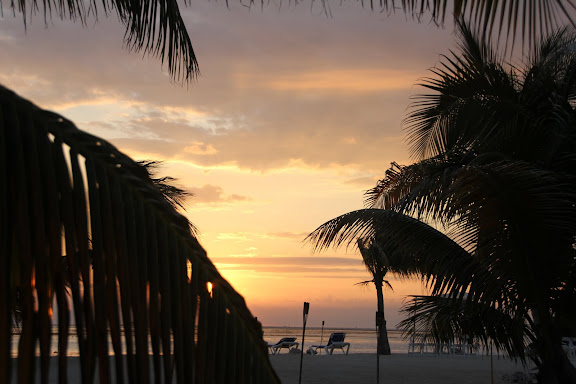
The weather at the start was a slate gray sky on slate gray sea, but the good news was that both wind and sea were calm. We paddled 2 miles before breaking out of the mangrove canals into open water and went down the shore of Key Largo. Most of us went inside of Rodriquez Key, and completed the 9.5 mile paddle to our lunch stop at Harry Harris County Park on Tavernier Key. Several saw wildlife, including hammerhead sharks, sea turtles, rays, and tons of fish and sponges. After lunch, we passed Plantation Key and Treasure Harbor to reach our first campsite at Coconut Grove Resort on Windley Key. The tides played a large role in our trip, and as we saw the cloud cover begin to break up to give us a nice sunset, the tide receded to turn the ocean front into a pasture of sea grass. We pitched our tents in the coconut grove next to the highway, and the wind picked up during the night to noisily beat the palm fronds. The day’s total was 18.9 miles, and the first long day I had dreaded was behind us.

The picture postcard end of Leg 1.


Wednesday, February 1, 2012

Florida Keys Challenge - 1

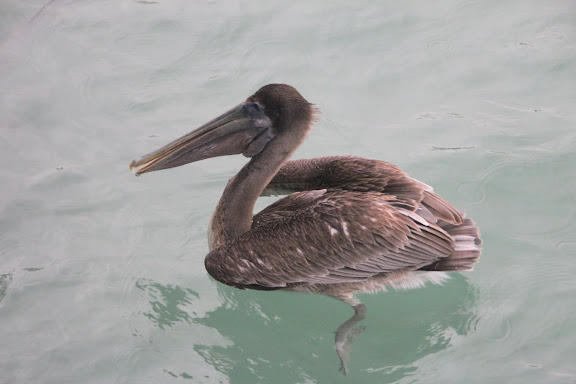
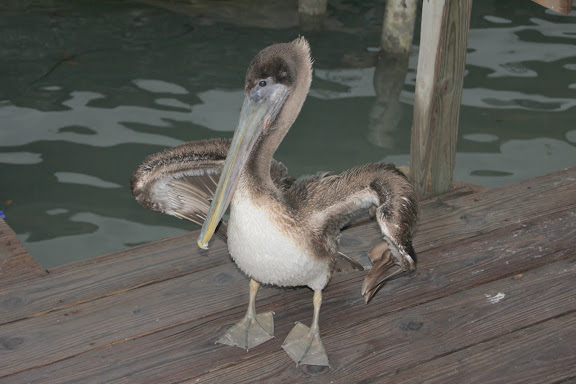
Brown Pelican

Today was the first official day of the first Florida Keys Challenge. We were up at 5:30 a.m., left Ed and Ellen’s, and went to wake-up the staff of the Hideout Restaurant nearby. Two men had beaten us inside for their morning coffee, but all the lights and the ’OPEN’ signs still weren’t on. They were happy for the business in such a nice, but out of the way place, where the interior had already been over decorated for Valentines. Besides wall Valentines, and garlands of Valentines around the ceilings, the flight of the sole waitress to and fro would set the inflatable red lips and hearts slowly spinning on their strings that hung from the ceiling.

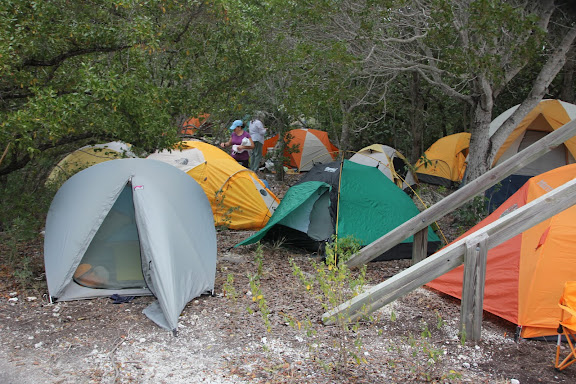
Home is wherever there's room.

The entire day was to be a race. As soon as we finished breakfast, it was off to the John Pennekamp Coral Reef State Park, which was still on Key Largo, and only a mile south of the restaurant. We had to get there, drop off our boats, and set up camp. We then had to drive to the finish point at Fort Zackary Taylor State Park at the south end of Key West to leave our vehicles.

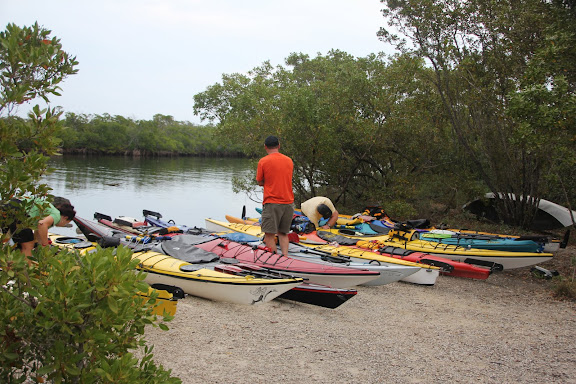
The boats were staged in about three openings that gave access to the water.


If you make the trip to the Keys, the first lesson is to forget any attempt at estimating travel time based on distance. Once you hit Rt. 1, the Overseas Highway, sit back and chill, because you’re not going anywhere fast. The Keys are crazy. The Overseas Highway is a two-lane road, and you’re only going as fast as the car in front of you. The idea of passing is insane and nearly suicidal, as evidenced by the traffic crashes we saw any time we drove. With another few thousand cars in front of you going the same way, passing one of them is as fruitless as it gets. There are indeed sections marked 55 mph, but all it takes is one motorhome, one scooter, one tourist determined to see all the sights while driving, and you’re going 35 mph whether you like it or not.

It took three hours to reach Key West. It is a town designed over a century ago with modern crowds. It is Manhattan with wild roosters and Key Lime Pie. You have to share the streets, all smaller than most of your driveways at home, with wall-to-wall people who can’t all fit on the sidewalks, with bikes, with scooters, with all the cars that have driven down the Overseas Highway and now have no place to go, with tourist trains, buses, and jitneys, and of course with a few delivery truck drivers trying to make turns around 20-ft. corners with 55-ft. trailers. After reaching the fort, we got our parking passes, left our vehicles, and boarded a couple mini-buses for the three-hour drive back to Pennekamp.
The first job on arrival back at Pennekamp was to finish our camp set-ups and check our boats and gear in preparation for the push off in the morning. The most important piece of business now would be the mandatory paddlers’ meeting as soon as we finished dinner. All the meals but one were catered. That one was a lunch where food couldn’t be delivered to an island lunch stop, so we packed our lunches for that day. Due to the distances to be covered, we had four catering services picked from locations along the route. The food was varied and outstanding. We had lasagna one night that was to absolutely die for. Several of the guys had taken off to find a sports bar with a TV where they could watch one of the football playoffs, and those of us left behind at camp were the winners as we grabbed their portions. The only chow crisis we had was if the morning coffee was a couple minutes late arriving. We then shoved off each morning around 8 to 8:30, depending on what we faced on the day’s paddle.

With the paddlers’ meeting about to start, Bill Richards, Executive Director of PaddleFlorida, took center stage to brief us on what we should expect. He said, “We’ve had thirteen paddling events so far, and not one of them has had to deal with rain.” With that, a flash of lightning lit the sky behind him, thunder rumbled, and the rain began to fall as we ran either for cover, or to make sure our tents were closed tight. We tried to continue later as we gathered under the picnic shelter. A few were unhappy with what they heard.

It takes a while for any group to find their own group personality and cohesiveness. This one was no different. When asked about safety, Bill was adamant that he wasn’t there to hold anyone’s hand, or plan for every crisis. That didn’t sit well. Many felt that his role was to indeed foresee and plan for anything that might happen. When talking with him by phone earlier, I made the statement that I had never participated in an organized event before. He responded that when I finished this event, I could still say the same thing. Some felt he was too hands off, and there was too little organization. What we came to understand with time, however, was what he didn’t say. He had certainly provided a structure that insured as much safety as such a large group could expect. My impression was that he didn’t want us to come and be part of a Bill Richards event, but to come prepared to create our own adventure, take charge of our own security, and lay claim to our own success or failure. In the end, we all managed to do that.

Even pelicans will pose for the camera.

Each day there would be a lead boat. While many of us carried our own charts and GPS, the lead boat insured we got where we were going. There was also a mid-fleet sweep boat to make sure the group stayed together. At the end was a rear sweep to keep pace with the slower boats and make sure everyone got in. Bill was surprised that so many carried VHF radios, so we also maintained a calling and working frequency. A U.S. Coast Guard Auxiliary boat stationed itself at critical points or ran up and down the fleet to check on everyone and provide any emergency response. An EMT carried a medical kit on the trip to address the few bumps and abrasions. Lastly, everyone reported their departure at the start of every day, and checked in when they landed at the end to guarantee that everyone was accounted for. There were some kinks in the system the first couple days, but everything then began to flow smoothly. Weather was discussed each day, and anyone who felt they couldn’t manage in the day’s winds or seas had the option of having their boat loaded in the truck for transport to the next site. In the end, only one person dropped from the fleet after a rudder failure, and the feeling that perhaps with his age, he may be in a bit over his head.


Tuesday, January 31, 2012

On The Road - 6

The first thing I awoke to this morning was a dead computer. Jean breathed a bit of life back into it, and I immediately started backing up files so I didn’t lose the last week’s work I’ve done on documenting the trip. It will have to go to the shop, so if there’s a short break, don’t lose interest. I’ll be back.

If there’s one thing I could count on with Ruth, it was that I was going to eat. I may get wind blown; I may get rain drenched, but I’d never get hungry. It was another 199.9 miles to Key Largo where I was to meet Gus, Carl, and Bill at Ed and Ellen’s Motel. I had rain. I had a very heavy, low cloud cover. I watched trees and palms whipping in the wind. But, I munched contentedly and continuously from a packed, insulated lunch sack that was straining its seams. Another new experience was passing nine highway caution signs for panther traffic, and panther crossing areas. Just to emphasize that they were serious, two had double flashing yellow lights while they warned of “Panther Crossing, Next 3 miles.” We were entering the Everglades on the Tamiami Trail, a 165-mile road that leads through marshes, wildlife areas, camping areas, and Indian villages.


L-R: me, Carl Anderson (Fernandina Beach, FL); Gus Bianchi (Orange Park, FL)
The Thin One, AKA Bill Finley (Hernando, FL)

I passed Ed and Ellen’s Motel four times. Once you find it, it’s quite pleasant to find yourself buried in a thick, wooded grove, but from the highway, it’s all wooded grove and no motel. The little yellow sign for the motel is high in the tree branches and almost impossible to see. It was only about another 15-minutes before Gus, Carl and Bill pulled in towing their boats on a trailer. We threw our bags in the room, and headed off for dinner. Gus, the one with all the local knowledge, was bound to show us the sights, so he took us on a road trip.

Credit: Florida State Parks

Our first stop was Windley Key Fossil Reef Geological State Park, an elaborate title for a quarry. The fossilized coral was cut in large slabs for the construction of the Florida East Coast Railroad by Henry Flagler in the early 1900’s, and smaller cuttings continued until the 1960’s. The display allows you to see the coral, and how the huge sections are cut and moved. The sign on the steel gate across the drive explained that the park was open Friday through Sunday. It was Wednesday.


Pilar
Credit: Yachting Magazine

The next stop was at the World Wide Sportsman, a Bass Pro shop on Islamorada Key. They have anything you’d expect to find at any Bass Pro, but one thing was unique. They have Ernest Hemingway’s M/V Pilar, or at least her sistership. Indeed Hemingway fished from this boat in 1933. He loved it so much, he decided he needed one just like it, and in 1934 contracted for her construction by Wheeler Boat Yard in Brooklyn, NY, for $7,500. With this, he knew he could pursue the great game fish of the Gulf Stream. She was christened ‘Pilar” as his pet name for his wife, Pauline, and also the heroine in “For Whom The Bell Tolls.” The two boats are as identical as can be. Both shared berths in Key West through the 1930‘s. Both participated in World War II for the Navy. Hemingway used his to patrol for U-Boats off the North Coast of Cuba. This boat appeared in the Bogart and Bacall movie “Key Largo” in 1948, bearing the name “Santana”. In the 1950’s, she showed up in the Bahamas as the “Blue Heron” in a movie of the same name.


Hemingway and his beloved Pilar
Credit: explorekeywesthistory.com

After his divorce from Pauline in 1940, he relocated to Havana with Pilar, and berthed her in a small fishing village that was the inspiration for “The Old Man and The Sea.” He came to the U.S. in 1960 with his fourth wife, Mary, expecting to return, but the Cuban Revolution and the Bay of Pigs Invasion in 1961 cut off his return to his beloved Pilar. He became clinically depressed. In July, he put a bullet through his head, and Mary gave Pilar to his long-time friend and Pilar’s captain, Gregorio Fuentes. Fuentes was so distraught over the loss of his friend, he never used Pilar again, and it was eventually moved and blocked on the tennis court at Hemingway’s home, where it remains in poor condition. Fuentes passed away in 2002 at the age of 104.


The Bass Pro boat was completely rebuilt and then rechristened by Mina Hemingway, Ernest’s granddaughter, as M/V Pilar in October, 1997. Sadly, the boat was surrounded by so many racks of men’s fishing shirts, a photograph of the boat was hardly worth the effort, so I’ve used some pictures found on line.


Gus coaxing tarpon at Robbie's Marina.

The next stop was the famous pier at Robbie’s, where 50-100 huge tarpon gather at the pier to be fed by hand, as they leap at the dangling bait fish hard enough to occasionally engulf half your arm. Well, on some days. On this day, it was still cold, windy, and gray. The tarpon were in no mood for gymnastics. If you dropped the bait in front of their mouth, they’d swallow it with a loud smack, but they weren’t about to work for it.


Credit: Tod Madar and Robbie's

My son once wrote a paper for school while living in St. Thomas about American tourists. It was so derogatory that the teacher sent us a note to express her concern over his apparent dark state of mind. In other words, his article was honest and insightful. When the girl on the pier at Robbie's tried to exlain why the fish acted barely alive, I decided to play the tourist card just for the heck of it. I said, “Well, it’s been raining. They don’t want to get wet.” She shot me that blank look that says, “Okay, your lights are on, but there’s no one home.”


Monday, January 30, 2012

On The Road - 5

With the planning for the Keys Challenge and the road trip, I spent a lot of time around 3 o’clock in the morning going over plans and checklists. Since that kept me occupied until it was time to get up, I wasn’t getting much sleep. I knew that I’d be fine once the event actually started. For me at least, things always appear more daunting in anticipation than in reality.

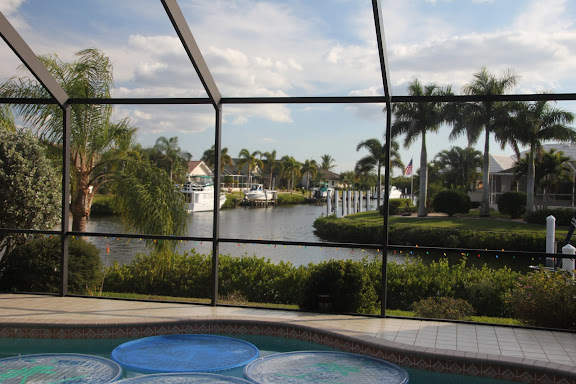
 The view across Joe and Ruth's enclosed pool.

Boat theft is still a problem in Florida. Joe told me about a couple thefts in his area. The Cubans come to steal boats for smuggling people, and the Mexicans come to steal boats for smuggling drugs and people. While in the Keys we were reminded yet again about the flood of people invading our country. One morning we passed a stranded Cuban boat in the shallows. In presentations, we saw pictures of just a few of the many stranded Cuban boats that find their ways to the Everglades and Florida Bay. People here send GPS units to Cuba with waypoints already entered for navigation, and landing and pick-up locations. Or is such a discussion too politically incorrect?

Credit: Photo by Kliments of me in canal.

The intention was for a bit of open water paddling while Joe took care of some commitments, but the wind was blowing hard enough that I took advantage of the canals. There is a good bit of current that develops as the area drains and fills as the tides change. While paddling against the current around the rim canal, a bit too much time was spent enjoying the sites. After lunch I found the current had changed and would also be running against me all the way back. The tally was only 8.5 miles, but the effort was much more. I didn’t need to feel cheated. There was a lot more paddling to come.

Just before I left, Joe decided to help by finding me an updated forecast. He sat the paper on the table in front of me. I took one look at it, and the only thing that would develop in my mind was, “Oh, holy crap!” The forecast was for winds gusting 30-35 knots over the next few days.


Sunday, January 29, 2012

On The Road - 4

Great Blue Heron, Punta Gorda

After an early departure, it was a 272-mile dash to Joe and Ruth Kliment’s home in Punta Gorda Isles. After some time to visit and catch up on the long time since we had seen each other last, Joe and Ruth took me out to scout out some launch sites for my next day’s paddle. We stopped at the Peace River Wildlife Center, a bird rescue and sanctuary. Some of the injured birds are treated and released back into the wild, but some, because of their permanent injuries, become permanent residents.


Their two eagles are a good example. The female, on the left, was scavenging in a landfill when she picked up and punctured an aerosol can. The explosion tore off her left wing. When she was found, the can was still impaled on her beak and clearly told the tale of what had happened. The male eagle was with his sibling in a nest that their parents had built on a branch not strong enough to hold the weight of an eagle nest, which can reach 2,000 pounds. The branch gave way and dumped the nest. The sibling died from its injuries, and this bird sustained such severe multiple fractures that, while they were able to save his life, he will never be able to fly.

Wood Stork


Another new experience was coming upon a handicapped sailing regatta. The event has become so successful, that handicapped sail racing has become an Olympic event. We spoke to one team from Washington State and another from Nova Scotia. Trials are underway for the World Cup, with matches in Miami, Melbourne, Canada, Great Britain, Palma de Majorca, France, Netherlands, Germany, and elsewhere. This is serious stuff, and includes classes in centerboard, keelboats, multihulls, and windsurfing. The boats we saw had two centerline seats. The forward one was convex so level is attained by simply sliding across the convex curve. The after seat was contoured for the more seriously disabled. Two handlebars erected across the seat moved fore and aft to control the twin rudders, and a toggle on the left handle rotated the seat mechanically so the boater always sat level.  They were between races, so we didn't get a chance to see them sail, but it's great to see such a program.  Because of an accident, or because of the injuries soldiers bring back after serving our country, it is wonderful to see there is a way for them to pursue what may have been their passion before their disability. 

Tomorrow will be a paddling day.

Yellow Crested Night Heron


Saturday, January 28, 2012

On The Road - 3A

I'd like to thank those who have joined the blog recently as regular followers.  I've never met, but have used Free Wine's website for information on paddling resources here in Oklahoma.  Welcome, 1pinkyak.  If you wish, send a message or add a comment to introduce yourself. 

Here's a picture I missed on the St. Johns River post.  This is a kid's playhouse!  It's large enough to be a mother-in-law or Nana house.  What lucky kids---a pulling boat that has the shape of a Whitehall, and steps that help them down the bank to the water's edge.

While we're off subject, take a look at this video David Hawkins sent me.  What beautiful flight, and just watch the eyes and talons.  Click to full screen and imagine yourself as a mouse.  Wow!
http://www.dogwork.com/owfo8/

All the best, jim

On The Road - 3

I launched from a county boat ramp just south of the Rt. 207 intersection, near Palatka, and headed upstream. The St. Johns River is one of only a couple rivers in the country that flows north from its source. The St. Johns’ headwaters are hard to define, but the flow starts from near Blue Cypress Lake to the Atlantic at Jacksonville. Officially, it flows 310 miles, but there are numerous other rivers, lakes, and streams that flow into the St. Johns that could occupy a paddler for a very long time. A canoe or kayak is the ideal vehicle for seeing this river, with some areas little changed since this was all Native American hunting and fishing grounds. However, near the head waters the airboat is very prevalent, and a wise paddler carries a brightly colored flag on a tall whip antenna to make himself visible among the tall grasses. Otherwise, airboat operators refer to canoes and kayaks as speed bumps.

Water management is becoming an ever greater field of battle in Florida. Huge metropolitan areas around Orlando demand ever increasing quantities of water for consumption and watering the ever-present golf courses. Agricultural and industrial concerns ignore the ecological issues, and even the Corps of Engineers is having to spend huge amounts of money to undo damage it did in years past with channeling and water diversion. The natural aquifer is unable to keep pace with the demand, and entire ecosystems are being threatened. I had wanted to paddle the St. Johns last year, but found when I contacted the St. Johns County Water Management District, that the headwater regions of the river were so dry that people were running the river by ATV, so the trip was off.


Winter comes even to North Florida, and autumn was present in early January. I thought it interesting to see the contrast between autumn colors and Spanish moss, or the colors of changing leaves between palm trees.


A few miles up river I turned into the channel at Gibson Dry Dock, where I had earlier seen Tommy Kight. Because it is small and fully enclosed, the marina’s basin is the best hurricane hole on all of the St. Johns, and because of the large dry storage area, people with less than 45-ft. bridge clearance come here for long term layovers from up and down the East Coast. It is also the home of the Rat Island Yacht Club, a very active sail racing group on the river.


White Heron

Great Blue Heron

A few miles further along, I turned into the beautiful Dunn’s Creek, which twists and winds its way southeast into Crescent Lake. All along the river there are continual opportunities to see wildlife from birds to gators. Shortly after turning into Dunn’s Creek, Murphy’s Creek turns west. I was once anchored in Murphy’s with a group of Boy Scouts. After dinner, they wanted to take the dinghy for a row. They became quite upset when I refused, telling them it wasn’t safe in a small round-bottom dinghy on the creek at night. They couldn’t understand until I took the spotlight and shined it up and down along the shores so they could see the reflected red eyes of all the alligators staring back at us. I continued a few miles beyond the Rt. 17 Dunn’s Creek bridge before turning back. The round trip was 15.0 miles, and a nice preparation for the first day’s run in the Keys Challenge.


Dunn's Creek Bridge


Friday, January 27, 2012

On The Road - 2


Our Keys Challenge trip continues from the start of our road trip on 8 January. Anyone who travels Florida will recognize the Blue Angle jet at the Florida Welcome Center as you enter the state near Pensacola. Pensacola is home to the Blue Angles, which are the greatest possible recruiting tools for the Navy and Marine Corps aviation programs. They began flying in 1946, and were officially sanctioned by the Defense Department in 1949. The squadron does around 70 shows across the country each year during their March to November flying season. If you’ve never seen them perform, definitely add them to your bucket list. My favorite part of the program is when one of the jets disappears from view. The absence is worked so well into the program that it occurs without you realizing it even after seeing the program many times and expecting it. With a little sleight of hand, the team dazzles the spectators and draws their attention forward as the missing jet silently makes a low altitude approach from the rear of the viewing area and suddenly, and I mean SUDDENLY, materializes directly over your head as the pilot jams the throttle and everyone in the crowd jumps a foot off the ground. The spectators’ responses range from tears to excited cheers and applause. The whole show is an exciting and very moving experience.
Florida Welcome Center, I-10 at Pensacola

The Spanish played many very important roles in the history of Florida. The English were actually here longer, but Spain put a stamp on the state that endures to this day. It will be seen in the architecture throughout the state, and especially in St. Augustine, and even in modern construction, such as this Welcome Center, which seems part Spain and part Margaritaville. 

My first destination in Florida would be to visit David and Margie Hawkins in St. Johns County. After the long two-day drive from Oklahoma, it was great to spend a day of rest with them before heading for the river. Besides the opportunity to visit friends along the way, they were graciously willing to help me with a problem. There’s no opportunity to train for a long paddle or practice ocean paddling in Western Oklahoma, and an attempt to start a long paddle trip with no muscle preparation is doomed to failure, as I learned last year. Then a change in the Florida Keys Challenge schedule compounded the problem. The first two days were supposed to be about nine miles each, with the longer legs scheduled later in the trip after we had a chance to build up to the demand. A campsite problem made it necessary for the staff to combine the first two days into a single 18.6 mile leg the first day. Besides trying to paddle on the Canadian River at Stinchcomb and the Great Salt Plains Lake, I planned to do a paddle on the St. Johns River and Charlotte Harbor at Punta Gorda for some minimalist preparation prior to arriving in the Keys.

I intended to launch Ibi from the Gibson Dry Dock marina at San Mateo from which I had sailed on the St. Johns, but the rocks and low tide made this impractical. Before going to a local ramp, I visited with Tommy Kight, the marina manager and friend, and got a chance to see his new shop. For years, Tommy has helped raise long-forgotten relics from the bottom of the river, from sunken wrecks to cypress logs.

"Growth of a Thousand Years"

Standing at the rear of the shop was a ten-foot piece of wood that would make any woodworker’s heart beat faster. It was from a cypress log that had probably laid in the mud of the river bottom for a hundred years, and was probably growing when Columbus arrived in the New World. I took a picture of the knot, simply to add more interest to the picture, but the texture throughout the rest of the plank was a perfect run of tight growth rings and grain that speaks of native woods long gone.

E. Stuart Hubbard wrote of “Harvesting the Growth of a Thousand Years.” Lumbering was the largest Florida industry in the state’s infancy, and millions of board feet of swamp cypress and longleaf pine were shipped from the Wilson Cypress Co., in Palatka, for destinations around the world. Wilson’s was the second largest sawmill in the world, and it felled virgin timber from 1893 until it closed in 1944, and worked 600 employees at 75-cents to a dollar a day. The mill used tugs to tow large floats of logs up and down the river, and invariably a few logs would escape and eventually sink to the bottom. You would think Florida would welcome the removal of these huge river hazards from the river bottom, but ever vigilant for a dollar, they charge a salvager $5,000 for a salvage permit, plus another $5,000 annually for renewal. Tommy also had a piece of longleaf pine with 32 growth rings to the inch, versus the 3-6 rings per inch found in any wood currently available.
 

Thursday, January 26, 2012

PaddleFlorida.org


I just returned home at 11 pm last night (Tues., 24th) after my 3,743.l mile road trip to the first Florida Keys Challenge. If you are just tuning in, please go back and read from 6 January. Jean did a great job of keeping everyone updated on the highlights of the trip, but also did a wonderful background on each of the keys that we visited that will add to your understanding and appreciation of the area. I’ll take you through the event with a fleshed-out “boots on the ground” account (or butt on the water, in this case) along with the pictures from the trip. I hope you enjoy it, especially the pictures.

I would be most remiss if I didn’t mention those who were most helpful in making the trip possible, such as Gus Bianchi, David and Margie Hawkins, and Joe and Ruth Kliment, and of course Jean. First, Gus Bianchi made me aware of the event and of PaddleFlorida.org. If you visit their site, you will see the wide selection of trips they make possible, including the Florida Keys Challenge. PaddleFlorida is a non-profit educational organization with the mission of promoting paddling in Florida, water conservation, and wildlife preservation. If you check under “about/contact us” you will get to meet the people that make PaddleFlorida work. Most of them are volunteers who really pour their hearts and souls into making the trips possible and making the details of every day a reality, often under difficult circumstances. We all really grew to be amazed by their commitment and appreciative of their efforts. Thank you all.

The first question is usually, “Would you recommend this to a friend?” The answer: “Absolutely.” There are several reasons why these trips play such an important role. First, they allow paddlers of nearly any skill level to participate in an event that will greatly improve their skills under the safest possible conditions. Paddlers are given the opportunity to try things that may be new to them, or may be a bit beyond their current skill level, while enjoying the security of a large support system. Sooner or later, regardless of what waters are frequented, a paddler will get caught out in conditions for which they may not be prepared. The varied conditions encountered during such an extended and supported trip build confidence and skill that make a paddler safer, and which otherwise may take years to acquire under normal paddling conditions alone.

Second, you spend your time with people with a wide range of experience. You learn from some by simply watching what they do, while others actively provide pointers and training, like the afternoon of instruction in wet exits, self-rescue, and rolling that occurred off one of the beaches.

Third, one of the best pleasures is getting to spend your time and share your experiences with a group of like-minded people that also share your love of nature and paddling. We had paddlers from New York, Georgia, Montana, Vermont, New Jersey, Michigan, Alabama, Tennessee, Florida, and of course, Oklahoma, and I may still have missed one or two.

Fourth, especially in the Keys Challenge, it is the best way to gain access to places normally closed to individual paddlers and campers. The Keys are densely populated by both residences and businesses, making stealth camping, commercial camping, or even just getting ashore impossible. Much of the shoreline is razor-sharp limestone or mangrove. What is accessible is generally private property or closed to access for conservation reasons. Commercial campgrounds require reservations a year in advance, and may charge $80-100/night just for primitive tent space. Trying to arrange access to nightly camping can be exhausting to impossible. Being part of a larger, organized event, opens up places otherwise inaccessible.

Tuesday, January 24, 2012

"I Hope You Dance..."

Received a note from an acquaintance yesterday expressing regret that he hadn't gone paddling that day.  Then came a note from another friend:  "I'm sitting in the yard and admiring the view without fussing about the weeds in the garden.  I'm spending more time with my family and friends and less time working.  Whenever possible, life should be a pattern of experiences to savor, not to endure.  I'm trying to recognize these moments now and cherish them.  'Someday and "one of these days' are losing their grip on my vocabulary.  It it's worth seeing or hearing or doing, I want to see and hear and do it now.  I'm not sure what others would've done had they known they wouldn't be here for the tomorrow that we all take for granted.  I think they would have called family members and a few close friends.  They might have called a few former friends to apologize and mend fences for past squabbles.  I like to think they would have gone out for a Chinese dinner or for whatever their favorite food was.  I'm guessing; I'll never know.  It's those little things left undone that would make me angry if I knew my hours were limited.  Angry because I hadn't written certain letters that I intended to write one of these days.  Angry and sorry that I didn't tell my spouse and family often enough how much I truly love them.  I'm trying very hard not to put off, hold back, or save anything that would add laughter and luster to life.  And, every morning when I open my eyes, I tell myself that it is special.  Every day, every minute, every breath truly is a gift!  Life may not be the party we hoped for, but while we are here we might as well dance!  (or go paddling!)  Hope you wring as much enjoyment out of this day as possible. 

Monday, January 23, 2012

Marathon Man

Just received this kind email from friends in Florida visited by Jim after he left Key West yesterday.
Jean,
We enjoyed Jim's visit yesterday, very much.
I'm amazed that he can have paddled 115 miles,
driven 7 hrs & still arrive appearing like it was a
normal day!! We thought he'd "crash" right after
dinner, but no - he was up till 11, visiting with us.

I know he pushes himself to his limits, paddling,
but his stamina for just plan exhaustion seems to
be endless.

He certainly is a marathon man!!
So we're just reporting in, to say that he was in good
shape when he left us this morning & will undoubtedly
arrive home looking like he's been on a vacation,
not a marathon paddle last week!

Patience, patience!

I'm sure many of us are familiar with a current TV advertisement depicting guinea pigs rowing a small boat to provide energy for their owner's computer.  One little creature sits in the back of the craft, with megaphone in hand, calling "Row," " Row,"  "Row."  During Jim's 110-mile paddle down through the Florida Keys, I'm sure he heard similar words in his mind, especially during the longer legs when other, faster paddlers got out of sight ahead of him.  He sometimes expressed frustration at the end of a long day that he hadn't been able to keep up with the speedier members of the group.  Still, he finished the trip in a good and timely manner, and was happy and well at the end.  The frustration he occasionally expressed to me by cell-phone reminded me of a segment from Travels with a Donkey by R.L. Stevenson.  "We got across the ford without difficulty - there was no doubt about the matter, she was docility itself - and once on the other bank, where the road begins to mount through pine-woods, I took in my right hand the unhallowed staff, and with a quaking spirit applied it to the donkey.  Modestine brisked up her pace for perhaps three steps, and then relapsed into her former minuet.  Another  application had the same effect, and so with the third.  I am worthy the name of an Englishman, and it goes against my conscience to lay my hand rudely on a female.  I desisted, and looked her all over from head to foot;  the poor brute's knees were trembling and her breathing was distressed; it was plain that she could go no faster on a hill.  God forbid, thought I, that I should brutalize this innocent creature; let her go at her own pace, and let me patiently follow.  What that pace was, there is no word mean enough to describe; it was something as much slower than a walk as a walk is slower than a run; it kept me hanging on each foot for an incredible length of time; in five minutes it exhausted the spirit and set up a fever in all the muscles of the leg.  And yet I had to keep close at hand and measure my advance exactly upon hers; for if I dropped a few yards into the rear, or went on a few yards ahead, Modestine came instantly to a halt and began to browse.  The thought that this was to last from here to Alais nearly broke my heart."  Jim refers to all his vessels as female entities, and Ibi is no exception.  He would never lay a hand on her rudely, but he surely wished several times during this trip that he could have driven her faster.  Still, they finished the journey together safely, as did R.L. Stevenson, albeit with some frustration and difficulty.  Can't wait to see the pictures he took and have him set down his own impressions of the trip.  Have a good one, and be safe out there!

Sunday, January 22, 2012

SPOT Up!

Jim's SPOT is up and running, being activated at 8:15 AM, EST, so today's track can be followed by clicking on the Follow Ibi's SPOT Track on the right side of this blog.  Jim hopes to be in at Ft. Zachary Taylor State Park before noon, and will probably head his truck north as soon as possible.  A big "fiesta" is going on at Key West this week-end, celebrating the 100th anniversary of completion of Henry Flagler's rail line to Key West.  While appreciating the importance of that building feat, Jim would prefer to leave the celebrating to others.  Look for news from him tomorrow! 

Contrast

The group will shove off early this morning on a short, last, leg of this particular paddling journey.  They will end at Ft. Zachary Taylor State Park at the southern tip of Key West.  It will be about a 6-mile trip.  It's possible that the SPOT track won't be available today because of their proximity to NAS Key West.  Weather conditions there are predicted to be almost ideal, with a high temp. of 78-degrees, mostly sunny and an easterly wind of about 10K.  Contrast that with this location:  High temp. of about 61, 20% chance of rain (we can hope), and wind gusts up to 60K.  Some members of the Flatwaterpaddlers of Oklahoma group went out for a bit yesterday, at Mission Bend, north of the Three Fingers area on the upper Fort Gibson.  Temperature yesterday was supposed to get to 45-degrees, but wind chill at beginning of the day was 9-degrees.  One paddler reported having ice on his glove fingers and on the boat.  He said that the wind finally died after the noon hour and the water became glassy.  Lots of birds were spotted during the trip including buzzards, red tail hawks, wrens, kingfishers, a mockingbird, crows, Canada geese, great blue herons, many kinds of ducks, cormorants and woodpeckers.  He also spotted squirrels and deer and some bobcat tracks.  To join this member-run group, go to Flatwaterpaddlers of Oklahoma on the net. 

Saturday, January 21, 2012

In safely

The group has arrived safely at Boyd's Camp after a long day.  The SPOT signal was lost when they were near NAS Key West.  Jim called at 4:55 EST to let me know all was OK.  They'll shove off tomorrow on the last 6-mile leg of the trip, which will end at Ft. Zachary Taylor State Park on Key West.  After a barbecue lunch everyone is expecting to leave.  Jim will be driving north to Punta Gorda for a visit with friends.  Thanks to everyone who has been along on this trip via the net!  Watch for Jim's next venture. 

Enjoy it now

The signal from Jim's SPOT unit was activated at 8:21 EST as he began a 20-mile leg of the trip toward Key West.  The group will stop on the northern end of Key West this evening and then finish the trip tomorrow with a last 6 or so miles.  Jim was able to shave a bit off his paddle yesterday by going in close to Cudjoe Key and following a channel.  That saved him about 1&1/2 miles so his trip yesterday was 16.4 miles instead of the expected 18 miles.  WHEW!  There was entertainment provided for the group at the KOA Campground on Sugarloaf Key last night, but Jim said all he wanted was to get some rest for sore muscles. Winds in the area today are expected to be easterly, at about 5-10 knots, with humidity at 67% and a high temp. of 79 F.  Family members in upper sections of the East Coast are expecting snow today.  It is extremely dry out here, and cold, with no precipitation expected here.  At least there are no prairie fires at the moment.  They did a lot of damage out here last year.  Drought conditions and fires exacted heavy tolls in the Okefenokee Swamp also.  An acquaintance who is a spokesperson for a Florida paddlers group, the FPCKC Group, says that water levels in the Okefenokee Swamp are so low that paddling trips are very limited, to about two miles.  Fires within the massive swamp began on April 28, 2011 with a lightning strike, and continued to burn until December.  Most of the fire is out now, except for some small areas of peat fires which only higher water levels will extinguish.   Overnight canoe trips within the refuge were temporarily suspended due to fire damage and low water levels.  As of July of last year that fire had consumed about 75% of the 400,000 acres in the refuge.  Okefenokee refuge is the largest freshwater swamp in North America, encompassing about 700 square miles across the Georgia/Florida state line.  More than 480 square miles of that were scorched by the massive fire.  We spent about a week near St. Marys, GA, last year, at a campground and witnessed ash-falls from the Okefenokee fire several times.  Paddling conditions in the Florida Panhandle are regularly reported to us by the Florida Panhandle Canoe and Kayak Connection.  Their website provides invaluable advice and some really neat pictures of paddling trips participants have taken.  It gives links to: Jim Parker's "Paddling the Florida Panhandle and Surrounding Area," USGS Real-Time water levels for Florida and Alabama rivers, Florida Designated Paddling Trails, Paddling.Net, and a list of other paddling clubs in the area. If you plan to do some paddling in the Florida Panhandle, look them up.  We were honored to meet Jim Parker last summer.  He came out to paddle with my Jim as he was beginning a paddling trip along the west coast of Florida.  We encourage anyone with an interest in that area or in paddling in general to look him up on the FPCKC site.  Now - as for the snowier part of the story; a cousin in snowier climes sent me this:  It was snowing heavily and blowing to the point that visibility was almost zero when the little blonde got off work.  She made her way to her car and wondered how she was going to make it home.  She sat in her car while it warmed up and thought about her situation.  She finally remembered her daddy's advice that if she got caught in a blizzard she should wait for a snow-plow to come by and follow it.  That way she would not get stuck in a snow drift.  This made her feel much better and sure enough in a little while a snow-plow went by and she started to follow it.  As she followed the snow-plow she was feeling very smug as they continued and she was not having any problem with the blizzard conditions.  After an hour had passed, she was somewhat surprised when the snow-plow stopped and the driver got out and came back to her car and signaled for her to roll down her window.  The snow-plow driver wanted to know if she was alright as she had been following him for a long time.  She said that she was fine and told him of her daddy's advice to follow a snow-plow when caught in a blizzard.  The driver replied that it was OK with him and she could continue if she wanted, but he was done with the Wal-Mart parking lot, and was going over to Sears next!  :>)  Enough with the smoke, fire and ice for now.  Fair winds and happy paddling to our intrepid group in the FL Keys.  Enjoy it while you can!!!

Friday, January 20, 2012

But it's only an inch on the map!

The group has a big task in store today, which began for Jim when his SPOT Track checked in at 7:21AM.  They'll be paddling from Bahia Honda to Sugarloaf Key.  By road they're only about 30 miles from Key West.  Paddling small vessels along the outlying reefs requires more miles and lots more effort!  Jim and I used to do vessel deliveries, mainly to the Caribbean from the East Coast of the U.S., but sometimes from Europe as well.  We had an inquiry once from a woman in New York who wanted a sail vessel delivered to the west coast of Florida.  When told how many days we expected the trip to take, she replied, "but it's only a few inches on the map!"  AHHHH - how blissful is ignorance!  The group Jim is paddling with will be passing Big Pine Key, Coupon Bight Aquatic Preserve, Little Torch Key, Ramrod Key, Summerland Key and Cudjoe Key on their way to Sugarloaf Key and the KOA campground there.   Coupon Bight Aquatic Preserve, a long and shallow expanse is a protected area of seagrass meadows, mangroves and coral reefs.  Key deer, the smallest of all white-tail deer are often spotted in the Preserve.  Little Torch Key, named after torchwood trees, is close to the Looe Key National Marine Sanctuary.  By road, Little Torch Key is just 24 miles from Key West.  Ramrod Key was so-named after a ship named Ramrod was wrecked on a reef south of there in the early 1800's.   Summerland Key, is midway between the metropolitan areas of Marathon and Key West.  Cudjoe Key was possibly named for the Joewood Trees found growing there, also known as cudjoewood.  Another possible origin of the name Cudjoe was a fugitive slave or free negro who lived on the island before 1849.  Drug interdiction authorities maintain a "Fat Albert" radar aerostat on Cudjoe Key.  Sugarloaf Key is  a U-shaped island, about 15 miles by road from Key West.  The name for this Key was possible given because of an Indian mound on the eastern side of Upper Sugarlof Key which resembled an old-fashioned loaf of sugar.  Another possible source of the name might be after a variety of pineapple once grown in the area.  The Key is home to the Great White Heron National Wildlife Refuge.  Weather forecasted for the area being paddled by the group today calls for 70-degree temps., light winds and high humidity (approximately 85-90%).  That'll result in a lot of sweating for sure!  Today's leg of the trip will cover some 18 watery miles, with a 20-mile leg tomorrow and then about 7 miles on the last day.  So, you can see, there's a lot more distance to be covered by the paddlers in those little boats than if they were going by land!  Hope everyone keeps well hydrated! 

Thursday, January 19, 2012

Long trek ahead

The group Jim is paddling with have two very long days ahead of them.  Tomorrow will be an 18-mile trip, and the next day will be an endurance run of 20 miles.  Now,  some of you intrepid youngsters out there might scoff at those distances, but for some of us older geezers those miles look mighty long!  At least Jim has learned to balance calorie intake with the output required for such efforts.  Last summer he had some days when he was all done in at the end of a run because he hadn't consumed enough carbs. while underway.  We're old dogs trying to learn new tricks, and sometimes those lessons don't come without pain.  It didn't dampen his enthusiasm, though, and he's thoroughly enjoying this trip. A real highlight tonight was a presentation to the group by Doug Alderson.  Doug is the Florida Paddling Trails Coordinator, Office of Greenways and Trails of Florida, Florida Department of Environmental Protection.  Impressive title for an impressive man!  He's a professional writer with many books to his credit, a photographer, and a very enthusiastic paddler.  You can check out more about Doug on his website at:  www.dougalderson.net.  Jim and I were privileged to meet him last summer while doing a camping/paddling trip on the west coast of Florida.  Doug came down to the St. Marks area for a day paddle with Jim, and they spent enjoyable hours together.  We subsequently bought a couple of his books.  Jim spent today doing housekeeping chores and laundering some clothing.  His cell-phone battery was charged in company with 12 others at a single available electrical outlet, by making use of a power strip with a couple of 3-way plugs attached!  Guess it's a good thing cell-phone batteries don't require a lot of energy to recharge!  The group will head off to Sugarloaf Key early tomorrow.  Keep track of their progress via the SPOT link on the right side of this page.  Best Wishes!

Day off on Bahia Honda

The group is taking a day of rest on Bahia Honda Key.  Jim checked in from there at 13:02 (1:02 PM, EST) yesterday after departing Knight's Key at 7:52 AM. One part of the group left early from Knight's Key, without breakfast, to take advantage of more advantageous tide conditions.  Jim left with the later group.  His group paddled to Molasses Key, and then went on for a lunch stop at Money Key.  Jim said it had been bothersome getting everything packed into the boats that morning,  All their gear had gotten wet overnight because of heavy dew.  During the 7-mile open-water paddle, though, they had experienced calms and seas.  After coming ashore at Bahia Honda, Jim's first consideration was to find a good place to put his gear out to dry and try to find a place to recharge his cell phone batteries.  The next leg of the trip will be a 20-mile paddle down the keys.  Follow along with Jim in Ibi by clicking on the Follow Ibi's SPOT Track link on the right of this blog.  Have a good one everybody. 

Wednesday, January 18, 2012

To Bahia Honda

Jim pushed off with the group at 7:52 am EST, heading for Bahia Honda.  The weather there is great, as seen on the "net," with zero wind, 73% humidity, clear skies and a temp of 75 degrees.  Out here on the plains our high is expected to be 49 today, with the low temp. this am at 18 degrees F, and it's very dry.  We're in normal OK wind conditions - S/SW at about 15 with gusts over 20.  Don't know how the wild birds survive here in this dry, cold winter weather.  On Bahia Honda the group of paddlers is likely to see many types of birds we'd never see here, including endangered white crowned pigeons.  Poisonwood trees there are probably as common as the Blackjack oaks and cedars are here.  We were surprised when we moved out here several years ago to find that this area regularly hosts migrating pelicans and sandhill cranes, as well as large flocks of snow geese and Canada geese.  Jim should have many opportunities for getting photos while on the extended stay at Bahia Honda (they'll be taking an extra day there) which he'll share on his facebook page and blog upon his return home.