Tuesday, November 24, 2015

Kings Gap Mansion

Kings Gap Mansion from the front lawn.  A tent is set up to the
left for a wedding.

The James McCormick Cameron summer mansion at Kings Gap, PA, is but a footnote in this long trail of old money, but an impressive footnote well worth the visit.  To start at the head of the trail, James’ grandfather, Simon Cameron, was Abraham Lincoln’s first Secretary of War and a United States Senator four times.  The family began buying up land around Harrisburg, Carlisle, and Lancaster, PA, having five simultaneous summer estates available for the family’s use during Simon’s life.  A son, James Cameron, served as Secretary of War under Pres. Ulysses S. Grant.  James McCormick Cameron was born in Harrisburg in 1865, the end of the Civil War.  He attended Harrisburg Academy and Exeter and Harvard College, and studied law under his father.  After college, he decided to enter the steel business, which had also been part of his grandfather’s commercial enterprises.  James operated steel furnaces, owned the Iron and Steel Company, owned the Elk River Coal and Lumber Company, was director of the Buffalo Creek and Gauley Railroad Company, was director of the Harrisburg Bridge Company, director of the Harrisburg Railway Company, and a member of the Dauphin Deposit Trust Company bank.


The front of the mansion as seen from the driveway as approaching
the entry portico.


The panorama of the surrounding countryside as seen from the
flagstone patio.

Wanting to escape the summer heat in the city of Harrisburg, he decided to build a mountain-top mansion in 1908 to enjoy the cooler breezes.  Being afraid of fire, the mansion was built of Antietam quartzite stone, which was quarried from a nearby ridge.  Being innovative for the time, it was also the first structure in the area to utilize a new construction technique employing steel-reinforced concrete for interior elements of the building to make it as fireproof as possible.  It was originally designed as an Italian villa of 32 rooms with large windows and a huge flagstone terrace to partake of the cooling breezes coming up the mountain.  While caretakers remained at the mansion year-round, the family only stayed there from May until October, between 1908 and 1948.

Another view from the terrace, half of which is covered for shade, 
leaving half open in full sunlight.

The water tank and tower to supply water to the gardens and the
mansion.  An apartment sat below the tank.

The property also includes a water tower, large gardens, ice house, caretakers’ house, generator building, and carriage house.  The first floor of the mansion is open to the public on Sunday afternoons from Memorial Day until October, and both floors are open the first two Sundays of December for the Christmas celebration.  The 200-ft. long building was enlarged to 38 rooms during a renovation project begun in 2000 to include an environmental education center.  The property’s 2,531 acres on South Mountain comprises the Kings Gap State Park with 18-miles of hiking trails.  Current uses of the mansion range from an orienteering course, conference center, educational courses, overnight lodging, and is a favorite venue for weddings.

Beautiful gardens included flowers, herbs, and a pond.

Sunday, November 22, 2015

Sunday Monarchs


It was a Sunday bike ride, part of my 3-P-100 (paddle, peddle, or plod 100 miles/month), that took me by several fields of Helianthus, a lower classification of sunflower.  In this one, I found a bunch of late migrating monarch butterflies.  I was hoping to get a picture of one with its wing outstretched, but there was enough of a breeze that as soon as they landed, like a sailor furling his sails, they would immediately flatten their wings.  The breeze would swing them into the wind where they could then pretty much ignore the wind as they inspected the blooms.


Friday, November 20, 2015

Low Overhead

The huge I-beams and hanging channel iron made it clear we weren't
going through here with the canoe intact.

We were on our way to a family reunion at Nockamixon State Park, near Quakertown, PA.  It was a convoluted route, so I had sought the assistance of Google Maps routing, and so the memories flooded in.

I drove tractor-trailers cross-country for several years to meet certain financial objectives.  It was in the early days of commercial GPS, and the first routing programs were of course for automobiles.  Regardless, trucking companies immediately latched hold of the technology, and so for many years drivers of eighteen-wheelers found themselves unwittingly following routes designed for compact cars.  If this led to a problem, both the solution and the consequences of any resulting wrecks fell on the drivers’ shoulders.  The driver is always responsible for everything.  The further one got to the North and East, where many remnants of the Revolutionary and Colonial periods of our history still remain, the more common the problems became.  Where roads were designed for horses and carts, or at most a team of horses and wagon, the driver of a 65 or 70-foot long vehicle would occasionally find himself facing a dog-leg in the middle of a railroad underpass where the kink in the roadway was too tight for anything much larger than the normal family car.  Or, a railroad grade would be so high above the roadway that a truck couldn’t cross it without getting hung-up on the tracks.  Or, the time my route brought me to an underpass that was literally so low a horse would have to duck its head to pass under.


So, on the way to Nockamixon, this is what Google brought me to.  While routing programs have improved greatly, problems can still pop up in front of the driver.  We had Ibi on the canoe rack, so even our pickup and canoe couldn’t get through here.  The objective of the height restriction is obvious---the 5-ton weight restriction posted to the left of the bridge.   One way to positively limit weight is to limit the size of vehicle that can pass through.  We found our way around the obstruction okay, but we couldn’t help but think about the fix we would have found ourselves in if we had been towing the RV with us.

Tuesday, November 17, 2015

Dry Paddles in Pennsylvania

We made the trip east for a family reunion.  This is not be a paddle-trip adventure, but I hope there are things of interest to our readers.  Ibi, our Superior Expedition decked-canoe was on the Ram for the entire 2,802 miles, but with family commitments and the need to have the truck available for kid shuttles, the only time the canoe got wet was the day and a half that we had showers.


"If you don't mind, you're blocking the doorway."  This is a couple
keeping house from our last litter.

We got underway and stopped to provision the RV in Enid, OK.  Since Jean’s latest batch of four squirrels were making the trip with us, we paused for their feeding, which was still taking place every four hours.   While headed up the Will Rogers Turnpike (U.S. Rt. 44), I saw a huge cluster of red and blue flashing lights ahead.  That awesome display of lights had to be a wreck, so I slowed and pulled into the left lane.   As I got closer, the lights slowly resolved into a pick-up towed trailer with a porta-potty mounted on top.  It was a comfort station for convicts working on highway clean-up, although we never saw a road crew either before or after encountering the potty-mobile.  That was the first time I had seen that.  A deputy sheriff drove the pick-up.  I can’t imagine this trained professional showing up for work every day to be assigned potty duty.

Beautiful morning glories growing on a red honeysuckle vine.  The
hummingbirds love them during the summer, and the combined foliage
makes a great haven for small birds now that the days are getting colder
and windier.

We stopped for the night at Marshfield, MO, at RV Express.  It is convenient for its closeness to the highway, and also a number of points of interest nearby.  While it is a very clean and friendly park, it is very small.  It is large enough for us, but small by the standards of the average RV park, and this was to provide an hour of entertainment.  A giant motorhome came in right behind us.  As if it wasn’t large enough on its own, it was towing a large panel trailer.  This must have been the driver’s first experience with handling the rig in such a tight spot, and since it was bearing Florida registration, one had to wonder how they managed to get from Florida to Missouri.  Anyone but the driver would have figured that the larger the vehicle, the wider the turning radius that would be needed.  The rig had to be worth a major fortune, and again proves that money doesn’t solve all problems.  The park is a single oval loop with one way in and one way out.  He needed to make a 180-degree turn, but instead of taking the outside radius to make the largest turn possible, he took the inside radius.  He made it less than half-way around the turn before he realized he was stuck, and was then jammed with a high curb both in front and behind him.  He had no idea how to maneuver the rig, and little inclination to follow the directions of the park manager, who was trying to help.  He and his motor-coach had a strangle hold on the entire RV park for nearly an hour.

Such wonderful colors.

These beautiful flowers definitely contribute more to the world than the people we met in our next experience.  On day three, we were east of Columbus, OH, when we stopped at a truck stop for gas, lunch, and, of course, to feed squirrels.  We were sitting in the parking lot when a car came in carrying four scruffy characters.  The show started as soon as they poured out of the car.  They quickly made it clear that they were from effin' Philadelphia, but then that was an adjective they attached to everything.  They went on non-stop about how they had driven all the way from effin' Philadelphia.  They had stopped for effin' gas when they discovered that they had an effin' flat.  They were livid when they discovered that ‘the effin' truck stop ain’t got no effin' air.’  The car and trunk were stuffed with a wide range of items from chunks of wood to loose clothing, all of which they threw out in the parking lot.  A couple men walked by and spoke to them.  They had strong accents, likely Slavic, and yet spoke better English than our effin' Philadelphians, who were undoubtedly the pride of those who have dedicated their lives to maintaining the educational and cultural standards of Philadelphia.  They returned to the convenience store for a bag of ice for their cooler.  Naturally, after dumping the ice, they threw the large plastic bag in the parking lot to blow around.   As they limped off, I went out to retrieve their trash and dispose of it.  I guess this is just how they were raised in Philadelphia.  All the while, Jean’s birds were sitting on the dinette table looking out the window with rapt attention to all the yelling and screaming.  Jean was waiting to see if the vulgar language had added anything to their vocabularies, but apparently even the birds have higher standards.


Sunday, November 15, 2015

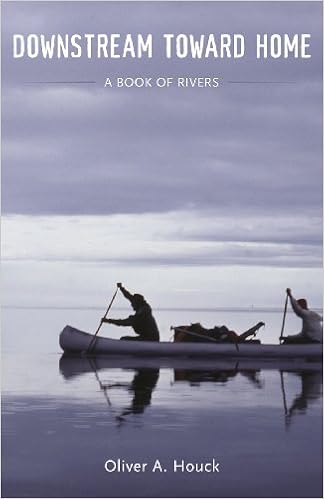
Downstream Toward Home

Photo Credit: Amazon

Downstream Toward Home: A Book of Rivers, by Oliver A. Houck (pub. by Louisiana State University Press, Baton Rouge, LA, 2014, 214pp plus bibliography)

The author shares a lifetime of experiences along roughly 30 rivers and streams that are scattered all over the country, and spanning the years between 1954 and 2013.  The book is a series of short stories that show that rivers just don’t flow and eddy along banks and rocks, but through people’s lives as well.  They include things like describing the types of people and vehicles most likely to help with a shuttle.  He tells about driving down a lonely country trail to check out a potential take-out.  The road ended in a turn-around littered with trash.  As he got out of his car and began to explore, he was still concealed behind some bushes when he observes a man dressed in a business suit and polished black leather shoes throwing dirt into a hole.  His suit jacket is neatly folded and laid over a branch.  He shovels and shovels to fill a rectangular hole just the dimensions needed to bury a human body.  The author quietly turns and follows his tracks back to his car.

The book covers a lot of trips for whitewater drops, but also many where he investigates environmental problems caused by poor governmental planning, or human stupidity or short-sightedness where people kill wildlife just to be killing wildlife, like trapping large birds in leg traps and then shooting them and throwing their bodies out to just float about in large numbers, or crayfish wars.  There are also numerous trips into wild isolated places where humans rarely invade.  

Friday, November 13, 2015

A Keen Edge

This photo is just a prop, but for safety reasons, a blade should
be left sunk in the chop block.

The hatchet or small axe is a perfectly appropriate camping tool, but often gets inaccurately blamed for being unsafe.  The only thing unsafe about a hatchet is the user.  We’ll cover a few other safety points here, but the one we’ll concentrate on now is the flying chunk of wood aiming for your face and eyes.  Physics demands that for every action, there is an equal and opposite reaction.  When we chop down with the hatchet, anything unrestrained will fly up, frequently sending a piece of wood flying into the face to cause injury by breaking eyeglasses, puncturing an eye, or causing a cut or puncture wound of the face.  This is simple to prevent.  If handled properly, it is something that should never happen.

This picture demonstrates a principle, not an actual requirement in the way of essential elements.  How we prevent free-flying wood is the requirement, not how we accomplish it.  We start with a safe chopping surface that avoids chopping into the ground.  Anything in the ground will damage the hatchet or axe blade, whether gravel, rock, or even the sand and dirt itself.  This chopping block is a section of tree trunk I acquired from a neighbor after she had a dead tree cut down.   When chopping, we need to secure both ends, the ends on either side of where we are cutting.  If I am holding one end of the piece of wood, something is needed to secure the other end, or it will fly into the air.  At home, where I have them available, I’ve just stuck the free end through a cinderblock.  At a campsite, I can stick the free end of the wood I am cutting under the fire ring, under a rock, or a log, or anything my imagination can conjure, just so I restrain the free end once cut.

Now, some other points:
1.      Always stand solidly on both feet, not balancing, straddling, or reaching across something.
2.      Chopping motion should always be directly down, vertical, into a cutting block, not in a swinging motion or arc.  Swinging is how hands, legs, and feet get injured.
3.      Always make sure the hatchet head is firmly attached (handle solidly set in the head, wedged, even epoxied in place), but never chop around bystanders.  Even the handle can slip from your hands.
4.      Be sure the blade is sharp, and kept sharp.  The duller a blade is, the more dangerous it is, since more force is needed, and the more likely it is to skip or glance off the wood.
5.      When splitting kindling, don’t try chopping it.  The smaller the pieces being split, the more important this is.  Use the hatchet as a wedge by setting the blade lightly into the wood, and then tapping the wood against the chopping block or driving the hatchet head with another piece of wood or something that won’t damage the hatchet head or handle.  NEVER split a piece of wood being held in your hand or braced with your foot.
6.      Cutting requires full attention.  When you become tired, or muscles are fatigued, it is time for a break.  Wood cutting calls for finesse, not force.  Avoid knots, and look for straight wood grain or cracks in the grain that betray the wood’s weak spot.
7.      Always keep the blade in a sheath or sunk in the chopping block.  If you need to carry the tool a short distance, be sure the blade is turned away from the body in the event that you trip.
8.      Lending a hatchet or axe to someone else is not a good idea unless you are 100% confident of their skill and maturity.  It may be their leg they chop, but it will still be your trip that will be ruined.  If they are someone likely to imagine themselves an Indian brave and the hatchet a tomahawk, keep the tool secured so you don’t suddenly see it flying through the air.  This reminds me of an advertisement I saw for “tactical tomahawks and throwing axes for beginners.”  There’s a scary image.

Tuesday, November 10, 2015

Triangle Tires

Delaminated tread and blown Triangle tire.

It’s not my place to tell you what you should or should not buy, so I’ll just lay out the facts and let you make your own decisions.  We had purchased an RV and were planning a trip to Pennsylvania with it.  The trailer hardly got used, spending most of its life stored in a shed.  In preparation for the trip, I crawled under the trailer to inspect the tires, and found myself lying there on the ground confused.  Half the tread was gone.  I couldn’t understand how the tires had worn so badly.  Trailer tires almost never wear out.  When they are replaced, it is because of age, not tread wear, but looking at the tread I thought, “Wow, I’m going to have keep an eye on these and replace them in another year or so.” 

So, we took off to Carlisle, PA, 1,400 miles away.  When we arrived, I checked the tires again and was surprised twice.  The first surprise was for how we managed to make the trip without blowing a tire, and again because the tires were now totally bald.  One showed a trace of tread, another a pale image of tread, and the remaining two were as smooth as racing slicks.  They needed to be replaced at once, but I needed to solve the mystery about what could have happened to them.  There was no sense putting new tires on if there was a problem, like axle alignment, that would destroy the new tires as well.  I called the RV dealer we had purchased the trailer from to pick his brain.  He hemmed and hawed a bit, and then said, “Look.  I need to be honest with you.  It is a bit embarrassing, but here it is.  The trailer manufacturer is not in the business of selling tires, but of building RV’s and getting them out the door.  They buy the cheapest Chinese tires they can find to put on as standard equipment.  We’ve had people leave here (Iowa) and not even make the West Coast before they are calling back to complain about their tires being bald.  Put good tires on the trailer, and you shouldn’t have any problem.”

I went to a tire dealer just a couple miles from where we were staying.  My daughter and son-in-law had done business with Highlands’ Tires in Carlisle, so I felt he’d steer us right.  I asked for Goodyear tires, but they didn’t have the tire I needed.  I told him I didn’t want any Chinese tires, and he said, “That’s tough.  Almost all tires are made in China now.  The Chinese do made some really bad tires, but they can also make some good ones.  I do have some Triangle tires in the size you need, and they do give good service.”  So I bought four new Triangle ST205/75R14 tires.  It was an expensive hit on vacation, but I had no choice.

A year later, we were making the same trip a second time with roughly 4,500 miles on the tires when a tire blew.  The outer steel belt delaminated violently, not only blowing the tire, but tearing the tandem wheel skirt off the side of the trailer causing more damage.  While again trying to solve the mystery as to why a tire should blow so prematurely, I wrote to Triangle Tires on their website.  I laid out all the conditions the tire had been used under, the diligent monitoring of tire pressure, the fact that the trailer is stored inside and therefore the tires were not exposed to UV degradation, and sought their input on the cause and a solution.  They never responded.  I wrote a second time, and they never responded.  I had also given them my phone number and mailing address, as well as email address, so it wasn’t a problem of not being able to contact me.  They chose to just blow me off. 

In the previous post, I had the account of the second Triangle tire delaminating and then going flat on the paddling trip to Medicine Park, OK.  I limped back home and went straight to the Goodyear dealer.  When they took the remaining Triangle tires off, they found a third had already delaminated across half with width of the tread, and it was ready to fail as well.  That was three tires that had delaminated by the time one tire was only a year old, and two more tires were only three years old.  When they asked if I wanted to keep the remaining Triangle as a spare, I told them I wanted to be rid of them all, and put on four new Goodyear Marathons.  I’ve had a long association with Goodyear tires, and a happy one, so I’m confident we have now finally solved the problem. 

Thursday, November 5, 2015

Highway Angels

Credit: Google images


No one needs to be introduced to the idea of river angels.  They are indeed a band of angels that line major shorelines and rivers to help paddlers with a wonderful home-cooked meal, a camping spot, a trip to the grocery, laundry, and even first-aid or medical assistance, all to help them continue on their way.  We had a chance recently to encounter a couple of highway angels.

We were headed for Medicine Park, OK, and Lake Lawtonka with our RV.  Driving south on Hwy. 54, south of Weatherford, OK, I suddenly heard a noise and felt a rumbling vibration.  I hit the brakes quickly to reduce speed, and Jean asked what was wrong.  “Blow out,” I said.  Like most rural roads in Oklahoma, there were no shoulders, and there were steep banks falling from either side of the pavement.  I was screwed, and had traffic behind me.  I turned the hazard lights on and crept along looking for a place large enough to escape with the trailer.

Finally I saw a farm drive ahead, and turned in.  I pulled off to the side of the driveway so I wouldn’t block anyone needing to get in or out, and walked toward the house to assure the owner that I’d be there only long enough to deal with my problem.  As I got near the house, I saw a man working on his fence line.  He was Ken Rose.  He not only had no problem with us being there in his drive, but asked if I had a good jack.  We have one, but not one I’d call ‘good.’  We had used it previously, and it fell a bit short of what I had hoped for.  Ken suggested I pull on up to the garage and use his 3-ton floor jack.  It made the job of changing the RV tire not only safer, but a breeze.  Ken’s wife, Susan, meanwhile had come out to invite Jean inside, or asked if we needed anything, like a drink or restroom.

I checked the spare tire air pressure as I put it on, and it was a bit low, so I asked Ken if there was a place where I could stop to get air as we continued south.  He said, “Sure, just follow me,” and led me around to his compressor.  Like most farmers way out in the country, he was set up to deal with almost any problem with tractors or trucks, and he turned it all right over to help us out.  They were angels indeed, because we would have been in a poor fix without their help.  It’s a shame they are so far away from us, because they are the type of folks that would be wonderful to become friends with.  Thanks to their help, we continued on to Medicine Park to enjoy several nice days.  It is heavenly to find we in fact have angels around us.  We’ve since purchased five new Goodyear tires and a two-ton floor jack.  More on the tires later.

3-P-100

Credit:  Abbey and the Vets
The headwaters of the Mississippi River as they started their
trip this spring.

3-P-100 for October was 108 miles.

Wednesday, November 4, 2015

Being Caribou

Credit: Being Caribou

Being Caribou: Five Months on Foot With a Caribou Herd, by Karsten Heuer.  (pub. by Walker & Co, New York, 2007, 48pp.)

REI decided to close all its stores and internet shopping site for Black Friday.  They felt that being outside was too important, and the best way to be thankful for what we have is to go outside and experience nature.  So instead of shopping, they are promoting the day as a nature day.  Now that is a non-capitalistic statement worth celebrating.

Well, this is the second time this has happened, but I actually don’t mind.  While preparing this post, I looked up the book shown above only to find it is listed as a children’s book.  I may be on Medicare, but it seems I still enjoy an occasional children’s book.  It was a coffee-table style book with a lot of wonderful photography.  I now see there are more mature editions in paperback, presumably with more words and fewer pictures, but either way you go, it is a great story about a wonderful experience shared by the authors.

Karsten Heuer and Leanne Allison decided to live the lives that many of us only dream of.  Wanting to learn more about caribou, and wanting others to share their fear that oil exploitation may destroy the caribou calving grounds and perhaps even the lives of the caribou herds, they decided to follow the caribou into the Arctic and along their annual migration to produce both a book and film on the migration life cycle of the Porcupine caribou herd.  Their trip was made with 60-80 pound packs as they walked 1,000 miles over five months, following the roughly 127,000 caribou.  The book I read is only 48 pages, but is filled with beautiful color photography.  Please also watch the 72 minute film on the trip at: https://www.nfb.ca/film/being_caribou/

Another film done by Heuer and Allison , that you will greatly enjoy, is about a cross-Canada trip in search of Farley Mowat.  Mowat was a prolific Canadian writer and environmentalist who died last year.  He had produced two movies and wrote five books, which were translated into 52 different languages, which have sold over 17-million copies.  This video can be found at: http://beingcaribou.com/findingfarley/index.html
Enjoy.

Sunday, November 1, 2015

Every Trail Has A Story


Every Trail Has a Story: Heritage Travel In Canada, by Bob Henderson.  Pub by Natural Heritage Books, Toronto, 2005, 242 pp plus notes and index.

The author and I share one thing in common.  It is the sense that it is not enough just to paddle a river or lake and marvel at the scenery and wildlife, but to seek greater enrichment by finding the feeling of the place, the history of those that have paddled there before, the stories of their lives and experiences that give the best flavor of the locale.  The author recounts the stories he has discovered, and the places he has specifically sought out because of stories he has heard. 

Henderson tells of special, spiritual places like Indian Stone, Warrior Rock, and Sweetgrass Butte that have had personal connections not just with whites, but for First Nations Blackfoot, Ojibwe, and Nez Perce people for thousands of years.  Their personal connections to these places are reflected in the petroglyphs.  He tells of swimming in the clear water off old fur-trading posts and finding pieces of old clay pipes left by the Voyageurs.  He gives you direct insight into the lives of fur-traders, like the baptisms celebrated by those making their first cross-country trips. 

You get insight into the lives and desperation of the gold-rushers.  For example, prospectors were required to carry a ton of supplies into the Yukon to they wouldn’t be looking to others to rescue them.  One man carried his load across the nearly 4,000-foot high Chilkoot Stampeder Gold Rush Trail.  When he reached the river, he built a boat to carry his gear into the prospecting area.  His boat was wrecked in a rapids and all his supplies were lost.  It took months to hike back over the same trail to the Pacific Coast, reprovision with another ton of equipment and food, and carry it back to the Yukon River and build another boat.  Pushing off into the river with determination, he started down the river and wrecked the second boat in the same rapids, again losing everything.  He pulled himself up on the river bank and committed suicide on the very spot that had twice defeated him.  Few of these men prospered.  Eighty-thousand of them crossed the mountains in two years.  Some failed and returned home.  Others moved to try new areas.  Some moved on to Alaska, and some became so entwined with the land they never returned home.  One, who entered the gold rush as a young man, remained until his death at the age of 88.  They would travel 300 miles on a sled to get groceries, or nearly the same distance a couple times a year to get mail.  So much took place there that Mark Twain wrote, “How wearing to have to read one hundred pages of history every three or four miles.”


He adds accounts of trips on skis, pack horse, and dogsled, of winter camping, a series on interesting women that have blazed trails across Canada and Labrador, and explores the fascinating world of the hermit or recluse.  It is an interesting book, and reflects the author’s excitement in exploring the wilderness.

Friday, October 30, 2015

Chocolate Halloween Bats

Halloween Bats

The canoe (Ibi) was on the Ram in the parking lot while we gorged ourselves in the state park pavilion.  For dessert, Jean had made a couple dozen chocolate bats that quickly took flight from the pan.  These were dark chocolate cupcakes topped with a Hershey's kiss, with two dabs of red icing eyes for night vision, and a mint chocolate cookie cut in half for wings.  Happy Halloween.

Friday, October 23, 2015

Human Depredation

Jean does wildlife rescue.  Regular readers know of some of the unusual rescues she has done, but every year produces some regulars, like doves and squirrels.  She will get calls from all over the state, and even gets some referrals from Arkansas, Kansas, and Florida.  Some causes are obvious, like broken bones, abrasions and cuts, and stripped feathers, but some causes of  injury and distress are mysterious and sometimes never solved, but likely causes are poisoning and chemical exposure from the misuses, sloppiness, and even illegal practices of agriculture and the oil industry.

As small as they are, they still have individual personalities.  
It's fun to watch how some of them feed.

Spring and fall both bring numbers of squirrels that are blown or otherwise fall from nests.  Some are pinkies, naked of any fur, while others begin to get their coats, but are still blind and not ready for solid food.  People will find them on the ground, and even an occasional dog will show up at its home with an infant squirrel carefully held in its mouth.

As they take the warm food, you can see contentment replacing
hunger as their eyes begin to close...

Healing and raising unfortunate animals is the easy part.  After weeks and weeks of around-the-clock hand feedings and cleaning and warming, the hard part is worrying about them once they are ready to be released to fend for themselves with food, water, shelter, and avoiding predators.  Having had no mother but Jean, there is always the question of what instincts have been passed to them, and what they need to be provided with until they learn to forage and identify enemies.


..and their posture slips into relaxation.

Jean’s last four squirrels had been released, and while she tried to keep them wild, they know that for their lives until now a human has provided for all their needs.  As they make the transition to a life in the wild, they take some time to divorce themselves from human dependence, and even trust.  For some days they will still be seen scampering across the yard for a visit, or another night in the more familiar cage, until they feel comfortable on their own.  This method of returning them to the wild is called a soft release, and gives them time to make the transition on their own.

After being cleaned up, it is time to curl back up in some warm fleece.

So, it was a shock to find that a man had trespassed into our yard, walked right up to the tree where they were nesting, and was able to take advantage of one squirrel’s still undeveloped natural defenses, and crushed its skull with a club not more than 50-feet from our back door.  As though he had every right, he continued right through the yard with the dead squirrel in hand, and proceeded up the street.  Before I could understand why Jean had yelled and could get the car out of the garage, he had disappeared.  The police said we needed to post ‘no trespassing’ signs, and as unreasonable as it seems that we should need to erect signs to tell people they have no right to enter our yard and kill animals right behind our house, the signs are up.


Thursday, October 22, 2015

Rainy Day Memories

2013 River Rumble on the St. Croix, WI


A tight community on the banks of the St. Croix.


Tuesday, October 20, 2015

Passow's Camel Ranch

Good morning, everyone.  The weather in NW Oklahoma is beautiful right now, except for the wind, but that's no surprise.  The air is as cool as silk on the skin, and the morning and evening light is perfect.  Even the mid-day sun has lost much of its harshness.

A llama in the stables.

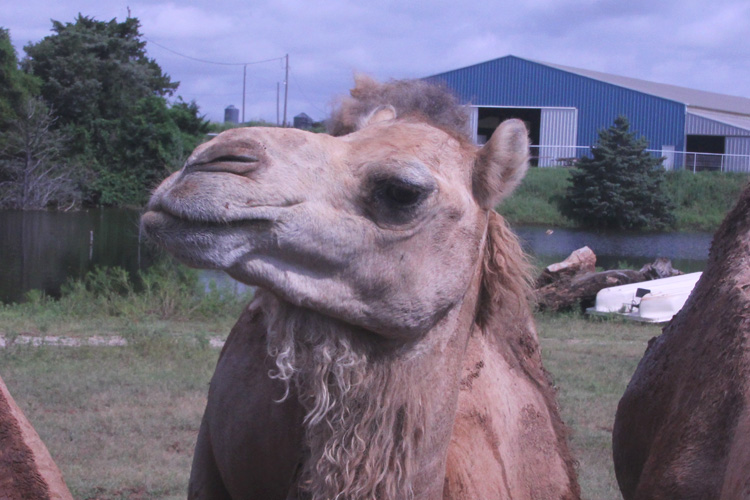
Another day trip we took with the granddaughters was to visit the Passow’s Camel Ranch.  Owned by Ralph & Wynona Passow, the breeding ranch for camels, mini-donkeys, mini-horses, and llamas, is located south of Perry, OK.  The owners loaded all of us on their ATV’s and rode all over the ranch, and even to a number of distant fields, to allow the girls to hand-feed and watch the animals up close.  Camels, in particular the males during breeding season, are territorial and sometimes unpredictable, so they stayed right with us and made sure we moved safely about the animals.


A female camel.

We learned a lot about the camels.  Some interesting things were that only one-hump camels, called Dromedary, are generally raised commercially for food, milk, and transportation.  They have a better temperament, and the two-hump camels, called Bactrian, are an endangered species.  Camels do not have hooves, but broad, thick, leathery pads to keep them from sinking into the sand, and can run at 40 mph for short periods, and can maintain 25 mph.  When they drink, they will down 5-21 gallons of water a day, but they do not sweat until temperatures exceed 106-degrees.  Not sweating as much, and having the fatty hump to protect their bodies from the heating of the sun are what enable camels to withstand greater variations in availability of water.  Also, their red blood cells are oval in shape, allowing normal blood flow when the blood thickens due to dehydration.  They weigh between 500-1500 pounds, and live 40-50 years, and normally carry 200 pounds on their backs.  In windy, sandy regions, their eyes have a second, transparent inner eyelid to protect their eyes from dirt and sand.  One of the things you most often hear about camels is that they spit.  If treated well, camels are very docile and well-mannered.  If they are ill-treated, however, they can quickly lose their sense of humor and become cross and difficult to handle.  When they spit, it is not saliva, but even less appetizing regurgitated food.

Maggie and Lucie feeding the camels.

Having been on the ranch for generations, the Passows also provided a lot of local history on those that settled the area following the Oklahoma land rush.  A few of their homes still stand in some condition.  One still had remnants of newspapers glued to the interior walls that had been used for wallpaper.  He didn’t say so, but since they had no insulation in the walls, the layers of paper probably helped keep the winter winds from whistling through.


There was a root cellar on this property made from the stone found on site.  Besides preserving garden produce, it doubled as a tornado shelter.  When we prepared to check out the interior, he cautioned us about entering slowly and looking for rattlesnakes, as they often slither inside to enjoy the cool stones while escaping the sun.  Further down the road was another original homestead made of stone.

A root cellar of hand-hewn stone.

...and a view of the interior.


The homestead of an original homesteader.


Friday, October 16, 2015

The Chickasaw Village

The Chickasaw Village at the Chickasaw Cultural Center

The Chickasaw Village reveals a lot about how the people lived.  The first building that is obvious is the Council House.  Larger than the other structures, it was the focal point of tribal life and combined the functions of an auditorium, convention center, church, tribal dance arena, and seat of government.  It features a sunken floor in the middle, and a fire was built in the center of that.  A trap door in the roof, operated by ropes from the floor, opened to allow smoke to escape.  Council members daily sat around the step created by the sunken floor and settled current business.  Women and children were free to sit around the meeting council members, but could not participate.

When the Chickasaw were forced from their Mississippi homeland to the Indian Territory, they first had to ‘move in’ with the Choctaw.    In 1855, a treaty between the Chickasaw and Choctaw tribes set aside lands for the creation of the Chickasaw Nation.  It was in a log lodge or council house like this that they created their own government and constitution, which served to govern the Nation until they built their two-story brick capital building in 1858.  The original log council house has been moved and preserved at the Chickasaw Council House and Museum on Capitol Square, in Tishomingo, OK.  The brick Capitol was replaced in 1898 by one of granite, but the Tribal Nation was forced to vacate their capitol building when Oklahoma achieved statehood in 1907, so it could be used as the Johnston County courthouse.  In 1992, the Chickasaw Nation was able to buy their building back from the county.

Just above and clear of the left roof line of the council house is a summer home.  It is basically a pole shed.  It is rectangular in shape, has a floor elevated 2-3 feet above the ground to allow storage beneath, a thatched roof for shade with open roof ends and eaves to allow free movement of any breeze through the home.  There were no sides to the house, but thin panels on frames were ready to quickly be set against the side of the pole shed and laced in place in the event of rain.  Shelves built between the poles allowed for storage and work surfaces.

Beyond the summer house are two winter homes.  These were built with a spiraling floor plan similar to the pattern of a snail’s shell.  The walls were of much heavier construction with logs set on end in the ground, and then chinked or daubed with a mix of mud, grass, and crushed shell.  The overlapping spiraling walls at the entrance would keep rain, snow, and wind from blowing into the interior, and also offered a narrow opening that could be further insulated with hung hides.  The conical roof was supported on four poles set in a rectangle in the center, and was thatched with bark or grass.  The floor was often dug out to a depth of 2-3 feet around the fire ring, like the council house, with a fire set in the center.  The shelf thus created was covered with work surfaces and bed frames covered with hides.

The village may be surrounded with a stockade wall, and the fields of crops would be set outside.  They typically raised primarily corn, but also squash, peas, beans, sunflowers, pumpkins, melons, and tobacco.  The village had a communal crib for crop storage, which was often raised several feet off the ground to provide for dry storage underneath.  They lived in a socialist society where all worked for the common good, and all prospered or suffered together.

Wednesday, October 14, 2015

Chickasaw Cultural Center - 3

The dugout canoe exhibit was central to our making the trip to the Cultural Center, and our visit was timed to make sure we had a chance to see it before it moved to another museum.  The area around Melrose, Florida, just east of Gainsville, is dotted with lakes.  In 2000, during a severe draught in the area, 101 Native American dugout canoes were unearthed in a dry lake bed.  Since then, a number of other similar, smaller discoveries have been made.  The canoes vary in age, some having been dated at 500 years of age, roughly coinciding with Columbus’ expedition to the ‘New World’, but others go back 5,000 to 7,000 years.  The Exhibition  Center was hosting the dugout canoe exhibit to recognize this discovery as well as the art of dugout canoe building in general.


The exhibit was not just about the Florida discovery, but included a wide variety
of sources, like this display of various paddle styles.


During work by the U.S. Army Corps of Engineers, this Native American canoe was found in the bank of Steele Bayou, Swan Lake, Washington County, Mississippi.  An analysis and report by Dr. Richard S. Fuller, in 1992, reported that the canoe was made from a single bald cypress tree, hewn by controlled burning and chipping and scraping with stone tools, not metal, and made and used between 1500 and 1600 AD.  The two holes in the end of the canoe on either side of the crack were likely to lace the wood together and tighten the lacings to prevent further cracking.


This dugout is from the First Nations tribes of the U.S. and Canadian Northwest.

Considering the resurgence of dugout canoe building and efforts to revitalize tribal culture, you may wish to seek out the video "Canoe Way: The Sacred Journey."  At http://www.canoeway.com/ you can see a trailer for the 2011 award-winning film, but unfortunately it has gone out of production, and is no longer available commercially.  It featured interviews with tribal elders, and explored the return to building dugouts and using them for youth expedition programs.  If you find a copy on the internet, grab it.

Lucie and Maggie posing in a dugout at the exhibition center.


Sunday, October 11, 2015

Chickasaw Cultural Center-2

Credit: Cultural Center photo
Turtle shell rattles on the dancers legs.

With our granddaughters visiting, we decided to attempt our first long outing since my surgery.  It would involve six hours on the road on one of the hottest days of the year, and with the tour of the heritage center, would make for a very long day.  We were greeted in the main drive by a Chickasaw man speaking his native tongue, which he thankfully translated for us.  He assured us we were just in time for the stomp dancing, one of the highlights I was looking forward to, and directed us to the Anoli’ Theater.  With the mercury hitting 104-degrees, the dancing had been moved into the air-conditioned theater.  Besides the dancing, we enjoyed an informative and very entertaining presentation on their tribal customs and traditions, and the common misunderstandings that whites have about Native Americans.

The stomp dances are accompanied by singing and the rhythmic rattles strapped to the dancers’ lower legs.  The dancers follow each other in single line as they form a tight spiral, which then dissolves from within as they follow a wave pattern to morph into a second spiral, but then it also dissolves from within to return to its origin.  The leg rattles were originally made from turtle shells filled with gravel.  The commentator joked that they have discovered that when turtles become a little scarce, there are these metal cylinders available at Walmart that come in six-packs and twelve-packs, that work almost as well.


Loaded for a trading trip, the canoe seems to contain items from both an
outgoing trip, such as the fur pelts in the bow, and a return trip bringing
steel tools and bolts of fabric.


A beautiful ceremonial robe made entirely of wild turkey feathers.

From the theater, we moved to the exhibit center to marvel at the many displays there.  We began in a theater in a simulated council house for an introductory film.  Displays included those highlighting tribal culture and lifestyle.  There is the Spirit Forest, which emphasizes their close association and harmony with nature, the Exhibit Gallery, which features everything surrounding their lives from beadwork, tools and ceremonial implements, a ceremonial robe made entirely of wild turkey feathers, a dugout canoe which illustrates how the canoe would be loaded for a trading trip, and much more.  The Removal Corridor tells the story of how Native Americans were impacted by the Indian Removal Act of 1830 by Pres. Andrew Jackson, their forced removal from their homelands, and the Trail of Tears.   

Several artisans displayed their skills in making Native American items, such as
the bow maker.  A flute maker showed a number of different flutes, some of which
he had made, and some that had been given to him by his music instructors. 

Thursday, October 8, 2015

The Chesapeake Bay

Credit: The Chesapeake Bay and photographer Peggy Colemane
Gorgeous Green Heron.

Monday, October 5, 2015

Chickasaw Cultural Center

The Chickasaw Nation is made up of the Five Civilized Tribes: Cherokee, Muscogee, Seminole, Chickasaw, and Choctaw.  They were forcibly removed from their homelands east of the Mississippi in the 1830’s along what became known as the Trail of Tears.  Their move to the Indian Territory (Oklahoma) was to allow for white expansion westward.

The Exhibit Center, Tribal Lodge Theater, Trail of Tears Exhibit
at the Chickasaw Cultural Center

The Chickasaw were first encountered by Hernando de Soto in 1540.  He immediately recognized their sophisticated governing system with their own laws and religion, and that they lived in towns and maintained themselves through farming.  The Chickasaw and Choctaw both continue to be well organized, industrious, and, honestly, unlike many of the whites around them, are quite far-sighted in anticipating needs and planning for their future.  They have their own constitution, ratified in 1856.  Dates often fail to make an impression until you realize this was a half-century before Oklahoma’s own statehood and constitution were ratified in 1907 by Pres. Theodore Roosevelt, making it the 46th state.  The Chickasaw Nation has its own Governor, Lt. Governor, legislature, judicial system and three-member Supreme Court, and are proactive in advancing education and health services for their people.  They maintain a list of approximately 200 services for tribal members that cover a broad spectrum from fine arts education, behavioral health and counseling, diet planning, sports and youth programs, employment services, voter registration, child care and elderly assistance programs, and too much to continue listing here.  They even have a program that supplies a landscaping package for new homeowners where they put in the grass, trees, shrubs, and flowers.   Their financial impact on the state’s economy in 2011 was $19 billion.  Besides the casinos they are most often recognized for, the tribal nation owns six radio stations, 18 tribal smoke shops, an inn and motel, seven motor fuel outlets, two truck stops, a family fun center, commercial golf course, health care facility, and even an outlet for fine chocolates.  They also operate and maintain a number of historical sites and museums, including the wonderful Chickasaw Cultural Center, in Sulphur, Ok., and this brings us to our visit of this facility, which I’ll feature over the next couple posts. 

The Kochcha' Aabiniili' Amphitheater with seating for 320.  The extreme heat
on the day of our visit had forced everything inside.


Friday, October 2, 2015

Hei Matau

The Hei Matau


Ancient cultural tradition of the Maori people of New Zealand hold that the great fisherman and mariner Maui caught a giant fish with a woven line and a fish hook carved from the jaw bone of his grandmother.  The hook caught in the fish’s side, requiring it to be dragged ashore in Hawke’s Bay on the North Island of New Zealand.   The Maori people call the North Island of New Zealand “Te Ika a Maui,” (The fish of Maui), so in acknowledgement of this tradition, the hei matau is an ornately carved hook that resembles the shape of Hawke’s Bay.  It was always carved from whale bone, but with bans on whale fishing, they had to find alternative materials, such as green stone, cow bone, or even ground cow bone in resin.  New Zealand law, however, allows the Maori the right to harvest the bodies of any whales stranded on the islands that are unable to be refloated.


The significance of the hei matau is that it is considered a taonga, or cultural treasure, and is commonly worn as a necklace to honor both their culture and Tangaroa, the God of the Sea.  It acknowledges their close ties to fishing, and is believed to show a great respect for the sea, and to insure safety while traveling on water.  International trade has carried the hei matau around the world, so it is now seen elsewhere.  It is supposed to carry particular significance when presented as a gift, so Jean purchased one and made a gift of it to me.  The beads that I have added to the cord each represent 100 miles of paddling.