Tuesday, September 29, 2015

Odd Jobs


A summer spent dealing with health issues really takes its toll in wasted time sitting around waiting to heal, or sitting around waiting on doctors’ appointments.  As I started feeling better, I took on a few odd jobs, and this was one.


The little elevated edge added to keyboard surfaces looks simple enough, but has the very important job of helping to avoid carpal tunnel syndrome and hand and wrist arthritis.  It does this by helping to maintain a neutral or zero-degree angle between hand and keyboard.  As with most modern furniture, however, little is intended for long-term use when materials like plastic and hardboard are used for building materials.  On our computer desk, the vinyl cover had worn through.  That exposed the underlying hardboard and the contact adhesive used to bond the vinyl cover.  Some wide plastic electrical tape kept us from the constant irritation of sticking to the adhesive, but this was a passing and very temporary way of dealing with the problem.  Once I got back in the shop, I measured the angles needed to duplicate the original piece, created a replacement out of fir, stained it mahogany to match the desk, and finished with several coats of varnish.  The original hand rest had been attached to the deck with two-sided sticky tape, another concession to cheap construction.  With that removed, the new replacement was properly affixed to the keyboard surface with concealed screws inserted from below.  It was a simple job that looks nice, and has paid high dividends.

Friday, September 25, 2015

A Death in the Family


The first thing my urologist/oncologist says when he walks in the room is, 
"So,
how are you doing?"
A picture is worth a thousand words---really.

Thursday, September 24, 2015

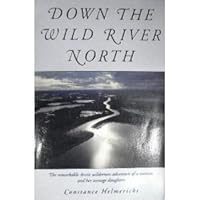
Down The Wild River North

Credit: AbeBooks.com
Down the Wild River North, by Constance Helmericks (pub. by Little, Brown & Co, Toronto and Boston, 1968, 501 pp., illus. by Michael A. Hampshire)

This story would have been highly improbable for anyone but Constance Helmericks, a seasoned explorer, adventurer, Alaskan camper, hunter, trapper and canoeist.  For her, however, she’d had enough of the daily humdrum, the closed-in small sky in the U.S., and smog, so she found homes for the family pets, and took her two daughters, ages 12 and 14, on a two-year trip paddling through Alberta, Canada, while living out of their 20-ft., 180-pound Chestnut freight canoe.  They paddled the Peace River to Lake Athabasca, and then the Slave River to Great Slave Lake, and crossed it with intentions to spend the winter in Yellowknife.  The second summer they came back down Great Slave Lake, went up the Mackenzie River, crossed the Arctic Circle, and concluded the trip in Inuvik.

The experiences they shared were life changing for all of them.  They faced several near tragic experiences, but in seeing them through, you see the girls mature.  There are those experiences on the water, and then those that threaten to wreck the trip, like when Ann suddenly requires two major operations that test the ingenuity of pilots, doctors, and hospital staffs in order to get her from the wilderness to medical facilities.  Experiences unfold when they meet missionaries, native peoples, true wilderness recluses, fishermen, tug and barge crews, homesteaders, all of whom they live and interact with.  Through their eyes you see the wilderness change as it is threatened by oil exploration, over-populations, and government manipulations, and the resulting impact on the land and wildlife.

For real adventure and excitement, this book is unbeatable.  Short of making such a trip yourself, you will be unlikely to find better insight into a real canoe adventure and life in the Northern wilderness.


Sunday, September 20, 2015

A Walk in the Woods

Book jacket photo from Amazon.

We have to have a good memory to recall when movies told a great story with a good plot that was informative, uplifting, and motivating, and developed wonderful characters.  Values, morals, the struggles between right and wrong were all explored, and we left the theater feeling good, challenged, encouraged, even somehow better for the two-hour experience.  Now movies are all aimed at thirteen-year-olds with anti-social sentiments who need to be shocked and propelled to the edge of sanity.  It has to start with a 737 loaded with orphans and tons of deadly toxins and pathogens, a fiery crash through a children’s hospital with the debris sliding and exploding in a packed NFL stadium.  There appear to be no survivors, but wait, hundreds, no, thousands of zombies and walking dead begin trooping from the apocalyptic scene (there always has to be an apocalypse) to begin either consuming or invading the bodies of the living.  Rubbish!  Well, I have good news.

I longed to see “A Walk In The Woods” from the moment I saw the first preview.  Robert Redford, Nick Nolte, and Emma Thompson and a long list of casting successes bring the true story by Bill Bryson to life.  Redford plays Bryson, Thompson is his wife, and Nolte is the intentionally long-lost friend, Katz.  You don’t want to miss this film.  There is a great story, and it is hilarious while frequently stepping a bit too close to some of life’s challenges.  Unlike many ticket costs, this is an investment in great entertainment that will send you from the theater with a smile on your face and leave you retelling scenes and jokes from the movie for days to come.  Best of all, it is a story dear to all our hearts, spending time in nature recharging our souls, and maybe even reclaiming our lives by stepping out to do something bold, even noteworthy.

I knew a visit to our daughter and son-in-law’s would coincide with the movie’s release, so seeing the movie immediately upon reaching Pennsylvania was top on my agenda.  We quickly put together a foursome with our daughter, son-in-law, our grandson who was home from his first semester of college, and myself.  I loved the movie, and was determined to see it again, but suddenly everyone was too busy to accompany me, so I went by myself for the second visit.  Then, Jean was finally available after watching the grandkids during my first trip, so I took her to walk in the woods.  That made three trips to the theater for this movie in a week.  Did I say it is a great movie? 

With some of the mature subject matter and language, I will say that I’d rate the movie PG-18, rather than 13, but you can see them as fitting between two old men facing struggles with nature, as well as with their own pasts and the courses their lives have taken.  Also, forget reading the reviews by a bunch of condescending pinheads that make a living by snootily and jealously looking down their noses at everyone else’s work.  One said the movie was a predictable rehash of their efforts to walk the Appalachian Trail.  Here’s a shocker for a reviewer that obviously hasn’t lived long enough to understand this:  when you reach a certain age, waking up every morning is a predictable rehash of all your efforts.   For those of us that are long-time patrons of the Last Chance CafĂ©, the challenge becomes finding something about life worth rehashing.  I don’t get paid for my opinion, but I say it’s a movie worth your time.  I wonder when the DVD will be available? 

P.S. - The DVD will be released in Jan '16.

Friday, September 18, 2015

Entering the Winter's Nap


These daylily  pictures were taken awhile back, but are appropriate now to celebrate the great season we've had this year.  We've had the first real growing season of rain in nine years (or five years, depending on who you ask).  But, everything is a compromise, so with a wetter year, we get bagworm caterpillars.  There are several mats of them in our pecan tree.  Today is not a great day for playing with fire, with up to 65 mph winds and rain, but as soon as this front passes, I'll burn the little buggers out of the tree.  Since nothing puts on a show like a daylily, I hope you enjoy the pictures.
jim


Tuesday, August 25, 2015

Finally, A Day Out


Slowly resolving health issues and a favorable, cooling turn in the weather finally aligned to force me out of the house.  I waited to leave in mid-afternoon, since we are only 20 miles from a Corps of Engineers lake.  Being a Tuesday also gave me the campground practically to myself.  There was only one RV in the circle where I decided to set my tent, and there was no one home there, so I was looking forward to a quiet, restful evening and night.

I pulled the camp bag out of the truck, which contains my sleeping pad, sleeping bag, tent, pillow, and an old pair of sneakers (to change into from my booties when coming in off the water).  I dropped it on the spot for my tent, picked for its absence of water-collecting depressions, overhanging dead branches or proximity to old trees, and a good easterly exposure to greet the morning sun.  The wannigan was pulled and set on the picnic table.  It is nothing more than a 5-gallon bucket with a screw-on lid to make it watertight and trap food smells.  It holds my stove, cooking pans and utensils, fuel, coffee and tea bags, dish detergent, hand sanitizer, scrubber pad and brush, large mug, matches and lighters, very small  bottle of cooking oil, a tight roll of trash bags to pack out any trash, and a medicine and vitamin bottle.  As I put a couple cups of water on to boil for dinner, a Mississippi kite flew into the tree next to me and sat above my head screeching at me all the time the water heated.  He finally flew off in search of something more bite-sized.

I poured the water into my cozy with the noodles for my mac and cheese while I set up the tent.  While dinner prepared itself, I pulled out my folding chair, put on two more cups of water for coffee, and returned to reading Down The Wild River North.   There was a nice breeze filtering through the trees, so I sat and quietly watched the lake as I enjoyed my bachelor’s banquet.

After dinner, the width of three fingers between the horizon and the lower limb of the sun meant I had three-quarters of an hour before sunset, so I decided on a walk down through the just-rebuilt Canadian campground.  An EF-3 tornado that swept through the area on 24 May 2011 completely destroyed all the trees for several hundred yards through the campground.  The twisted stubbles that remained had to be removed.  What remained of the campground buildings and facilities were so ravished that the earth in the area had to be swept bare.  The new facilities the Corps of Engineers have just finished are beautiful, strong, and state of the art.  The new restroom/shower buildings, which double as tornado shelters for campers, are designed to withstand a strong tornado.  In addition, the construction project put in 77 new camping sites, playground, boat dock, and several additional amenities. 

For those readers living in the Canton Lake area, the Corps and volunteers that work at the campground are asking for your help.  While funds helped rebuild infrastructure, they didn’t allow for buying and planting trees.  The volunteers are asking for help collecting aluminum cans to recycle for tree-planting money.  The cans may be dropped at collection barrels near the camp ranger booth.

The rains we’ve had this year were instrumental in them getting a bumper crop of new grass growing, and I was amazed at the number of rabbits that have re-established themselves in the campground.  Then I came the closest ever to a roadrunner before it turned and ran into the brush at the lake’s edge.  It has been four years, but still, it is encouraging to see how wildlife is able to return after an area has been completely destroyed.  Finally, I settled onto one of the new park benches and just enjoyed the breeze coming off the lake.

As I walked back to my campsite, I heard a pack of coyotes barking, howling, and yipping on the other side of the dam spillway.  My first thought was that the construction around the spillway had kept the coyotes away from the rabbit population, enabling them to thrive.  That idea was quickly dispelled in the middle of the night, however, when a pack of coyotes woke me as they came hunting right through our campsites.  They don’t miss much, and are very hard on a rabbit population.  Perhaps the rabbits are able to hide in the riprap (large rocks and boulders) along the lake shore.


A nearby owl lulled me to sleep last night, and a cicada greeted me first thing this morning.  It had settled on the concrete bench of the picnic table next to my stove.  It had been our first cool night, so perhaps the cool concrete slowed it down, but it was very lethargic and only moved a couple inches the whole time I made breakfast.  Anyhow, it’s nice to have the chance to visit nature again.

Friday, August 21, 2015

Video

Photo with permission from 2012 Kaw Nation Pow-wow

Only after the last tree has been cut down;
Only after the last river has been poisoned;
Only after the last fish has been caught;
Only then you will realize money cannot be eaten.
Sitting Bull


Please watch this video.  It speaks a clearer message than any political candidate.
https://www.youtube.com/watch?v=WmVLcj-XKnM
Paste to web search page if link fails to connect.


Saturday, August 15, 2015

Dale Gets It Done

Photo Credit: Shannon Silvey Williamson

Dale Sanders celebrates at the Gulf of Mexico with a hug from Anna, his grandniece, in whose honor he paddled Source to Sea down the Mississippi to benefit juvenile diabetes research.  According to his SPOT, he landed on a small island at the mouth of the river about 1:40 pm today, 15 Aug.  At the age of 80, this would make him the oldest man to complete the passage in a single, straight-through trip.  If you haven't followed the trip, the links are still in the right margin under Favorite Links.  Congratulations to Dale, Anna, and their families.

Monday, August 10, 2015

Bear Attacks

Cover Credit: biblio.com

Bear Attacks: Their Causes and Avoidance, by Stephen Herrero  (pub. 1985 by Nick Lyons Books and Winchester Press, Piscataway, NJ, 260pp of text plus 27 pages of notes and index, b&w illustrations)

The author’s Ph.D was in animal behavior.  When his wife refused to visit Glacier National Park following the gruesome killings of two young women there, Dr. Herrero decided that his interests in bears should be used to reach a better understanding of bears, encounters and attacks, bear behaviors and habits, and what can be done to make bear and human interaction safer.  What followed would be a 17-year study of black and brown bear encounters dating from 1872 to 1980,  including analysis of 414 records of encounters that led to 357 injuries, as well as interviews with victims, witnesses, and other experts in bear behavior, and personal interaction with the animals.  To paraphrase the TV warning, reader discretion is advised.  Some of these accounts are gruesome in their detail.
  
There are no sure-fire rules or guarantees.  Many of the deaths investigated by Dr. Herrero were of seasoned outdoorsmen, game wardens, and park rangers with decades of experience with bears.  One had 42 years of such service.  Herrero quotes a psychology professor who said, “Studying nuclear physics is child’s play compared to studying child’s play.”  Both human and animal behavior is difficult to predict, and there’s always the odd terrorist or mental deviant, again, either animal or human.  Herrero says of himself that he is a scientific odds maker.  In short, his research can improve the odds, but can’t make guarantees.  Due to the absence of foolproof rules, he provides a lot of information that would help enable those concerned about safety around bears to do their own situational analysis.  These include things like where bears conceal themselves, how they feed, what makes them aggressive, how to avoid encounters, detecting bear activity, how close is too close, campsite safety, firearms and deterrents, when to know you are being just plain stupid and inviting trouble, and much more.

If you want a good read, this book is hard to put down.  If you seek insight, this book should give you the best possible understanding of why bears do what they do, and what you need to do to insure that encounters with bears are both survivable and enjoyable.  Some of the deaths were almost unavoidable, but many were the result of what we might call stupid human tricks.  This should go a long way toward correcting errors and myths, and making sure none of us do anything unwitting in the outdoors.

Friday, August 7, 2015

Just Cool It

Credit: Google images.
The seldom used, but very effective, neck gaiter.

With the mercury hitting 105 F), and indices reaching 115 or more, being hot becomes not just an issue of comfort, but an issue of survival.   Heat exhaustion or stroke can be fatal in pretty short order, or can cause organ damage or failure, especially in babies or young children, people over the age of 65, those with pre-existing conditions like heart disease, high blood pressure, or lung disease, pregnant or nursing mothers, or people on medications that make them more susceptible to sun and heat problems.  The problems become even more dangerous if you are engaged in strenuous exercise, like paddling.  Here are some tips on how to beat the heat.

1.      Go easy and take frequent breaks.
2.      While stopped, take a swim or soak for a while to lower body temperature, as well as invigorate yourself.
3.      Wear loose, light colored clothing.  Wear synthetics, especially those with an SPF rating, since they evaporate sweat faster, creating a greater cooling effect.  Avoid cotton clothing, period.
4.      Cover the body---long trousers, sleeves, wide-brimmed hat, shield the face, such as with a light, synthetic balaclava or neck gaiter.  These and the hat can be frequently pulled off quickly, dipped in the water, and put back on to enhance cooling.  You can also dip a hand towel in the water and wrap it around your neck.
5.      Plenty of sunscreen.  Your skin is a once-in-a-lifetime gift.  If you abuse it, you will lose it later in life and regret it when it’s too late.
6.      Perhaps schedule activity for cooler times, like putting in earlier, taking a nap or rest during the day, take out later, or even paddle at night when river hazards are not a risk.
7.      Eat fruits high in water content for snacks.  Eat lighter meals.
8.      Drink a lot of water, every 15 minutes whether you are thirsty or not, or a glass of water every half-hour.  If you are not peeing, you are dehydrated.  Make the water more pleasant, encouraging consumption, by flavoring or using athletic drinks for some fluid consumption.  Add salt occasionally to replace the minerals being lost through sweat.  Sports drinks like Gatorade are a help with this, and for cutting weight in your gear and minimizing waste, use Gatorade powder in your own water rather than carrying bottled liquids. 
9.      Hydrate before you start out.
10.   Avoid diuretics, like coffee and alcoholic beverages.
11.   Camp in the shade, but still in the open rather than in dense woods or vegetation, and closer to water.  Leave the fly off the tent if the weather will permit, or sleep under just a tarp, or use the tarp over the tent to shield it from the heat of the sun.  Sleep in a hammock.  Use a battery-powered fan in the tent.  Place a space blanket or ground cover between the ground and the tent.  There is a recommendation for removing several inches of earth to place the tent on cooler ground.  I don’t know about this.  The space blanket has much more merit, plus you won’t make a hole that will fill with water when the thunderstorm comes through.
12.   As uncomfortable as it may be, sweating is good.  It is nature’s way of cooling your body.  If you stop sweating, your skin or face is red, you have a quick pulse, are dizzy or have a headache, become nauseous, feel exhausted or lethargic, can determine that your body temperature has elevated, you are going into heat exhaustion and are IN TROUBLE NOW.  Get out of the sun, wet yourself down, drink more fluids or sports drinks (especially if you have access to cold drinks), relax, but leave the beer alone.
13.   Postpone the trip until September or change your latitude.


Monday, August 3, 2015

Abby and the Vets

Beautiful picture of the upper river from Abby's blog.

Abby Kaeser, of Bloomginton, Indiana, is just two weeks into her Source to Sea paddle of the Mississippi River.  Being joined by some vets for their Warrior Hike Expedition 2015, the six paddlers departed July 22nd, and plan to travel from Lake Itasca to Morgan City, LA.  One of the points of interest in reading her blog will be comparing this late season departure with those started earlier in the season.  Early and late seasons bring totally different challenges.  Abby starts her blog with a description of her kayak and an inventory of her gear, and a proposed schedule for stops along the river.

I have added Abby and The Vets to my Favorite Blogs, and it can be accessed by simply clicking that tab in the right margin.

Saturday, August 1, 2015

Scrap the I-Phone. It's Illegal to Take Pictures

I don’t like politics.  It has become, or maybe it always was, synonymous with lies, manipulation, deceit, corruption, greed, pride, idolatry, ah, did I mention lies, and crushing control of any people deemed to be irrelevant or inconsequential.  Unfortunately, since the majority of us remain apathetic voters, the irrelevant include people like us, people like Americans, you know, those who claim the benefits of being the brave and the free, but who are too disinterested, too timid, and too intimidated to take 30 minutes every couple years to cast a vote.  Admittedly there are many things more important than politics, but the crime is that we are controlled by politics, also spelled m-o-n-e-y.  In a book by Patrick Dobson, he defined his mission as a journalist as “comforting the afflicted, and afflicting the comfortable.”  That is a mission worthy of a journalist, but it has eroded into ‘afflict the weak and patronize the wealthy and powerful,’ and so those things that are indeed more important than politics are the very topics we never hear about.

Here’s are three perfect examples.  We have already heard, very briefly, how Republican Gov. Rick Scott’s administration in Florida has been ordered to not use words like ‘climate change, global warming, or sustainability’ in any communications, emails, or reports.  We already know that the worst thing you can do to a Republican is to tamper with the 2nd Amendment.  That’s the mantra they scream, that their guns are at risk, and overpowering big government is trampling personal liberties and the Constitution.  Of course when they can use big government to their own benefit, to squash personal liberties that they find inconvenient, that is okay, which means an attack on the 1st Amendment is totally justified if it helps conceal the abuses committed by commercial interests, big business, and the wealthy.  Then it is okay to tell people that their freedom of speech goes only as far as being told what they may or may not say, and which words or phrases have state approval, and which ones clearly don’t.  http://fcir.org/2015/03/08/in-florida-officials-ban-term-climate-change/


If you think this is an isolated incident, it is more like the continued loss of personal freedoms that are inconvenient for Republicans.  Just a month after the attack on free speech in Florida, a Republican controlled Board of Commissioners of Public Lands in Wisconsin issued a gag order restricting their employees.  They are directed to not do any work related to climate change, can’t even answer emails directed to them on related issues, and can’t even talk about climate change issues while at work.  It was felt that such things distracted employees from their primary mission---making money.  Their official position was, “That’s what we want our employees working on.  That’s it.”

Now, it’s illegal to take pictures in Wyoming.  In May, Republican Governor Matt Mead signed Senate Bill 12 into law.  It’s called the ‘data trespass law,’ and here’s how it works.  If you are paddling down a stream and see a creek or pipeline flowing some foul smelling, strangely colored liquid into the stream that is obviously a pollutant, and you take a picture of it to report the violation to a government group, like fish and wildlife or natural resources, without first tracking the effluent back to its source and asking the polluter’s permission to take the picture, you could be subject to a fine of $5,000 and a year in jail for obtaining evidence of a violation without the violator’s permission. Taking samples or preserving data by any other means would also be illegal.

Government can’t be everywhere, and it’s logical for an honest government to rely on its citizens to make it known when illegal, hazardous, or dangerous situations exist.  This law does just the opposite.  It is a blatant effort to protect the illegal activities of those permitting or causing dangerous runoff from cattle or pig farms, those dumping raw sewage into waterways, the illegal dumping of hazardous chemicals by industry, the failure to prevent leakage from tailings ponds at mining operations, the improper handling of crude or other materials, and so on.  This rips the First Amendment right out the Constitution and makes it clear to every citizen that he would be wise to hear no evil, see no evil, and certainly to speak nothing about the evil.  It is designed to protect the financial interests of industry and the wealthy over the health and safety of the public.
http://thinkprogress.org/climate/2015/05/13/3657795/wyoming-pollution-photography-jail-time/


If anyone should jump to the conclusion that this is a diatribe against Republicans, that simply isn’t the case.  I have included references for all of these so you can check them out for yourself.  These are actual laws that have been enacted, and perhaps it is just coincidence, or perhaps part of a larger plan, that all of these have come from Republicans.  I give myself an equal opportunity to be sickened by stupid politics and dumber politicians regardless of party affiliation.  These should, however, give one serious reservation about what is taking place in our country, and should be kept in mind when picking a candidate for office.  Special consideration should also be given to the $900 million dollars the Koch brothers are spending to buy the election so as to deny American citizens the right to have a say in the destiny of our country.  That’s just my two cents.  If we as a people are stupid enough and apathetic enough to permit a one-percent minority to control the other 99% of us, we deserve what we get.  In that case, I will change my beliefs.  As Henry David Thoreau said, “Everyone must believe in something.  I believe I’ll go canoeing.”

Thursday, July 30, 2015

North to Athabasca

Credit: goodreads.com

North to Athabasca, by David C. Curran (Pub. by Hellgate Press, Ashland, OR, 2010, 130 pp.,B&W illus.)

David Curran, Ph.D., is a psychologist that has plenty of experience solo canoe/camping in Maine.  He decided to he wanted to change his experience to something more remote.  After looking through the maps and trip descriptions of Saskatchewan, he decided on the remote, seldom traveled MacFarlane River from Brudell Lake, north and through Davy Lake, and on to Lake Athabasca.    It should take about a week to ten days.  He reluctantly invited a family friend, Walter, mainly to settle the concerns of his wife.  Walter unexpectedly jumped at the chance.  It turned out they made a great paddling duo, and had a wonderful trip.

Even though it was June, there was ice on the lakes, raising concerns over it possibly packing into an entry into or exit from a lake to create long delays or longer portages.  They flew onto Brudell Lake and didn’t even make it to shore, making their departure right from the plane’s float.  The author had kept it a secret, but started the trip with a bad back, and that was a constant concern over whether his own weakness would sabotage the trip.  The back strengthened with time and the exercise, however, and the only injuries were badly cracked hands and a machete injury that sliced a couple fingers.

The only time they got lost was when they reached their destination.  Paddling out into Lake Athabasca and heading up the shore, they sought a point of land with two off-lying small islands.  They finally saw a float plane and realized they had mistakenly paddled past the lodge where they were to be picked up.  The maps they were using were 25 years old, and a long Canadian drought had caused the islands to join the point of land.  This drove the lesson home that everything in paddling and camping is always about remembering that expectations and reality are often not the same, and that one must always be prepared to adapt and improvise. 

The bottom line is that the book is well written, clearly relates the experiences they shared, and tells of their encounters with wildlife that had seldom met man before.  It is an enjoyable and worthwhile read.

Monday, July 13, 2015

Canoeing Mississippi

Credit: goodreads.com

Canoeing Mississippi, by Ernest Herndon  (pub. by University Press of Mississippi, Jackson, MS, 2001, 244 pp with several appendices and index., b&W illus.)

I messed myself up with this book.  When I saw the title, my mind wanted to insert a ‘the’ in the title.  It is not ‘canoeing the Mississippi,’ but canoeing the waters of the State of Mississippi, broken into seven regions plus the state’s lakes, refuges, state parks, national forests, and even water parks.  So after being a bit put off by missing a chance to vicariously paddle down the Mighty Mississippi, and then again on finding that the author doesn’t even like the river all that much, I still felt the book draw me in once I got into it. 

Ernest’s experiences on the state’s waters began in the 1970’s.  He introduces us to the different types of paddle boats that have been used on the local waters, and the more modern boats most suited there now.  He takes you through the flora and fauna likely to be encounters, like 16-ft. alligators, 50-lb catfish, black bear, 6-ft timber rattlers, quicksand (mostly shallow), whirlpools, suckholes, and a bumper crop of cottonmouths.  We are introduced to the Deinosuchus, the 30-ft and 10,000 pound ancestor of the alligator.  I saw a skull fossil of this beast at the Kaw Nation Museum, in Oklahoma, and was more than impressed.  The reader is introduced to the region through the Natchez, Choctaw, Chickasaw, Creeks, Cherokee, whose fishing weirs have been dated to 1350, then the Spanish, French, and British that opened the area to whites, to those who began to settle.

Herndon has done a massive amount of historical research that adds tremendously to the fascination with the region.  We meet Lewis Wetzel in the 1760’s, who became the nation’s most famous Indian fighter.  We come upon Andrew Jackson when he was proprietor of a store.  Ulysses S. Grant crisscrossed back and forth through the area.  We meet J.L. ‘Casey’ Jones in 1900 just before he runs through a railroad stop signal, orders his fireman to jump for his life, and crashes into a freight train, killing himself.

In fairness to the reader, however, this is less a casual read, and more of a manual for the dedicated paddler venturing onto Mississippi’s waters.  While the book is a decade and a half old, the one thing obvious in the reading is that the state’s government at that time was slower to realize the recreational value of their own state than the author, as evidenced by the poor availability of access points to the rivers and streams.  Reviews of each waterway are thorough, listing both the good and bad points to be encountered.

Tuesday, July 7, 2015

Wait For Signs

Credit: Google search

This is not a paddling item, but really enjoyable all the same.  In fact, I was without a good paddling book, and waiting for one that I had ordered to arrive at the library.  Jean and I had both really enjoyed the Longmire A&E Series, so she suggested I read a book she had just finished.  This is “Wait for Signs” by Craig Johnson, the author of the Longmire series.  This is a collection of twelve of Johnson’s short stories that gave birth to Sheriff Walt Longmire, Sheriff of Absaroka County, Wyoming.   Having watched the programs and become acquainted with Henry Standing Bear, proprietor of the Red Pony CafĂ©, and Deputy Vic Moretti, it was interesting to see them appear in my mind as I read the characters' portrayals on the pages.  It was great fun again to see Johnson weave a tale, enjoy Walt’s dry humor, and see the punchline finally revealed after a dozen or more pages. 

Jean and I both loved the story “Messenger.”  Besides a great tale, it is hilarious.  The best scene is when Walt and a deputy are in a covered pit toilet, standing on the molded plastic bench seat, while holding Vic upside down by her lower legs as they lower her through the toilet opening.  She has sunglasses on to protect her eyes in the black tank, and toilet paper shoved up her nostrils to protect her sense of smell, and a game warden and tourist are sitting on the roof of the toilet…..  Well, that should be enough of a hook.  You will really enjoy these stories.
Wait for Signs by Craig Johnson, pub by Thorndike Press, Waterville, ME, 2015; and Viking Penguin, of Random House, in 2014) Introduction by Lou Diamond Phillips   

Wednesday, July 1, 2015

In Canada's Wonderful Northland

In Canada’s Wonderful Northland: A Story of Eight Months of Travel by Canoe, Motorboat, and Dog-Team on the Northern Rivers and along the New Quebec Coast of Hudson Bay, by W. Tees Curran and H. A. Calkins  (Pub. by G. P. Putnam’s Sons, New York & London, 1920, with 60 photos and maps, 331pp of text or 334pp with index.)

This is an extremely fascinating book.  The 1,800 mile trip that created its story was done in 1912.  It was the second of such scientific explorations of the still unknown Quebec, the first taking place in 1907.  That trip was reported in another book titled, “Glimpses of Northern Canada, a Land of Hidden Treasures,” which was published by the Canadian Government.  It was so widely received and in such demand, that writing this second book was a foregone conclusion before this trip even started.

To wrap our minds around such an undertaking demands we first consider that Quebec covers over 17,000 square miles, a fifth the size of the entire United States, and six times greater than Great Britain, and larger than the British Isles, France, Spain, and Germany combined.  It had been 400 years since its discovery, and yet save for the indigenous Eskimos, Indians, and a few trappers, so little understood that Voltaire, after the transfer of Quebec from France to Great Britain in the Treaty of Paris, made this statement.  “We were foolish enough to establish ourselves on the snows of Canada, among the bears and the beavers. …….(The loss of) These fifteen hundred leagues, being a frozen desert, are not a very considerable loss.”


Pinterest search, from near Fort George, circa 1900.

Besides understanding the need to explore and ascertain the new land’s treasures in minerals and other natural resources, the reader is given a clear understanding of the challenges endured, the lives of people among the Hudson’s Bay Company posts, the nature of local Eskimo and Indian groups, and even the struggles of living among teams of Huskies.  The challenges of traveling with scant knowledge of the region, little to no navigational information, no communications between the groups of the expedition or the outside world, sometimes little food or even wood for starting a fire, and savage weather are clearly brought to the reader.  The launch was used mainly to transport the supplies needed to sustain them for eight months, but the canoe was used for exploration, reaching the shore, and more importantly, while pinned down for days on shore, using the canoe in rough seas to recover supplies from the launch, which may be anchored a mile or more offshore to keep it from being bashed on boulders.

From the point of view as an adventure, a canoeing story, or acquiring a better understanding of history, this is a book well worth your time.


Tuesday, June 23, 2015

Step One to Getting Back on the Water

Today was to start my return.  I made a list of jobs last night that I would tackle today to start rebuilding my endurance and strength, but by the time I was done at the hospital this morning, I felt feverish, washed out, and spent.  I had to take a step back.


To review, I had cryo ablative prostate surgery, came home with my new stitches and a plastic catheter through my abdominal wall into the bladder.  Once this is inserted through the abdomen, the balloon is inflated to prevent the tube from being accidentally pulled out.  A plastic collection bag was strapped to my leg for day use, and at night this was switched out for a much larger collection bag that lay on the floor next to the bed.  There is nothing pleasant about this process either for the patient or those that are providing aid.  The first week is just dedicated to healing and getting by.

Credit: Google search

The second week is dedicated to voiding trials, in other words, how much you are able to pee naturally versus what is left behind to be voided from the bladder catheter.  The collection bags are removed, and the tubing plugged to force you to get up and pee as needed. One of the post-op directives is to get plenty of rest.  This goes out the window real fast.  Every 40-60 minutes around the clock you head for the bathroom, measure and record the two voidings, and update the log for the doctor’s inspection.  It’s like having chemistry lab at three in the morning.  The patient doesn’t get any sleep, and any person listening to you stumbling around the house doesn’t either.  It is a long week.  A couple mornings I got up and just sat up for four hours so Jean could get a bit of uninterrupted sleep.  The objective is to start getting higher amounts voided naturally while leaving smaller amounts to be voided by the catheter, a measure of returning to normalcy.  I perhaps got up more than most, I understand, because I encountered a lot of incontinence.  I was peeing myself continuously, 24-hours a day, filling one Depends after another.  Instead of trying to lay in bed longer, I’d opt to get up and void my bladder rather than wet myself, my clothes, and the bed, although it was of course covered with a plastic absorbent pad.   

In my first week after surgery, I gained 18 pounds from fluid retention, so off I went to the emergency ward for a cardiac stress test.  My legs inflated like I had elephantiasis, and the skin was stretched until it was slick and shiny, and I couldn’t bend my legs more than about 30-deg.  The test included chest x-rays, ultra-sound, and the injection of Lasix to force me to expel the fluids.  In the few hours I was at the hospital, I lost 5 pounds.  This was followed by another week of Lasix pills to keep things flowing.

Then I came down with a severe case of gout, which took about a week to play out.  If you’ve had gout, I don’t need to describe it.  If you haven’t, it would be a shame to ruin the thrill of discovery.  It is one of those never to be forgotten experiences.  My dance card was filled with doctors and nurses.  I went back to the hospital again for an echocardiogram, and another day for an abdominal ultrasound.  This past Monday, however, I returned to the hospital in Oklahoma City again to have the catheter removed, and that improved my outlook on life a hundred percent.  Maybe that was what made me feel human again.

From here, the hole in my stomach is supposed to close on its own in about four days.  The incontinence should slow and stop over time.  I sure hope so.  I know it happens to some guys, but spending the rest of my life peeing myself continuously is not a happy thought.  The idea for a bumper sticker couldn’t help but present itself:  “Incontinence pisses me off.”  So, I’m not completely back yet, but I’m on my way.


Monday, June 15, 2015

Missouri River Breaks with Lisa Swanson

In case you don’t subscribe to Missiouri River Paddlers on Facebook, I’ve shared this video here to make sure you don’t miss it.  This is Lisa A. Swanson’s trip through the Missouri River Breaks.  Great music and breathtaking scenery.  Be sure to enlarge the picture.  https://www.facebook.com/jbarlranchmontana/videos/10153885271023747/
Ignore the low volume  in the beginning.  It only lasts about 10 seconds.

Thursday, June 4, 2015

Mississippi Mission

Credit: Lancy Loney's Facebook page

Here’s another one just getting started tomorrow.  I’ll add their blog to “Favorite Blogs” in right column.  As with Dale Sanders and company, it may really be interesting to follow their adventure.  This trip, by Corey Smock and Lance Loney, is called Mississippi Mission 2015, and is dedicated to raising funds for suicide prevention.  Check out: http://paddleforprevention.weebly.com/blog.

Wednesday, May 27, 2015

Paddle Pilgrim

Credit: author's webpage

Paddle Pilgrim: An Adventure of Learning and Spirit, Kayaking the Mississippi River, by Dr. David R. Ellison (self-published, 2013, 122pp, 85 b&w photos)

If his biographical site is current, Dr. David Ellison is a Professor of Children, Youth, and Family studies at Trinity Lutheran College in Everett, WA.  His trip down the Mississippi River was done as a sabbatical and took place in 2012.  It wasn’t until near the end of the book that I learned that he had written it to supplement the blog he has done during the trip.  That helped to explain the brevity of the book.  At 122 pages, fairly large print, and 85 pictures, making almost one to a page, it is a very, very short book.  So, I had to go searching for the blog.  It may be found at http://paddlepilgrim.blogspot.com/, and has the pictures from the book in color, along with many others that weren’t in the book.  You may find the blog of interest.  Also, here is the link to a video he did about his trip that I found on his Facebook page.  He started the trip in a folding kayak, which did not survive, so you’ll later see the red kayak he replaced it with. https://www.facebook.com/dave.ellingson1/videos/10206207373084673/?pnref=story


It’s unfortunate that the book wasn’t done as a stand-alone project, but it does provide the reader with a flavor of the trip.  In spite of the tougher paddling, he likes the river above Minneapolis much better than the remainder of the river because of the abundance of wildlife and more enjoyable scenery.  Also helpful was having companionship on that first leg.  Jim Lewis, author of Ka-Ka-Ska-Ska, which was reviewed in this blog previously (2/18/15, accessible in blog archives), accompanied Dr. Ellison on that initial section.

Sunday, May 24, 2015

Canoeing The Great Plains

Credit: Amazon.com
Canoeing The Great Plains: A Missouri River Summer, by Patrick Dobson (Univ. of Nebraska Press, Lincoln NE, 2015, 193pp.)

This is a very readable and enjoyable book.  It is about the restorative and rehabilitative powers of water and a canoe.  Patrick Dobson reveals he was without direction and pretty much at the end of his rope.  He didn’t know who he was, where he wanted to go in life, or how to meet his responsibilities.  The situation is well explained by the title of the first chapter---  ‘Doomed.’

The story starts in 1995, so he’s had time since then to test how his trip helped him mend and grow.  His journey began as he stepped off his porch in Kansas City and started walking, walking about 1,250 miles to Helena, Montana.  His intention was to return to Kansas City by canoeing down the Missouri River, but as he walked across the plains, the closer he got to Montana, the more apprehensive he became about the fearsomeness and size of the mighty river.   A talk with a fishing guide in Helena didn’t help when she assured him that he would die. 

His canoeing experience amounted to passing out drunk in the bottom of a canoe ten years earlier with no memory of how he got home.  Thinking he might benefit from some paddling instruction, he sought the help of an outfitter, who recommended an instructor.  The instructor took Dobson and his 16-ft. purple canoe to a Helena park lake.  When he tried to teach the author how to J-stroke, Dobson flipped the canoe.  When he tried to teach the author how to sweep, Dobson flipped the canoe.  He finally told his student to always wear his PFD; he was going to need it.  Hoping his instructor would contradict the fishing guide’s doom and gloom, he asked the instructor if he had paddled the river.  The response was basically, “Not me.  Too dangerous.”  Mr. Dobson’s start was as unsteady as his confidence, but the river quickly taught him what he needed to know.  Not only did the author make a go of it, but he became so comfortable with the river life that his apprehension grew about how he would manage when he got ‘home.’  He had learned enough by the time he was within a couple weeks of his destination, that he took another dejected paddler under his wing, who was about to quit, and helped him finish his trip as well.  Along the journey, you will share every emotion and every mosquito between Helena and Kansas City, and by the last page, you also will feel better for the experience.

Thursday, May 21, 2015

The Big C

I've been asked whether or not I was going to blog about my predicament, being diagnosed with prostate cancer.   I still have mixed thoughts on that.  The main thought is that everyone has health issues in their lives, so you all may not be interested in hearing about mine.  The only reason I bring it up here now is to explain why you'll be exposed to a lot of book reviews in the next couple months.  I'll have surgery in a couple weeks, and will be inactive until the end of July.  Then it becomes an issue of how long it will be before I feel like sitting up in a canoe for 10-12 hours a day.  In the meanwhile, I'll be doing a lot of reading on canoeing, kayaking, and camping.  At least I can give you some insight into a number of titles and authors.

There is, however, another side of the coin as to why you may be interested in all this.  I found it very difficult to find information on this problem.  Without speculating as to why this may be true, I've learned a lot.  Whether for men, or women wanting to take care of the health of their men, I'll share if asked.  Until I can get back on the water, I hope you enjoy the reviews.

Monday, May 18, 2015

Listening Point


Listening Point, by Sigurd F. Olson (University of Minnesota Press, Minneapolis, 1958, in its 5th printing in 2011,  243 pp, illustrated by Francis Lee Jaques)

Sigurd Olson was one of the greatest conservationists of the 20th century until his passing in 1982.  He was an award-winning activist, best-selling author of nine books, president of the Wilderness Society and the National Parks Association.  His awards include those from the Sierra Club and the National Wildlife Federation for his works.

The cabin at Listening Point
His understanding of nature came from listening to it, observing it, and acquiring a reverence for it.  He was at home and at peace in the wilderness, but it was hard at any given moment to escape to the true wilderness, so he sought an oasis deep enough in nature to be appreciated, yet close enough to escape to when the notion struck.  While paddling, he found a spot on the south arm of Burntside Lake, adjacent to the Boundary Waters Canoe Area, near Ely, MN, that fit the bill.  He and his wife, Elizabeth, acquired the original 26 acre tract in 1956, and later added another ten acres.  It included alder and willow along the shore, upland second-growth birch and pine, a cove and beach, and huge boulders that have rested there since the last ice age 10,000 years ago.  It was only ten miles from home, but in another world of its own where only the sights and signs of nature could be perceived.  Loving to listen to nature, he called it Listening Point.


The shore at Listening Point

There are two ways for you to get to this special place, either spiritually or physically.  The first is by reading this book.  As I mentioned when reviewing another book of Olson’s, The Singing Wilderness, his writing is so detailed, articulate, and of such depth that the reader can’t help but find himself there listening to the loons and woodpeckers, watching the seasons color the landscape, smelling the wood smoke, and being entertained and enlightened by the mice, deer, beavers, birds and all other wildlife.  You can also visit the Olsons’ cabin with permission of the Listening Point Foundation, which was created to maintain and preserve the site.  It was added to the National Registry of Historic Places in 2007.

The Foundation just recently acquired the Olsons’ home in Ely.  Behind it is the garage which Sigurd transformed into his writing shack.  Inside are all of his collections of rocks, books, photographs, and personal items still resting where he left them.  His pipes are in an ash tray by his manual typewriter on which he wrote all his books and papers, and still in the typewriter is a sheet of paper with the last words he typed, “A new adventure is coming up, and I’m sure it will be a good one.”

If you visit the home, where nature programs and classes are held during the year, a member of the Foundation will take you out to Listening Point.  Olson’s other books and related items may be purchased there to benefit the Foundation.  A visit would create a memory of a lifetime, and this book and Singing Wilderness are certainly two that should be on your must-read list.
(Photographs used with permission of Alanna Dore, Executive Director, Listening Point Foundation)

Sunday, May 17, 2015

Carpe Diem

Credit: Aaron Gray

This is the day the Lord has made.  Let us rejoice and be glad in it.  Psalm 118:24

In other words, no matter how bad things look today, we need to put a smile on our faces, have a good time, or make like we’re having a good time, and get on with it.  This is the best day we have.  The Pollyannas will tell us that things will get better.  They lie.  Whiskey and wine are about the only things that improve with age.  Once we reach maturity, it’s a one-way street, and all downhill.  Tarnish doesn’t get shiny, rot doesn’t become solid wood, rust doesn’t become steel, paint doesn’t unpeel, and we don’t get quicker reflexes, run faster, have greater strength, or more endurance.  Our organs get tired and less inclined to do their jobs, and diseases our bodies sloughed off for years and decades are welcomed in and given a home.  If we want joy in our lives, if we want our lives to have meaning, purpose, or fulfillment, if we want to satisfy a dream, learn something new, get a better job, stand-up for ourselves, or find love or happiness, we need to either accomplish it today, or at least set priorities, ignore naysayers, eliminate distractions, and make a serious step in that direction.  And no, 'planning' to do it some time later when we are more ready is not a serious step.  There may be no tomorrow, and even if there is, we’ll be less capable to take advantage of it.  Time is wasting.   Carpe diem! 

Friday, May 15, 2015

Over the Dam


Credit: naznet.com
Lake Itasca Dam

They haven't wasted any time.  According to Dale's SPOT Track, they crossed the dam from Lake Itasca into the head of the Mississippi River at about 10:30 this morning.  The trip has started.  Be sure to watch Dale's Facebook page and follow his track.  Both links are in the right margin under Favorite Links.  

Thursday, May 14, 2015

Anna Goes Down the Mississippi

Credit: Dale Sanders' Facebook page

For any of you that don’t know Dale Sanders’ story, this may be a trip more than worth your while to follow.  First, Dale Sanders is attempting to become the oldest man to solo paddle the full length of the Mississippi River’s 2,340 miles.  He will celebrate his 80th birthday in just a few days.  Second, he is dedicating the trip to his Grand-Niece, Anna, who has Type I diabetes, so his canoe is also named Anna in her honor.  The goal of the trip is to help raise funds for diabetes research in Anna's name..

I have been watching their SPOT tracker all day as they make their way north to Lake Itasca, MN, for the start from the river’s source.  It looks like they should get to Lake Itasca today.  You can follow the entire trip to the Gulf of Mexico by simply clicking the “Follow Anna’s SPOT Tracker” link in the right margin under Favorite Links.  You will also find Dale Sanders’ Facebook page link there as well. 

If you would like to help Dale and Anna, you will find several links on Dale’s Facebook page for making a contribution to their cause.  Thank you.


Wednesday, May 13, 2015

Idleness, Water, and a Canoe

Illus. Credit: amazon.com

Idleness, Water, and a Canoe: Reflections on Paddling for Pleasure, by Jamie Benidickson (pub. by University of Toronto Press, Toronto, CA, 1997, 256pp plus test notes)

On seeing the title, I thought the book would be a light, relaxing read.  The title comes from a 1940 quote from the ‘Queen’s Quarterly’ that states that “the ingredients of a holiday in Canada are idleness, water, and a canoe.   Instead of taking the reader on an idyllic drift down a picturesque stream, it launches into a treatise, a quite detailed coverage of paddling from as many perspectives as you can imagine, and probably some you couldn’t have imagined.   The message is that, at least in Canada, canoes and paddling are woven into almost every facet of life, from inclusion in countless forms of advertising and commerce to political cartoons, romance, hunting and fishing, recreation, exploration, youth development, and spiritual, physical and mental health.  We are introduced to the line of personalities that moved the canoe from a tool of survival to a recreational gem, starting with John “Rob Roy” MacGregor in 1859.  This book may tell you more about canoeing than you ever wanted to know, or it may engender a deeper appreciation for this loved and unlikely member of your family.

Sunday, May 10, 2015

Canoe Sailing

Credit: youtube.com
 
If the idea appeals to you that canoes can fly, you should enjoy this.

Thursday, May 7, 2015

On Being a Mole

We were glued to the TV and computer yesterday afternoon and evening for storm updates.  Storms were firing up right on top of us and then moving to the northeast and continuing up into Kansas.  The tornado shelter was readied.  Of our two cats, one is a literal scaredy cat and vanishes with the first clap of thunder 25 miles away.  She is impossible to find until she comes out on her own hours later, and even if we could find the hole she was curled up in, it would probably take a crowbar to extract her.  I picked up the other cat, Piper, still napping contentedly on the couch, and put her in a cat carrier.  The decision had already been made to move to the shelter when the tornado siren went off.  We had one tornado here with no damage in the immediate area, but the central part of Oklahoma took the brunt of the damage.

One of the intriquing aspects of these tornadoes was how slowly they moved, and much of the damage was caused not by a high EF-rating, but by them going stationary and just churning in one spot.  The area of I-35 just south of Oklahoma City was hit.  One motel was demolished and condemned, another had the facade removed, other normal severe storm damage was done over the area, like the removal of the metal roof over the Sonic restaurant and downing of utility poles, etc., but an RV park was seriously damaged with RV’s rolled, tossed, and stacked all over the place.  The park had a storm shelter, so residents and campers found cover there. 

No deaths have been reported.  There were 5 critically injured last night, and by this morning three have been upgraded, leaving just the two in need of more trauma treatment.  (Update:  A 42-year-old woman was found drowned in her storm shelter in South Oklahoma City.)

Bridge Creek, southwest of Oklahoma City, took a direct hit.  Between 1,500 and 2,000 buildings have been seriously damaged or destroyed in the small community.  A serious indictment of the leadership there was the total absence of any tornado warning system.  The fire department had to drive around the community warning residents to take cover, while the firehouse itself was damaged and the firemen were put in peril.  Any community in such tornado-prone areas that fail to provide a warning system for their residents and businesses are clearly nonfeasant.


The severe storm and tornado risk is low today, about 25%, but then goes to about 55% tomorrow, and up to 95% Saturday with the arrival of a really ugly looking system.  A lot more Oklahomans will be moving underground in the next few days.

Wednesday, May 6, 2015

Picture of the Day

Credit: Alex Comb

"Rivers know this: there is no hurry.  We shall get there some day."
  A.A. Milne, Pooh’s Little Instruction Book

Monday, May 4, 2015

Border Crossing

I got a shock this morning.  While returning a book to the library, the librarian informed me that one of the books she had ordered for me had come from Canada.  (The Paddlers’ Reading list is in the right margin under ‘favorite posts.’)  She has been ordering me books through the interlibrary loan exchange program.  It was no surprise that a desired paddling title may be available only from Canada, but the postage was a surprise.  I had paid $2 for an interlibrary loan book, but when she went to return it to the lending library in Canada, she had to pay $10 in postage.  Shocked herself, she called them and asked how much they had had to pay to mail the book to the U.S.---$17.   She said that from now on, if a book was only available in Canada, she would have to check with me to make sure I still wanted it.  The implication that I would have to be responsible for the excessive postage was obvious.  I said, “No need to call me.  If the book is only available in Canada, just scratch it off the list.  For $27 I can probably find a used paperback version on line somewhere."  Postage is almost getting to the point where you can seal the book in a dry bag, throw it in the canoe, and paddle it to its destination yourself.  Another example was the GPS bracket I was prepared to order.  It was $12.  The postage for it, which weighed about an ounce, was $24.  I took a ‘thank you, but no thank you’ stance, and will continue just hanging my GPS from a thwart.