Friday, December 2, 2011

A Picture's Worth a Thousand Words

A blog is of little value without good illustrations to accompany the stories, so I needed a camera. Paddling brings you into some beautiful, but also some very tough and demanding environments---water, sand, mud, and the likelihood of getting dropped or knocked about among your other gear. Paddling.net has good recommendations on a number of different types of cameras. Not all are intended to survive going swimming with you, but that is an important consideration in a canoe or kayak. I initially decided on the Olympus Stylus 1030-SW. It is waterproof, dustproof, shockproof, freezeproof, and lifeproof. They even had a video of the camera being driven over by the wheels a truck, and then using it to take pictures.


It is 10.1 mega pixels, auto or manual operation, outstanding macro capability, zoom lens, through the lens exposure compensation, and a long list of other capabilities. For a camera that is waterproof, and small enough to slip in the pocket of your PFD and thus always at the ready, it’s hard to beat. I’ve used it a couple years now, and find no fault with its abilities, except on one count. It is not intended to compete with a long-lens camera, and therefore leaves you without the ability to capture most wildlife.
I’ve had a few people compliment some of my pictures and encourage me to expand my capability. They’re undoubtedly being most gracious, but I’ve taken the encouragement to heart. The next problem would be the most appropriate selection of gear to meet my needs. I’d lose the waterproof advantage, but wanted to gain the advantages of SLR (single lens reflex) ability to format, focus, and meter directly through the lens. For the most part, what you see is what you get, in other words. I lacked the expertise to know what camera and lens would give me good wildlife capability, especially while taking pictures from the uncertain platform of a canoe. While searching links at Paddling.net, I found John Van Den Brandt, of Wild Wind Images.


He’s a professional photographer, and one of his specialties is wildlife photography from a canoe. I didn’t know if he would take the time to entertain my inquiry, but he was both cordial and supportive. He recommended a Canon 60D or a Canon Rebel, with a 300-mm F4 IS (image stabilization) down to a lens of 220-mm. with IS. He also recommended B&H Photo as a very reliable outlet that is used by many professionals. I wanted to add zoom capability, so I got the Canon EOS 60D digital SLR with a Sigma 18-250-mm IS (Sigma calls it OS for object stabilization) with auto-focus ability. Then comes the next challenge. I don’t remember his exact words, but Mr. Van Den Brandt pointed out ‘it’s not the wand that makes the magic, but how the magician wields the wand.’ So, I have some work to do. I thank him sincerely for his guidance, and offer it here for anyone else that may benefit from it.


I’d also like to recommend you check John Van Den Brandt’s website, Wild Wind Images. You’ll enjoy the outstanding pictures, and they’re available for purchase. He also has a 2012 calendar available with some wonderful images that would make great Christmas presents. If you enjoy wildlife photography, go to http://www.wildwindimages.com/

For B&H, check
http://www.bhphotovideo.com/

Thursday, December 1, 2011

Welcome Aboard Port Canaveral


1,436 miles from Port Canaveral!

We’ve had another person sign on to follow the Log of Ibi blog. Welcome aboard. I’d like to express my appreciation to all who have been so devoted as to follow Ibi’s blog through the lean times when there hasn’t been much to write about---or at least not much to write about that I felt anyone else would find interesting. I think the newest member of the family is from Cape Canaveral, Florida. That was always one of my favorite ports when I was doing vessel deliveries. It is an all-weather port, and until the turning basin filled with marinas, it was a great place to pull in and drop the hook for some sleep while running up and down the coast, or coming in from offshore. One little anecdote is from a trip taking a trawler from New York to Puerto Rico. I was approaching the channel entrance after making the loop around the Canaveral missile range restricted area. I heard, then saw a submarine breaking the surface a quarter mile off my port quarter (over my left shoulder). There’s a sub base just inside the port entrance, and my immediate reaction was, “Great! He’ll get in the channel and tie things up for half an hour while tugs join him and jostle him into the base.” I reached for the throttles and nudged them forward, determined to get in ahead of him. I was wasting my time. The skipper flew in there and right to his berth like he was piloting a little Boston Whaler. I was impressed. The speed and maneuverability was mind boggling.

On another occasion, we were anchored in there when the menhaden were in there in the millions. And these weren’t the little bunker fish you generally think of; these were all around a
foot long. They were leaping from the water in such numbers that the splashing was making sleep difficult. They had the cat all excited, since a couple had already landed on deck, and one had come to rest in the dinghy tied off the stern. We were sleeping with the forward hatch open, and I commented to Jean, “You know, it’s only a matter of time until one of those come down the hatch and land in bed with us.” Splat! Then there was a lot of scurrying to corral the thing before the whole bed was covered with slime and scales. Sometimes she accuses me of making things happen just to prove a point. Anyhow, Peter, thanks for joining us.


Wednesday, November 30, 2011

"Nothin' says lovin'...."


…Like somethin’ from the oven.” Boy, you should have smelled these when they were baking. Two scratch loaves of bread, one banana nut and one orange peel, just came from the oven. We immediately grabbed a steaming cup of coffee and sampled the banana nut. Goooood! While at the local grocery for flour, Jean found a box of Tortuga Caribbean Rum Cake. A taste of the islands. What could be better?…but wait. Reading the label can be a good habit, or not. The Tortuga Rum Cake comes from Grand Cayman, British West Indies, or A LICENSED MANUFACTURER. So sadly the closest this cake may have come to the Caribbean may have been St. Louis, or China. Well, we know where the homemade bread came from.


Tuesday, November 29, 2011

Spray Skirt Maintenance

I’ve heard some refer to my expedition canoe as a canak. Like a kayak, it is decked with a cockpit, even though the cockpit is 90-inches long. It also uses a spray skirt for rain or rough water protection. The skirt fully encloses the cockpit, running around and under the high cockpit coaming. Aluminum arches elevate the skirt to cover gear and also to insure the water runs off rather than puddling in the skirt. A sleeve with a Velcro closure is all the way forward to receive a sail mast, and a long heavy zipper runs almost from the mast sleeve to the waist opening to facilitate getting in and out of the boat, or for access to binoculars, camera, or lunch lying in the boat.


When putting the skirt on, it is run around the cockpit and is held in place with self-adhesive Velcro pads under the lip of the coaming until the elastic cinch cord pulls the skirt tightly around the cockpit. These Velcro pads required a bit of maintenance after water, dirt, and sand gradually ruined the adhesive and lifted the edges. After cleaning around the pads and outlining them with masking tape to keep glue from getting smeared everywhere, I used Weldwood contact cement for the repair. The problem is the directions require that both surfaces being bonded are 65-deg. or more for 24-hrs. before the repair and 72-hrs. after. That obviously isn’t going to happen until next April, so I’ve tried to make up for the temperature deficit by allowing more time for drying. We’ll have to see how that works. Anyhow, this is what it looks like when in place.


Once the paddler is in the boat, the skirt pulls up under the arms and is tightened around the chest. The elastic cord and zipper both allow for quick escape in the event of a capsize. I can attest that the skirt works great. I had some pretty good waves coming across Escambia Bay in Florida. Several waves that otherwise would have gone into the boat rolled up the deck, up over the spray skirt, and hit me in the chest. It was a rather tough introduction to a new boat that I was just beginning to feel at one with, but it all worked and kept me and the boat dry.

Saturday, November 26, 2011

Whiskey Jack

I’m in the middle of reading the Nahanni Journals. They’re really interesting and reveal a whole different way of life. Patterson talks about many of the flora and fauna he encounters, and one that attracted my attention, being totally unfamiliar with it, was the Whiskey Jack. It is also called the Gray Jay, and favors higher latitudes and altitudes---Russia, Norway, Tibet and Canada, but also dips down into the American Rockies.


Of course the Whiskey Jack was also adopted as the name of a beautiful canoe paddle made in Montana. They are handcrafted, and they say, like snowflakes, no two are exactly the same.

Credit: WhiskeyJack Paddles


Another thing that attracted my attention was when Patterson was coming back south out of the Northwest Territories in 1927. He had made it to Fort Nelson worn and tattered, and after a huge meal had spread his bedroll out on the floor of the Hudson Bay dinning room. They had a wireless, and I would never have guessed that he’d be laying there in the wilds of British Columbia listening to dance music coming from Atlantic City. Too cool!

Tuesday, November 22, 2011

Across The Top Of The World

Illus. credit: Perseus Academic


Across The Top Of The World: The Quest For The Northwest Passage

By James P. Delgado (202pp., 1999, Checkmark Books, New York, NY)

The name for the Arctic comes from the Greek “arktos” (bear) because it lies beneath of constellation for the Great Bear. The normal seasonal temperature extremes, summer to winter, range between 50-deg. down to 60-deg. below zero. Polar ice ranges in thickness from 2 to 14 feet thick.

The kayak date of origin is unknown, but may date as far back as 2,000 B.C. The frames were made of anything that could be lashed or pegged together, such as driftwood and bone. To cover it required five caribou or nine seal skins waterproofed with seal oil, and are normally recovered yearly.

I’d strongly recommend this book, especially for those with no prior reading on the Arctic. It is heavily illustrated with paintings, drawings, and photography of actual events. There’s even the exhuming of one of Franklin’s men during an archeological expedition. Buried in the permafrost, he is completely preserved as if he just laid down for a rest with his eyes open a few minutes ago rather than over a century and a half ago. This book will give you as clear an understanding of the Arctic, as well as the hardships endured in exploring it, as you’ll get without making the trip yourself. You can follow every step from John Cabot’s voyage in 1497 to the first successful submarine transit of the Northwest Passage by the USS Seadragon in 1960.

Saturday, November 12, 2011

Trip Becomes Day-Paddle

I had been dragging around here sick for three weeks, and I needed to get out of here and on the water. The river trip was planned, and feeling normal for a couple days, I decided to make a run at it. I met Scott Richard at his house after driving the length of the state, planning to spend the night camping in his back yard so we could make an early start the next morning. It wasn’t long before my mistake became apparent. I was ready to go, but my body wasn’t. The temperature dropped to 34, and the cold air burned my throat and lungs. The chills started half-way through the night, sleep was impossible, and by morning I felt horrible.

When we prepared to leave at 5:30 a.m. for the car shuttle, I told Scott I was beginning to doubt if I was going to last, but maybe I’d feel better if I could just get some food on my stomach. We stopped for breakfast, and it was shortly apparent that wasn’t going to solve my problem. After a short discussion, we decided to do a day-paddle and save the trip for another time. That’s the bad news, and I apologize to those who may have planned to join us along the route and whose schedules I may have messed up.

Old Verdigris channel at Rt. 66 bridges.

The good news was that it was a beautiful night. The sky was devoid of any clouds, and the cold, crisp, clear air made the full moon brilliant. Scott had told me of three coyote packs in the woods behind his house, and I could clearly make out two of them during the night. One came obviously close enough to be just beyond the utility shed I was camped by.

We launched from Rogers Point on the Verdigris River just east of Catoosa, OK. We started up the old river channel only to find it totally blocked. They were setting new bridge spans on the Rt. 66 bridges, and since the river was too shallow to get barges up there with cranes on them, they totally filled the river with rock and fill-dirt to run the cranes across. I trust once the spans are set, the fill will be removed to prevent flooding.


Scott Richard and his wood kayak.

We paddled up the dredged section of the Verdigris, which is part of the McClellan-Kerr Arkansas River Navigation System. We turned into the Port of Catoosa, which has the distinction of being the most inland port in the United States. Going in only as far as the sign warning it was a secure port and recreational boats were restricted from access, we took a couple pictures and came back out, making the turn and continuing up the Verdigris to the first rapids. The autumn colors in the trees aren’t as bold as further north, probably because of the on-going draught conditions in Oklahoma, but they were probably the best we will see this year.


Port of Catoosa, NE of Tulsa.


Autumn colors along the Verdigris.
From the Verdigris we paddled up Bird Creek and followed the old oxbow back out to the river, seeing deer, pileated woodpeckers, blue herons, and hundreds of turtles covering every piece of wood to soak up the sun.
Rock ledges entering Bird Creek.

                 
It was an enjoyable four-hour day-paddle, and like the turtles, the sun and climb of the mercury to 64-deg. was making me feel better, but during the four-hour drive home, I went back down with the sun. Today I’m back on another regimen of antibiotics. Traveling 476.6 miles to do a 7.9 mi. paddle, and aborting the planned trip, it wasn’t the best executed plan by a long shot, but at least we got the bottoms of our boats wet.

Tuesday, November 8, 2011

Source to the Sea


Will and Zak have started a trip down the Colorado River from its headwaters to Mexico, or as their blog says, from Source to the Sea.  As you can see from this photo from their trip, some of the scenery is breathtaking, and for a bit of variety, the trip started on snowshoes.  I thought you might enjoy this, and have added a link to the Favorite Blogs section in the right margin.  We can all join in cheering them on.

Storm Delays Trip 24-Hrs.

Look at all that red and purple!

As we prepared for the start of our paddling trip, it seemed the weather would be the most likely to upset our plans. I remarked the best ways to get rain were silver iodide seeding, tribal rain dances, and planning a paddling trip. We desperately needed rain, but it looked like this would be torrential downpours in the bands over which it was to track with tornadoes and flash floods.

Here, Mike Morgan from KFOR Channel 4 in Oklahoma City tracks Storm 5 among those streaming SSW to NNE across the state. They produced several tornadoes, one setting a record for staying on the ground for nearly two hours with speeds up to EF-3 & 4 and diameters up to a mile wide. The good news was that it traveled mostly across open prairie with few targets to destroy. The bad news was that it traveled through the 8,200 acre Washita Wildlife Management Area, which is populated with large numbers of buffalo, elk, and other wildlife. It may be some time before it’s known what impact that may have had. This morning the storm is still tracking across the area of our paddling trip, so we’ve set our plans back 24-hours to allow for flood run-off and a bit of drying out. An interesting aspect was that as the tornado went across the lake, it paused and formed a waterspout. Water from the lake was drawn up to 50,000 feet, and after the funnel cleared the lake, radar actually created an image of the large plume of water falling back to earth.

Monday, November 7, 2011

Going Paddling

Ibi and I will be taking off tomorrow for roughly six days.  You can follow the trip by clicking "Follow Ibi's SPOT" in the right margin.

Saturday, November 5, 2011

Messing About on the River

To give credit where due, I found this video on the Doryman blog.  It's great.  You'll enjoy it.  Also, if you haven't checked out the Doryman blog, please do so.  There's a link in the right margin.  If you love boats at all, you'll find what pleases you there---beautiful boats, hand crafted boats, antique boats, character boats, and everything else.  The lyrics in this video are really cute.  I've added them below, but while researching them, found several slight variations.  Play the video in full screen.

http://vimeo.com/search/videos/search:yaquina%20river%20halloween/st/38ff9e07
or http://vimeo.com/31180687
Messing About On The River
(Tony Hatch/Les Reed, Josh Macrae)

When the weather is fine then you know it’s a sign,
For messin’ about in the river.
If you take my advice there’s nothing so nice
As messin’ about in the river.
There are long boats and short boats and all sorts of craft.
And cruisers and keel boats and some with no draft,
So take off your coat and hop in a boat,
Go messin’ about in the river.

There are boats made from kits that’ll reach you in bits
For messin’ about in the river.
Or you might like to skull in a glass fiber hull
Just messin’ about in the river.
There are rudders and tillers and anchors and cleats,
Ropes that are sometimes referred to as sheets,
With the wind in your face there’s no finer place,
Than messin’ about in the river.

There are skippers and mates and rowing club eights,
All messin’ about in the river.
Capstans and quays where you tie up with ease,
While messin’ about in the river.
Outboards and inboards and dinghies you sail,
The first thing you learn is the right way to bail,
In a one-man canoe you’re both skipper and crew
Just messin’ about in the river.

There are bridges and locks, and moorings and docks,
When messin’ about on the river.
There’s a whirlpool and weir that you mustn’t go near,
While messin’ about in the river.
There are backwater places all hidden from view,
And quaint little islands just waiting for you,
So I’ll leave you right now. Go cast off your bow,
Go messin’ about in the river.


Wednesday, November 2, 2011

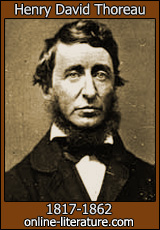
Works of Thoreau

Portrait: The Literature Network


Works of Henry David Thoreau, edited by Lily Owens, Illus., (713pp. 1981, pub. By Crown Pub., Inc., Avenel Books, New York), including Walden and other writings originally published in 1906 and original photographs by H. W. Gleason.

Walden and From the Maine Woods are, of course, familiar at least in name to anyone with even the scantiest acquaintance with American literature. Even Thoreau’s discourse on Civil Disobedience is being quoted by the Occupy Wall Street Movement. Included in this collection of writings also are From Cape Cod, Wild Apples, Life Without Principle, Autumnal Tints, and A Winter Walk. I find his writing interesting, and even identify with some of his principles, but still occasionally find some of the discourse tedious. It’s as though he is sitting alone with a continuous mental stream of thoughts, and every thought goes onto the page without editing or consideration of its value. Although I admit I might find myself in the same position if I was locked away in a small cabin in the woods for two years. (On the other hand, it may be that I’m presently sick and feeling miserable, and perhaps looking more to be entertained than enlightened.) The parts I found most interesting, and the ones likely most interesting to those who love the outdoors, are the chapters on the pond, winter and summer, and woods. You can share his feeling of transcendence into nature as he describes in detail the impressions made by the wildlife he encounters, snowfall, trees, even the ripples in the sand on the lake bottom or air bubbles under the ice.

His thoughts on economy in living were most interesting on the backdrop of our disposable, wasteful, narcissistic, Kardashian society. While not adjusted for inflation, at a time (1845) when land in New England could be purchased for $8.08/acre, he found he could live off of 27-cents a week for groceries, and by working for six weeks at manual labor, could earn enough to cover all of his living expenses for the remainder of the year. Here’s one I’ve always considered true. “And when the farmer has got his house, he may not be the richer but the poorer for it, and it be the house that has got him.” “Most men appear never to have considered what a house is, and are actually though needlessly poor all their lives because they think that they must have such a one as their neighbors have.” “It makes little difference whether you are committed to a farm or the county jail.”


As if touching on the current suits over navigation rights (the right to float on or paddle) on rivers and streams, Thoreau had no tolerance for the greed of property owners, especially those that would go so far as to name a section of water after themselves. “What right had the unclean and stupid farmer, whose farm abutted on this sky (reflecting) water, whose shores he has ruthlessly laid bare, to give his name to it? Some skin-flint, who loved better the reflecting surface of a dollar, or a bright cent, in which he could see his own brazen face; who regarded even the wild ducks which settled on it as trespassers; his fingers grown into crooked and horny talons from the long habit of grasping harpy-like.”


Like Emerson, Dickens, or Twain, Thoreau should probably be looked on as required reading for oneself. Thoreau himself was a devoted reader and held the practice in high regard. “To read well, that is, to read true books in a true spirit, is a noble exercise…” Books must be read as deliberately and reservedly as they were written.” “A written word is the choicest of relics. It is something at once more intimate with us and more universal than any other work of art. The symbol of an ancient man’s thought becomes a modern man’s speech.”


Monday, October 31, 2011

Tornado Trees

The lyrics go, "Oklahoma, where the winds come sweepin' down the plains."  Here are some swept tornado trees behind a split-rail fence where the rails have split and gone elsewhere.  To complete the picture, they stand next to a "lake" which is actually just a damp depression in the ground.  It can't be a lake when it has no water.

Friday, October 28, 2011

Happy Halloween


Two of the granddaughters came over the other night to carve pumpkins, so I shamelessly highjacked one of them to pose this picture.  With the jack-o-lantern is my solo decked Superior Expedition canoe, the 280-cm twin-blade Bending Branches Slice Glass solo canoe paddle, and the Bending Branches bent shaft BB Special.  Yes, I plan to get them wet (not the pumpkin) any day now.  Enjoy the season. jim 

Monday, October 24, 2011

Birch Bark Canoes

I came across a seven video series done by Ray Mears for BBC TV.  Working with an Algonquin canoe builder, they built a birch bark canoe in 9 days from raw materials and basic hand tools.  I think you'll find it informative, interesting, and with the humorous banter between them as they work, just plain entertaining to watch.  Total viewing time is about 45 min.  This link connects you to the first of the series, and you can follow one to the next.  The second link is just a view at a series of bark canoes.

http://www.youtube.com/watch?v=c1J1-bup-7s
 

Friday, October 21, 2011

From Worse to Worser

Canton Lake yesterday.


This picture was taken by a lady that lives near the lake.  The Corps says the lake is down 58%.  The Corps has released the water to supplement reservoirs in Oklahoma City, which also looks like this.   There was a question for a while as to whether they would in fact do the release, because they said it would take a week for the water to reach Oklahoma City.  During that time, half of the water would be lost to absorption and evaporation. 


While we were at Kaw Lake, we could actually see the water level dropping every day as it receded from the shoreline.  At the time, the water level was listed at -5%.  It is now at minus 6%, so the rain we had last week (the first measurable amount we've had in the last year) has done nothing to help the lakes.  To feel better, we have to look at Meredith Lake, which shows a level of minus 106%.

Wednesday, October 19, 2011

The Last Guide

Photo credit: AbeBooks.com
The Last Guide: A Story of Fish and Love, by Ron Corbett (230 pp., 2001, pub by Viking, the Penguin Group, Toronto, Ontario, Canada)

Ron Corbett, a columnist and feature writer for the Ottawa Citizen, met Frank Kuiack (pron. Kwe-ack) while in Algonquin Park area doing an article on wolves. In the wilderness where Frank was raised, there were few opportunities for employment. There was a chance to work felling trees for the lumber company, being a cook in a lumbering camp, working on road crews, but little chance for a real paycheck until he found a job in the mines 2,800 feet below ground. He was making more money than his Dad ever had. One day after some time off, he was returning to work. He had his ticket and sat on his duffel on the platform waiting for the bus. Later in life he would say “there are few moments of true clarity in life,” but that was one of them. He changed his bus ticket and returned to the wilderness. He’d become a full-time fishing guide.

Over the years he would gain a reputation for being one of the best. His clients returned year after year. His regulars were such people as E.B. White, author of Stuart Little and Charlotte’s Web, trumpeter Al Hirt, who was so big he had to lie in the bottom of the canoe when fishing, Michael Landon, Dan Blocker, and Lorne Greene, nearly the whole cast of Bonanza, and wealthy corporate execs and professionals. Even executives from Germany, Holland, and the rest of Europe, had his home phone number and would call him of an evening to book trips. Frank knew every lake and every hole where a fish could be found. The book takes you canoeing through streams and lakes, talks fishing, has you setting up camp and spending evenings around the campfire, tells you the lore and history of the area, how it changed over the years, and about not just Frank, but several other guides as well. The fishing guide business in Algonquin nearly died in 1979 when motors where banned from boats on the lakes. Most guides quit or moved on, but Frank had rowed or paddled his clients most of the time anyhow, so he hung on. The Last Guide takes you by canoe for some of the nicest memories, and some of the biggest fish. It’s a wonderful read.

Sunday, October 16, 2011

The Snipping Tool


I spent about four hours learning how to use the Snipping Tool to better illustrate my posts.  It took a dozen tries, but I finally got through the process and finished with a map.  This was Day 4 from the Kaw Lake Trip.  As you can see from the map, they indeed showed the channel into the Arkansas River entering the lake from the East shore, when changes in the channel now have it along the West shore.  This is not a work of art, but with work, I hope to improve.  I also added it to the original Day 4 post if you want to go back and see if it makes the description of the trip any clearer.

Saturday, October 15, 2011

Black Spruce Journals

Photo credit: Barnes and Noble


Black Spruce Journals:
Tales of Canoe-Tripping in the Maine Woods, The Boreal Spruce Forests of Northern Canada, and the Barren Grounds by Stewart Coffin (183pp., 2007, pub by Heron Dance Press, Williston, VT)

That’s probably the longest subtitle I’ve ever seen, but it describes his travels over a lifetime. His story spans the period from when he was introduced to canoe/camping by his father and then as a Boy Scout until, at age 77, he felt it was time to chronicle his travels. Mr. Coffin signed up for a whitewater canoeing course in 1954, one of the first such programs in the country. Through whitewater training, he met Jane, his wife, who was as passionate a paddler as himself. They began their travels through the Maine streams and lakes using a paddling guide published in 1935. It was apparently the first such guide ever done, was difficult to find, as only 500 copies had been published, and was in dire need of up-dating. Through their memberships in the Appalachian Mountain Club they began to scout every lake and stream, first in New England, and then beyond, to do write-ups for a new and more comprehensive paddling guide. The book is chocked full of personal experiences, good and bad, about old guides, canoe builders and paddle makers, his experiences as one of the first in the country to venture into fiberglass canoe construction, his work in nature photography, and the rivers, islands, and bays he explored in the Canadian provinces and territories. One of his goals was to never travel a river more than once, but to keep moving on to new territory. Occasionally, however, he would retrace his steps while working as a guide for other tripping parties, or when a section of river would be used again when it became part of another route, but he covered a tremendous amount of country.


I found one story interesting because it intersected with something that happened right while I was reading the book. Somewhere a stone had hit the left fog light on the Ram and put a hole through the light. We were coming from Ponca City, headed back to the campground at Kaw Lake, when I saw a Dodge dealership. It was a spur-of-the-moment decision to pull in and see if I could get a replacement bulb. After looking up the part on his computer, the man at the parts counter said the replacement bulb would be $150, and since they are so expensive, they don’t carry them in stock. It would be a special order. A hundred and fifty dollars, for a light bulb----A LIGHT BULB. No wonder American auto makers aren’t doing any better than they are. How do they expect to get return customers when they select parts that are so expensive that it breaks the bank to replace a bloody light bulb. Of course this is all the harder for those of us who can remember what things used to cost. Stewart Coffin tells the story about one of their trips up into Maine in 1958, when a wheel bearing went out on their 1950 Ford. They left the vehicle with a local garage. Since they were from out of town, the mechanic stopped what he was doing and promptly replaced the wheel bearings so they could get back on the road. The total bill, including both parts and labor, was $13.50. And now they want $150 for a light bulb.

Thursday, October 13, 2011

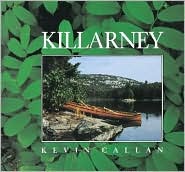
Killarney

I've spent all week just trying to drag myself around with a miserable cold.  I haven't even felt like reading for more than a half-hour at a time.  If you're still in good enough health to enjoy a good book, here's another one to relax with from the Paddlers' Reading List.


Killarney    by Kevin Callan (84pp., Stoddart Pub. Co., Toronto, Canada, 1990/94)
Any paddler will of course immediately recognize Kevin Callan’s name from his videos, speaking tours, and numerous books. This book is more a soft-bound coffee table book about the Killarney Provincial Park that sits just above Georgian Bay, at the north end of Lake Huron. The many photos that accompany the text show the beauty of the area in full color, except those from historical records, which are in black and white or sepia (a brownish tint that, you may find interesting to know, came from the excretion of cuttlefish). At the end of the book, for those who may want to turn daydreams into reality, are seven canoe routes through the area via lakes, rivers, bays, and some portages. Both the history of the area and the unique beauty will draw you in. In fact, the author said he had misgivings about doing the book. Making one of his secret, special places public would only mean more and more people would beat a path to his secret haven.


Monday, October 10, 2011

Moving Waters

Photo Credit: eBay


Moving Waters: Adventures on Northern Rivers by Sam Cook (116pp., Stone Ridge Press, Wrenshall, MN, 2007)


Sam Cook shares his experiences canoeing and camping throughout the Canadian provinces and Northern Territories. Once he was on such a trip, usually dropped off by float plane, he was totally without outside assistance or support until his scheduled pick-up on a lake a couple weeks later and a few hundred miles away. He had encounters with grizzly bears, shares numerous fishing stories, was confronted with unexpected experiences with raging rapids, other wildlife, the beauty of nature in its most pristine conditions, and much more. It’s a short book with a large color photo section in the middle that is meant more to whet your appetite for similar adventures of your own rather than an exhaustive telling of his stories.

Early in the book is one of the best written descriptions of the angst he feels before the start of every such trip. He thought for some time it was unique to him, that maybe there was something wrong with him. Why would he feel such deep guilt for trying to do something he enjoys? Some honest discussions around the campfires revealed the feelings weren’t unique. He looked forward to the trip, enjoyed the preparation and anticipation, but also felt, even if his family preferred to stay at home because they didn’t share his enthusiasm, that he was being selfish. He knew he had earned the chance to pursue a personal interest, but still feared he was being unfair to his wife at home dealing with the daily routine or problems. The conflicts would even detract from the enjoyment of the trip, especially in the early stages before the daily challenges of survival demanded his attention. If you too have experienced this, you may appreciate his honest look at this problem.

Kaw Lake, Day 7

There was a nip in the air this morning, and sea smoke drifted across the lake. While we were having breakfast, the DJ on the local FM radio station was unwittingly doing a commentary on the Oklahoma public education system. I surely hope it’s one that’s undeserved. We sat there alternately laughing and shaking our heads. He claimed to be good at math, and was surprised at how many homework problems his daughter had gotten wrong. She insisted her solutions were correct, so he proceeded to explain the process of subtracting two numbers. He couldn’t remember what to do with the zeros in a minuend or larger number. He knew a zero had to be changed to ten, but never borrowed anything. By his description, 200 - 24 = 286. And he was on the radio explaining this process to thousands. Jean added that perhaps he should run for Congress. A lot of our politicians have problems with zeros too.


Back on February 5th, I described the U-Haul Universal One-Man Canoe Loader. I’ve had to abandon it in favor of a simpler, cheaper, and safer method of loading the canoe by myself. The theory behind the One-Man Canoe Loader was great, and it specifically addressed my problem of getting a heavy canoe on top of a very high truck cap and rack. It managed okay on the stripper Micmac canoe pictured in that article, but it fell short on application with the Superior Expedition. The pole had too much movement. The swivel bar would not hold the canoe in place, and several times spun around and dropped the canoe with its sharp rudder on the cap roof. I incorporated controlling and stabilizing lines, and before long the rigging of the canoe started taking a ridiculous amount of time. Now, I can load the canoe in a fraction of that time. I lay a doubled blanket across the rear of the cap roof. One end of the canoe’s bottom is propped against the blanketed roof. Grabbing the other end that is on the ground, I just shove the canoe up onto the rack as it slides on the blanket. I then climb up onto the tailgate, roll the canoe over so it rests on the cockpit coaming and tie it down.

The U-Haul Universal One-Man Canoe Loader


Sunday, October 9, 2011

Kaw Lake, Day 6-B

I continued north until I once again ran out of water. Gifford says the catfish are scarcer, but I found the north end of the lake lousy with them. The water was shallow enough their dorsal fins would cut through the water, or a large fish would explode from beneath the canoe in an eruption of water and a swirl of mud. When every stroke brought up slimy mud, I came about and headed south. When I got back to Gifford, he showed off the 5-lb cat he had caught during my absence, but added he had caught his largest right there about a year ago, a 35-pounder.


The hills are made up of layer upon layer upon layer of rock. As the erosion undermines it, the large outcroppings jut out in mid-air until they become unstable, or break off when they become fragile from their own tonnage, and down they crash. They break off in random sections, but some are large enough to park a car or pickup on.

Continuing down the shore I found a square building constructed under a large outcropping. It cleared the overhang just enough for the chimney to pass in front of the cliff face. There had been a normal sized door, but one side of the cabin face had broken away enlarging the opening. It looked like walls had been set up in a form of cribbing, which was filled with rock and scraps of steel. Mortar was then worked into the cribbing from both sides and plastered smooth. Once a support was constructed, the cement for the roof was poured over a matrix of pieces of whatever steel the builder could find to use. I saw evidence of re-rod, steel cable, pipe, and flat stock. The roof was mounded slightly around the chimney to insure drainage off the roof. My imagination was screaming to suggest some old Indian had lived there with his pot-belly stovepipe running up through the heavy steel chimney. When I sought out a COE employee that had grown up here, however, he reported it had belonged to a farmer who lived in the valley below here before the lake was filled, and he had built it as a smokehouse.
I continued south down the lake, finally crossing the lake again and returning up the west shore to the campground. In all, it was 10.7 miles. I got far enough south that I was just north of the cape that separates Washunga Bay from the main lake.


Wild purple liatris.  It is beautiful, but this really is a bad time of year to be
poking around tall grass and rocks.  The poisonous snakes are blind during the
end of September and October.  As they shed, their eye scales go opaque.  They
are really ill-tempered (as I would be if my skin was peeling off), and will strike
at any sound or movement.

Friday, October 7, 2011

Kaw Lake, Day 6-A

It was 47 degrees this morning with a cloudless sky. It was one of those perfect autumn days with sunny, crystal clear air and miles of visibility. I launched Ibi and headed straight across the lake with a light chop on the port beam. When I reached the Eastern shore, I stopped to take a picture of the interesting limestone rock strata on shore.


. Just as I took the picture, a movement up on the bank caught my eye. I looked up to see three white-trailed deer bounding up the hill and through the trees. Since it was just a day-paddle, I went without my usual gear, and the light boat had me running along at a steady 3 mph with an easy relaxed stroke with the Bending Branches Bent Shaft BB Special. I was seeing something about 2 or 3 miles up the lake that I couldn’t identify. It was a good distance into the lake from shore.


There was a splotch of white on the top and bottom and black in the middle---maybe pelicans or egrets on a couple stumps. When I closed with it, I discovered the white was two five-gallon buckets, one on the ground in front of an ATV and one perched on top. The ‘ground’ the ATV was on was a very long, skinny sand spit that ran well into the lake. Relaxed in his folding chair with two fishing poles was Gifford Kurtsick.


Gifford is one of those 81-year-old guys that looks 20 years younger. I nosed the canoe up onto the sandbar, and we proceeded to talk away for nearly an hour. He told me about being on a destroyer in the midst of the Korean War, up near the Manchurian border. The bow had been damaged and several men killed when the ship hit a mine.
The USS Ernest G. Small struck a mine 7 Oct. 51.  Four days later the forward section broke off in heavy seas.  She was steaming in reverse for Japan.  I'm shocked to realize as I'm typing this, that today is the anniversary of the disaster. 

Gifford has fished here on the lake for 20-some years and lives just over the hill. He fishes until it’s time to go home for lunch, takes a nap, then returns to fish some more.


Thursday, October 6, 2011

Kaw Lake, Day 5

Another windbound day. Winds are out of the north 25-35, gusting to 45. Whitecaps and rollers were sweeping down the lake. So, we visited the Chief Standing Bear Museum in Ponca City for several hours.
While this bison and calf are life-size, I'm afraid they're bronze.


Click photo to enlarge.  An irony of the time was that while Native Americans
were being moved to free land for settlers, the settlers were free to move in among
the Indians and settle on their assigned lands.  The school, church, and cemetary
were along the west shore of the lake just south of the campground.  

Wednesday, October 5, 2011

Kaw Lake, Day 4

Finally! I launched Ibi and paddled away from the ramp at 1020. Actually, it was more like poling, as the water was only 7” deep for the first 100-ft, making the ramp pretty much useless for anything but a kayak or canoe. The lake is down at least 5-ft according to water marks along the shore, which means I need to talk with someone at the Corps.


It's a long, long way to the water.


Obviously, I need schooling in interpreting their daily lake water level statistics. According to what I found on their site, the lake was supposed to be down 2 ft. Paddling the coves and feeder streams are what I enjoy most, since they are more picturesque, and that’s where you find the most wildlife. Since they are all dry, I tabled the idea of canoe-camping around the entire lake now in lieu of family time and a few day paddles. The wind helped reinforce that decision. When I first planned the trip, I had hoped to start from Arkansas City, just north of the Kansas state line, and follow the Arkansas River down to the lake. I called the town’s executive secretary to explain what I was doing and seek


guidance on the town’s launch sites. She said, “I wouldn’t recommend trying that. You’ll be extremely disappointed. Right now you could walk the Arkansas without getting your shoes wet. There’s grass and weeds where there should be water.” Instead, Plan B was to paddle from Kaw Lake up the Arkansas with the objective of reaching Trader’s Bend. Sometimes finding the feeder stream for a lake can be tricky, especially since I was holding two conflicting maps. One showed the river entering the lake along the west shore around a bunch of islands, and the other from along the east shore. As it turned out, I went up the west shore and ran right into it.


With the water level down, the shores and coves were seeded
with millet by plane for the migratory waterfowl.

With the lake way down, there were also countless dead trees, stumps, and other obstructions to avoid running up onto. The river was shallow, seldom much more than a foot deep, and as little as eight inches. After a few miles, I rounded a bend, and the river suddenly broadened and flattened out. I ran aground a couple times trying to negotiate sandbars in search of a channel. Finally I got out and towed the canoe behind me as I walked 80-yds. back and forth across the river seeking a channel. Nothing! It was earlier than planned, but I had little recourse but to come about and head back down the river. I had bucked a decent headwind all the way up the lake and river, but found comfort in the prospect of riding the wind all the way back. The joke was on me. As soon as I came about, the wind died. In all I paddled 13.4 miles.


It was a great day, and plenty physical enough after several months of hibernation. My body was saying it may have been a bit much. You can say anything bad you want though, about the low lake, tree stumps everywhere, sandbars, shallows, but just being on the water always brings things to enjoy and appreciate---watching huge catfish leaping and darting from beneath the boat, pelicans gathering to begin their migration, the first hint of changing fall colors. Cool!
 

Tuesday, October 4, 2011

Kaw Lake, Day 3

It will not surprise those who know me, or regular readers of the blog, that some rather unusual things can latch onto my interest and attention. At Coon Creek Cove Campground, it was the restrooms. After doing the entry on May 26 about the EF-3 tornado that swept Canadian Campground at Canton Lake, I began to think a lot more about tornados in campgrounds. When you’re out in the middle of nowhere and a tornado is barreling down on you, where do you go? When the funnel went through Canton, six people ran into the shower stalls of the restrooms. The cinderblock walls collapsed, but all those inside survived. At the restrooms of Coon Creek, a Corps of Engineers camp, I found myself standing outside examining every square foot of the structure. The bottom was done in horizontal lapboard siding, and the top half was done in board and batten construction. The roof was covered in cedar shakes. That’s a bit different than the one shown here.

Then I knocked on the siding and realized everything was concrete, including the roof. It had all been molded in concrete to give it a natural appearance, but the thing was massive, and even attractive. When I looked inside, I saw the CXT Buildings, Hillsboro, TX, label over the door. I sought out a COE employee for more insight, and he said the buildings are reportedly supposed to withstand an EF-6 tornado or an earthquake. For you own peace of mind when camping or enjoying a picnic, you may wish to check out this site. http://cxtinc.com/
Tomorrow will be a paddle day.  Ibi takes a rest along the Eastern Shore of the lake.


Today was hot and windy, so since another day would prove unfit for paddling, I sought to learn more about the local history. The valley that is now Kaw Lake was the site of Kaw City and the Native American town of Washunga. In talking to a lady born and raised here, she gave me this account of how the lake came about. The federal government condemned the land in preparation for a project designed for flood control along the Arkansas River, especially for Tulsa. The residents were offered $3,000 per household and required to vacate their homes. They could have their homes moved to higher ground where the new Kaw City would be, or leave them to be bulldozed. When asked during the public hearing what would happen if they refused to leave, they were told, “Then you’ll be swimming.” Apparently the only building they were unable to move or destroy was a five-story hotel being used as a retirement home. Trying to implode it with explosives failed, as did trying to reduce it with a wrecking ball. Finally the Rt. 11 bridge was built over what remained, and it still sits at the bottom of Kaw Lake. The dam is 11,000 ft. long and rises 121 feet above the riverbed. It creates a 38-mile-long lake with 168 miles of shoreline. The lake was filled in 1976. Another interesting sidebar is that the river that feeds the lake is known to everyone as the Arkansas River, except for those living in Kansas, to whom it is the AR-Kansas River.

Another lady, a Choctaw, told how Indian women were not allowed to conduct any business, being considered incompetent. Regardless how much money or land they had, they were required to have a white sponsor before they could either buy or sell. When her grandfather died, he left her grandmother a large farm with a good bit of land. To sell the farm to have money to live on, she had to marry a white man. He managed her business for her, stole everything she had, and left her with nothing.


Monday, October 3, 2011

Kaw Lake, Day 2

During the powwow last night, the MC broke into the program several times to give OU and OSU footfall score updates. The Cowboy is the OSU mascot, and I had to chuckle at what seemed an amusing historical reversal where hundreds of Indians sat around cheering on Cowboys. Regardless of race, however, if you live in Oklahoma, you’re a rabid football fan. I think it may be required by a part of the state constitution.

The Kaw are called “the wind people,” and their presence was evident from dinner last night through today. The wind was forecast 15-30 mph, but it blew 30 mph or better all night. It didn’t drop to about 20 until late afternoon today. I found no peace of mind from Judy, a campground caretaker, telling me about a 70-90 mph straight-line wind that blew a camper trailer off the cliff and into the lake. In short, it was not a paddling day.


A small band of pelicans drift by our camp while feeding.


The north end of the lake looks like a field covered with fresh snow from the thousands of pelicans settling into the lake during their migration. During the afternoon a fragment of the group floated down the lake by our campsite while feeding. To get out of the waves, a powerboat had tried to land on the beach below our site, but was sunk as large whitecaps rolled over the transom and swamped the boat. An organized effort by a couple men simultaneously lifting and bailing finally got the boat afloat before it was moved around to the boat ramp.

The 22-ft. bronze statue of Chief Standing Bear.


With the rest of the day open, we traveled to the Chief Standing Bear Museum. I think it important to reflect a moment on the significance of the Indian Territories and Chief Standing Bear. During the travel reports of Lewis and Clark, other expeditions by the French, Spanish, and the fur traders, the impression in Washington was that the portion of the Louisiana Purchase that would become the Indian Territories, was of little value to whites. Since it was also barren and open, it would make Indian activities and movements easy to observe. Indian control or eradication was debated for some time. Several issues would conspire to settle the issue. Forcing all the Native Americans here to Oklahoma would free richer lands then available for farming and settling by those continuing to press west and south. Under ever-growing pressure for their lands, and fearing the government would not honor its promises, several tribes in Georgia, Florida, Alabama, and Mississippi had gone to court to seek jurisdiction over their own lands. Then gold was found in the Cherokee lands of Georgia, and something had to be done about Indians competing for the buffalo herds. Congress passed the Indian Removal Act of 1830, and Pres. Andrew Jackson signed it into law. Over the next ten years, over 70,000 Native Americans would forcibly be driven from their lands and into the Indian Territories. The 14th Amendment says that “no person shall be deprived of life, liberty, or property without due process of law.” However, forced movement of these peoples from their homes and lands was considered legal and appropriate since Indians were not persons, or humans, and therefore did not fall under legal protection.

“The soldiers formed a line at one end of the village and drove the people like cattle before them. The 500-mile march was hardest on children, the old and sick.” Chief Standing Bear’s own daughter was one of the victims of the march. They arrived in the ’warm lands,” where the government promised to provide food, blankets, and implements to sustain them until they got established, since they had been unable to bring anything with them. The supplies never materialized, and the tribes faced famine. Between their arrival on July 9 and the end of the year, 158 of the 730 Poncas from one village that survived the march had died of pneumonia and malaria, including Standing Bear’s second child, his 12-year-old son. As his son lay dying, he asked his father to promise to return him to the land of his grandfathers for burial.
 
On a January night, Standing Bear and 29 others slipped away to carry the boy’s remains north. When they arrived, they were arrested as renegades and imprisoned without a trial. Two attorneys, one being chief counsel for the Union Pacific Railroad, filed a suit for a writ of habeas corpus on Standing Bear’s behalf. After a two-day trial in 1878, the judge ruled on Standing Bear’s behalf, and for the first time in U.S. history, Standing Bear had made it possible for an Indian to be considered “a person--a member of the human race.” To make sure it wasn’t a total victory, the Indian agent approached Standing Bear at the conclusion of the trial to inform he that since he was now a non-Indian, he could never again enter any Indian Territories, even for a visit. There is a lot of U.S. History that is never taught in public schools.


Sunday, October 2, 2011

Kaw Lake, Day 1

We just returned from a 431 mile road trip to Kaw Lake in North Central Oklahoma, east of Ponca City. We camped at Coon Creek Cove Campground (COE), which sits on a peninsula, or at least it is a peninsula when there is water. Today was dedicated to getting camp established and taking the two nearest granddaughters to the powwow at Standing Bear Native American Memorial Park in Ponca City. For those not familiar with powwows, they are a Native American gathering of tribes for council meetings, rituals, tribal and family reunions, dance competitions, and a celebration and passing-on of tribal culture and tradition.


Frontal pictures taken with permission only. 
Dance competitor's tribal regalia.


Before becoming a state, Oklahoma was the Indian Territories to which 64 tribes from all over the country were forcibly removed. The word Okla-homa in fact means “Red Peoples.” With so much Native American culture based here, powwows run almost non-stop, somewhere in the area, from May through the end of September. While many people see such dances in tourist venues, there is nothing like seeing the real thing, and since they are mostly open to the public, it is the best opportunity for whites to begin to appreciate the rich Native American traditions. So, besides paddling, I’ll include some of what I’ve learned on this subject as well, and I hope you find it as interesting as I do. Besides, we inherited our paddling from the Indian peoples.


There were six tribes represented at the Kaw Nation powwow: Pawnee, Otoe-Missouria (originally of the Winnebago), Osage, Tonkawa, Kaw, and Ponca. They were all part of the Kanza or Kansa Nation, who gave their name to the Kansas River, also called the Kaw River, and the States of Kansas and Arkansas. The event is held in a circular arena with an inner circle 150 feet across. All spectators and tribal members sit around an outer ring. A group that seemed to vary between about 30-50 sat in the center of the arena to provide drumming and singing for the dances.


Because of the different tribal dialects, they use vocables in place of words so all can participate. There is a lead singer who starts, and then everyone joins in as the sound swells and dancers move into the arena either for several categories of dance competition, or huge inter-tribal dances. In the latter, you can see the heritage being passed to the next generations as four and five year olds join in the dance. By the time they are six or eight, they begin to appear with their own regalia.


While the dance competitions had been going on all day, the formal ceremony and adult dances began at 7p.m. and continued until they were done. As the night goes on, the regalia become fancier and more colorful, and the dancing more strenuous and athletic. The awards ceremony is held when the competitions are complete, with one awards ceremony reportedly not being started until 4 a.m.


The winds conspired to keep me from meeting my expectations for paddling during the week, although you’ll see I got in a couple real nice days. The winds started this evening and it got cold. Finally, the youngest granddaughter wanted to get in my lap and cuddle to keep warm and sleep. I wrapped my arms around her to keep her from sliding off. I later got my report card---I’m nice and warm, but I squeeze too hard.