Wednesday, January 17, 2018

A Gift of Beauty and Memories

Credit: Arni Photography
 

We’ve enjoyed Kenneth Arni’s wonderful photography for years.  He travels a good bit, but his day-to-day operations are from his home at Fenwick Island, Delaware.  Most of his work runs from Bombay Hook, DE, south to Chincoteague, VA.  My wife and I follow him on Facebook, and the first thing you will see here in the blog’s right column is Arni Photography, where you can view his work.  His greatest treasures include wildlife, avian, and landscape photography.  There are so many of his pictures that we’d love to have to enjoy, but we’d have to live in a gallery.  Finally, we encountered this shot above from a Chincoteague marsh, with frost on the grass and glaze ice on the still water, and a beautiful sunrise.  Christmas was rapidly approaching at the time, so I decided this picture on our own living room wall was to be our gift to ourselves.


The Chincoteague Marsh matted and framed on our wall.
 

Chincoteague strikes a chord with me for two reasons.  One, if you enjoy oysters, Chincoteague is the gateway to heaven.  My parents were friends with a couple in Chincoteague.  The man was an oysterman.  A couple times a year we would head down there to visit, and one of those trips would always be in late fall or winter so Dad could get a several gallons of oysters.  Two gallons were always for us, and the balance would be for whoever wanted to chip in for fresh bivalves.  For a young kid, the ride from Delaware to Chincoteague, on the Virginia Eastern Shore, was a road trip that never seemed to end.  There were two compensations, however.  The oysterman’s wife always had the table straining under a load of food that made the dining room look like Thanksgiving.  The second was that my brother and I always got turned loose for the day.  How much trouble could two young boys get into in a marsh?    


The Chincoteague Pony, also called the Assateague Pony.
 

The second reason was to see the Chincoteague ponies.  A small channel separates Chincoteague and Assateague Island National Seashore Park.  The feral herd of ponies, which are actually horses, but called ponies because of their small size, live on Assateague.  Since food is in such short supply on this spit of sand, there is a round-up each year so some ponies are culled from the herd to prevent starvation.  The source of the ponies is a topic of historic disagreement.  Some say the ponies swam ashore from a Spanish galleon that foundered offshore in a storm.  Others believe that the first colonists kept them on the island to avoid the livestock tax they would have to pay if they were on the mainland, but that leaves the question of how the colonists got them.  Maybe both stories are true.


Oyster tongers at work in the shallows.
 

Our favorite story comes from the oysterman’s false teeth.  Perhaps unlike the pony stories, which can’t be proven, this story is true.  Oystermen, especially tongers, live a very close hand-to-mouth existence, so when he got a new set of ‘store bought’ false teeth, it was such an investment that it was a huge deal.  His wife had urged (ordered) that he not wear the false teeth on the boat to avoid the risk of losing them overboard.  We don’t know why he was defying orders, maybe he just forgot to take them out, but he was standing on the side deck of the boat working his tongs over the side.  The teeth still didn’t fit exactly right, and he was coming down with a cold.  One sudden sneeze was all it took to send his upper plate overboard.  He spent most of the afternoon tonging more for teeth than oysters.  They not only represented a big financial loss, but he would catch holy hell from his wife every day from now ‘til death do us part.’  The rest of the story was picked up on the opening day of oyster season the following year.  He went out to his favorite spot to start tonging.  He dropped the tongs over the side, worked them, and pulled them up into the boat to dump the oysters on the sorting board.  There, in the first tong of the year, was the upper plate of his false teeth.  Domestic peace at last.


Thursday, January 11, 2018

Osprey

 
Osprey are lighter in color than most raptors.  They are brown over most of their slender body with a white head and breast,  a brown band that extends from their back, through their yellow eye, to the prominent black beak.  They are commonly found where their perch gives them a good view of their hunting waters, such as the top of a post, tree, or navigational marker where they love building huge stick nests so they can hunt from their 'living room.'  They have rebounded well since the end of DDT pesticide use that had killed their populations off to endangered levels. 
 
During their 15-20 year lifespan, they can fly 160,000 miles during migrations.  The oldest recorded osprey lived to be 25 years, 2 months.  In 2008, one 2-3 year old bird was observed to fly 2,700 miles from Martha's Vineyard, MA, to French Guiana, South America.  They are excellent fishermen.  Their success rate is 1 successful catch out of every four dives, and often as high a catch rate as 70%.  Their hunting time between catches averages 12 minutes.
 
All their eggs do not hatch at once, but are spread over about 5 days.  Seniority ranks their place in the nest, meaning the first born get fed first.  In good hunting waters, all the chicks survive, but when food supply is more scarce, the younger chicks may starve to death. 


Tuesday, January 9, 2018

Fort Cobb State Park

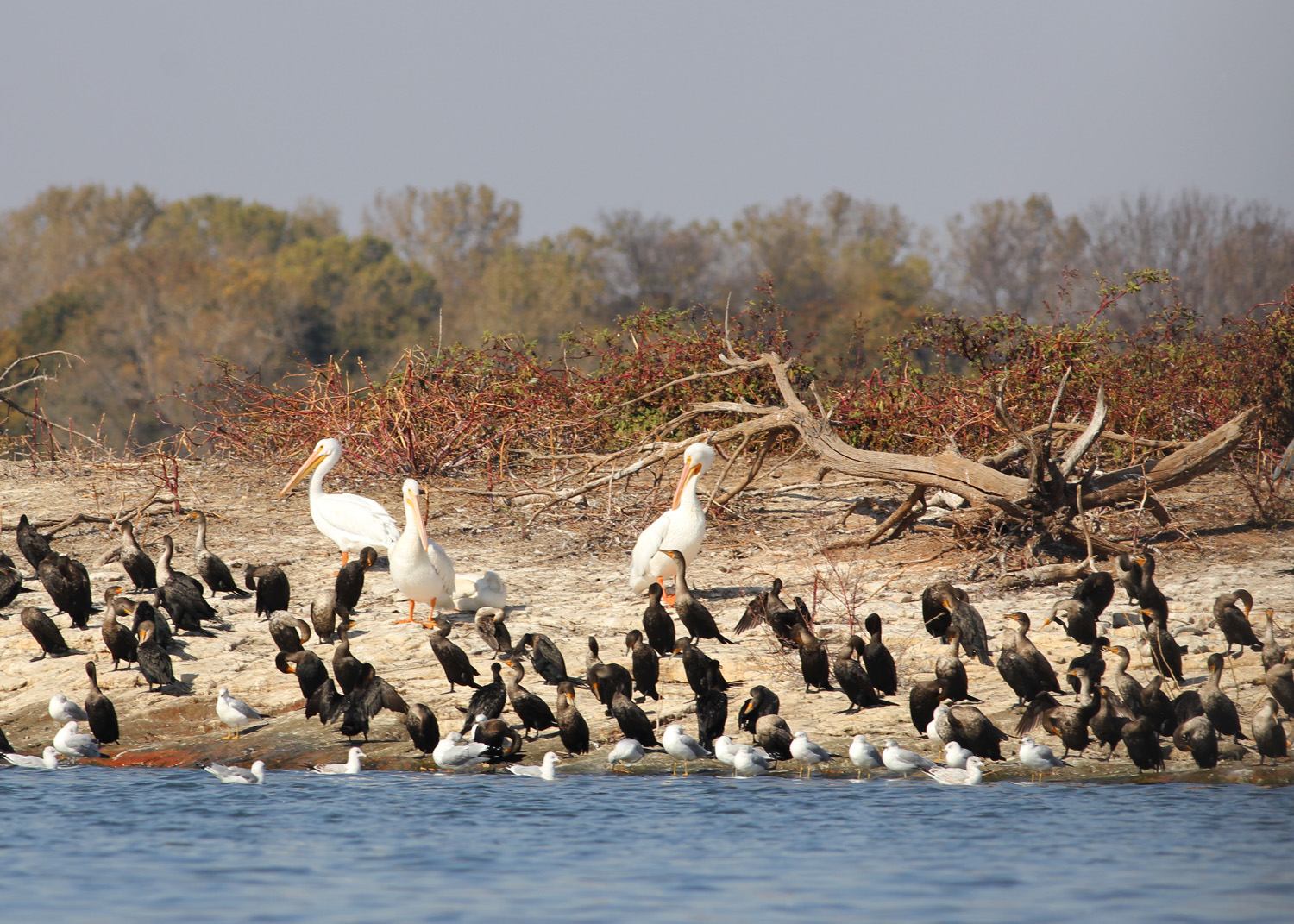
Just off one of the coves in the southeast part of the lake is an island
that is just covered with birds---seagulls, cormorants, pelicans, Canada
geese and more.
 
The weather last night had huffed and puffed, but this morning wasn’t bad.  The temperature had only dropped to 48, and while the wet pavement belied an earlier shower, what we had now was a fog ceiling that had dropped almost to the ground.  Sky and water were colored lead grey, and there was every hint of more rain to come.  The wind was at least calm.  While I waited to see which way the weather was going to go, we took time for eggs, bacon, and toast for breakfast. If we couldn’t do anything else, we could eat.


Wave on wave of geese filled the sky.
 
I was re-reading a sailing classic called “Princess” by Joe Richards.  Princess was a traditional full-keel, gaff-rigged Friendship sloop designed by Wilbur A. Morse of Friendship, Maine, in 1880.  Morse built them until 1910, but they have a cult following that has continued their construction to this day in both wood and glass, and an active Friendship Sloop Society keeps them alive.  Richards had found a neglected 25-foot “Princess,” and after a significant refit on her, he decided to put his career in New York as a commercial artist on hold, liquidate his worldly possessions, and head off on a quest to find a patch of ground on some Caribbean island.  He was 31 years old.  The year was 1940.  As he headed south, he was to discover only a few days into his trip that the world had decided to go to war.  By the time he reached Florida, Joe and Princess would both be swallowed by World War II.


The beautiful and historic Friendship Sloop during their annual
gathering at Friendship, Maine.
 
I met Joe quite by accident many years later.  I was driving east from Leipsic, Delaware, toward the coast when I saw this boat sitting in someone’s front yard.  I knew instantly that it was a Friendship Sloop.  I did a U-turn, went back, and pulled into the drive.  As I walked around its stern on the way to the front door of the house, the transom declared her to be Princess.  I walked up and knocked at the door.  When the elderly man answered, I asked, almost unable to believe my own words, “Are you Joe Richards?”  He said he was, and invited me in.  What an unbelievable thrill to meet a stranger who I already felt like I knew and had a bond with through his book.  He made tea, set out some cake, and we sat and talked boats and adventures for four hours.  As I said my goodbye and thanked him for his hospitality, he told me to bring my book by so he could autograph it for me.  I never did.  Go figure.  And now Joe and Princess are both long gone.  I think of him every once in a while, and it was during one of these times that I went back to my office and pulled “Princess” down off the shelf again to relive the experience.
                    
After reading a bit further, we had an early lunch.  Jean heated clam chowder while I got Ibi off the truck, onto its dolly, and loaded.  The sky refused to allow the sun to even lighten the sky, so I threw my foulweather gear in the stern just in case.  I was underway by noon.  The air was still light, and I paddled south toward the dam and Sunset Cove.  I wasn’t making miles, but spent a lot of time trying to get a few photographs.  After I turned back north, the sky finally cleared to reveal the sun and a beautiful, blue fall day.  With ‘V’ after ‘V’ of Canada geese flying overhead and the fall colors, I could easily have been mistaken in thinking I was back on the Chesapeake.  If only that was true. 
This is a very special state park.  Fort Cobb State Park is open all year.  Even during the winter, RV sites have running water and electricity.  Unlike most parks that seem more and more intent on eliminating primitive camping, Cove Drive goes out of the north end of the park and follows the shoreline for two miles from Caddo Hill to a dead-end at a locked service gate.  Every hundred yards or so is a nicely isolated campground right on the shore of the lake.  Each has room for parking, a concrete picnic table, a pole for hanging a lantern or tarp, and there are three enclosed pit toilets within easy walking distance.  There are trash dumpsters every few sites, but there are always some people that seem to have trouble finding them even though they sit right on the edge of the drive.  Most of the sites are single camp locations, but there are also a few with room and provisions for two or even three sites provided for in a group camp.  Camping is $14 per nite, winter or summer.  Best of all, the shoreline undulates continuously like teeth of a very large saw blade.  Unless the wind is out of the southwest, there are sites to provide for smooth water and easy shore launching.  If the wind is southwest, Eagle’s Nest campground on the west shore of the lake, also open all year, is a good option from its protected cove in Farmer’s Slough.  Please protect your right to camp by being a clean camper that carries out all that is carried in, and properly disposing of trash.  Thanks.


Friday, January 5, 2018

Fort Cobb Images


Canada Geese
Killdeer on the shore.
Juvenile heron taking great advantage of his natural
camouflage in this dead wood.  From a greater distance,
he was nearly invisible.
Juvenile heron about to take flight.
Cormorants hung out to dry.
This is an unfortunate combination of dense fog
and a bit of backlighting, but he looked good
with his right foot on a fish having breakfast.
An osprey.

Friday, December 29, 2017

Thursday, December 28, 2017

Day 2 on Fort Cobb Lake

The end of the road.  The green to the right behind the sign is where
we took out across the farmer's field (authorized).
We had to greet today with a high degree of both flexibility and equanimity.  We decided to make this trip because of the wonderful weather forecast---3 clear days with winds of 8-13 mph.  At least for today, they lied.  With strong winds blowing straight into the cove, there was no reason to rush onto the water.  We took the time for a wonderful breakfast of French toast.  Within minutes, the wind had escalated to 25 mph.  White rollers began marching into White’s Catfish Cove after crossing the expanse of Ft. Cobb Lake from the southwest.  Paddling was definitely off the schedule for today.


This 12 or 14-foot double-barrel shotgun illustrates just how serious
they are about their hunting around here.  It looks like it could use a
new stock though.
 
We took a nice long walk and checked out other campsites and the open lake, which looked like it had been frosted with white icing.  The day was beautiful, but for the wind, and that was a deal breaker.  With the days really shortening and my poor paddling muscle conditioning, paddling the full 35 mile perimeter of the lake was not even a pipe dream.  A fall back option was to do one side of the lake, take out at the furthest north ramp, and then return to do the other side on the following day.  Many lakes, however, will shallow-out and turn to marsh and reeds before reaching the ultimate headwater, so the last ramp is sometimes impossible to reach.  I had wondered during the night if Jean could find it by road as well as whether I could reach it by water, so after lunch we decided to go exploring and drive north to check it out.


Where White's Catfish Cove meets the lake is the foot of Caddo Hill,
and the best of the fall colors here.  We were starting into another deep
drought, and that steals most of the colors, but still not bad.
 
The road was “interesting.”  It finally petered out to a ride across a farmer’s field, dodging side to side to keep tree limbs from removing the canoe from the rack.  When we finally got to the end of the rutted lane, we found the broken derelict remains of a long-ago ramp and piles of dumped trash and broken glass.  It was workable, barely, so I got the GPS coordinates for a planned future run, whenever that might be.  While we were out, the wind had lightened and turned to the north.  It filled me with enthusiasm for an afternoon paddle, but on the way back Jean pointed to the huge mare’s tails being dragged across the sky. 


All that is left of the ramp is a pile of concrete slab rubble to make
people realize that they've reached the end of land before diving
into the lake.
 
By the time we got back to the campsite, the wind’s strength had continued to build from the north, and the temperature began to plummet.  When I sat down at 8 p.m. to write my journal, the wind was roaring and whistling around the RV and sounding like a Nordic winter storm.  I thought we’d wait to see what the morning brought, but it wasn’t sounding promising.


Tuesday, December 26, 2017

November on Fort Cobb Lake

Credit: Google Images
 
Fort Cobb is a bit of a misnomer.  Unlike some towns, like Fort Sill, that actually grew out of  ‘old west’ military installations, the town of Fort Cobb is three miles NW of the site of the actual military fort, which was located at the fork of the Washita River and Pond Creek.  Pond Creek was later renamed Cobb Creek to fit with the fort’s name.  The fort was created in 1859 by the Superintendent of Indian Affairs to establish the Washita Agency.  The fort that would house the Washita Agency was named after the Secretary of the Treasury, Howell Cobb.  Four companies of cavalry would be assigned there under the command of Maj. William H. Emory to protect the local Washita Indians from attacks by the Comanche, Kiowa, and Cheyenne tribes that had in turn also been relocated there from their natural homes.
 
With the coming of the Civil War, Emory feared his command would be cut off if Texas and Arkansas seceded, so he relocated his forces to Fort Leavenworth, Kansas.  Texas Confederates quickly seized the fort, but they soon left, and Fort Cobb was left abandoned for most of the war.  U.S. forces returned to Fort Cobb in 1868 to find only the walls of a stone building remaining, and a few broken pieces of adobe structures.  The latter were thatched over for storage buildings, but most of the soldiers lived in dugouts in the ground covered with tents.  Forces under Gen. Philip H. Sheridan arrived the following winter as part of his campaign to force the remaining hostile tribes onto reservations.  Fort Sill was established only 50 miles away early in 1869, so on March 12, 1869, Fort Cobb was abandoned for good.  The only thing remaining to mark its existence today are a few trenches.
 
While the town of Fort Cobb was northwest of the original fort, Fort Cobb State Park was created in 1959 with the damming of Cobb Creek 4.6 miles north of the town.  (L35.1745N Lo98.4402W, P. 79 of the Oklahoma Water Resource Board book, “Lakes of Oklahoma.”)  Our 110 mile drive down to Fort Cobb State Park took three hours.  Part of the extra time was due to missing a turn.  We were going west from Binger when we came into a long construction zone.  I had been concentrating on meeting traffic with the RV on the narrow temporary lanes.  I finally decided we had gone too far for our turn onto Rt. 146 South, so we needed to turn around.  For the most part, shoulders have yet to be invented in Oklahoma, nor were there any good, safe turnaround locations.  We had to turn onto a dirt side road, but that left us backing across the main road through a blind intersection to turn the rig around.  I asked Jean to go back and signal when it was clear for me to back across the highway.  As I backed across, she walked across by the rear of the trailer to come upon a skunk in the tall grass, which left her trapped between the skunk and the side of the trailer.  It was about half-grown and just as startled as Jean was, but as it turned its business end toward her, she ran around the back toward the other side of the trailer, and yet another catastrophe was averted.
 
Trying to figure out where we could have gone wrong, it made sense that the problem would have occurred in the construction zone.  Sure enough, when I got back to where I felt the road should be, there was again no sign for the state park, but the route sign stood nicely hidden behind a large piece of construction equipment where even a careful observer wouldn’t have seen it coming from the east.  We made the turn and headed south as we followed the DeLorme Atlas ever more carefully.  When we reached the road that the atlas indicated should have been the turn for the state park entrance, again there was no sign for the park, and as I looked to the right I was faced with a huge hill like I was looking up an Olympic ski jump.  Surely they would not be having RV trailers pulled up that hill, but I noticed traffic approaching from behind us, so I committed and made the turn.  That indeed led us into the entrance and the park ranger station.
We had never been there before, but found a paved campsite that was absolutely beautiful…level, smooth concrete, with plenty of room, and high enough to drain well.  We pulled in, not believing our luck, and got set up.  It was 3:30 p.m.  Once I was about done, I got out to walk around a bit, and there in front of the longer than normal lane to the campsite, on what would have been the blind side of the truck, was a small brown sign designating the space as reserved for handicapped usage.  My dubious luck was obviously holding, so we undid our set-up, moved to another space, and repeated the whole process over again.

Our campsite on White's Catfish Cove
 

American Pelicans and Cormorants enjoying the evening.
 
A nearly full moon rose to illuminate White’s Catfish Cove.  This was the fall’s last hurrah, and all the wildlife were out to enjoy a beautiful evening.  In the short while before darkness fell, we saw cormorants, Blue Jays, woodpeckers, flock upon flock of Canada geese, seagulls, a couple hundred or so coots, heron, ducks, an owl, a bull frog, a few pelicans, and two packs of coyotes calling back and forth between themselves.  About the only thing we didn’t see in the cool evening were mosquitoes.  Finally, a win.


Tuesday, December 19, 2017

Mississippi By Canoe

Here's an hour-long video of a canoe trip down the Mississippi.  It is exceptionally well done.  You will love it.  I promise.  And, if you are ready to make the trip, let me know.  So am I.
https://www.youtube.com/watch?t=113s&v=2aoFVA1vmPs&app=desktop

Friday, December 8, 2017

Paddle Camping Chair - Helinox

This is the Helinox chair I got.  Depending on inventory,
other colors are available.
Here’s a story somewhat like my purchase of the Sea-to-Summit Thinsulite Reactor sleeping bag liner.  I have ogled the Helinox Camp Chair for years, but could never justify $140 for a camping chair, but then three things conspired to change my thinking.  My Coleman folding chair was years old, had been repaired multiple times, was heavy but study, and while it is easy to repair, it continues to shed part.  Second, I’ve watched Larry Ricker, nibimocs, sitting comfortably at his campsite in numerous videos, even holding his dog in his lap.  I think Larry said he had a different model, but for all intent and purposes, they look and work the same.  Each video made this chair seem all the more appropriate for paddle/camping.  Thirdly, I received an email offering an enticing sale price.  Even then, I looked at the ad every day of the sale before making the plunge only hours before the sale ended.


This compares the two chairs in their packs.  Also, the Coleman chair came
with a light, felt-like bag that didn't last any time at all, so Jean made a duplicate
bag out of upholstery material.  The Helinox comes with a bag of sturdy material
with hand loops at both ends.  The zipper also runs the length of the bag, making
it very easy to put the chair in.
 
Here is a comparison between the two chairs, my current Coleman and the Helinox.  Why I couldn’t stand being tempted any longer becomes apparent.  The Coleman Max Quad Chair is $40, 10 lbs., steel construction, 8 X 38 in. packed size, oversized feet, oversized seating with drink holder in each arm, 600 pound capacity, with a 24“ seat height.  The Helinox Camp Chair is listed at $139.95, 2 lb. 9 oz., sturdy aluminum & polyester seat, 5 X 20 inches packed, 18” seat height, 320 pound capacity.  The two photos here show the best comparison between the two.  For packing efficiency, the Helinox is half the size and a quarter of the weight of the Coleman.  The Coleman is still serviceable, and serves well at an RV site or if we travel to an athletic event or something similar, but it is a load in the canoe, and would be next to impossible on a kayak, and therefore gets tied on top of everything else making the boat top-heavy.  Instead of being tied on top of the canoe packs, the Helinox slips lightly and comfortably in with my sleeping bag.  The combination of pack-ability and lightness finally scored a win.


Wednesday, December 6, 2017

Comanche Powwow - Part 2

This beautiful young lady is wearing what is known as a jingle
dress.  It originated from several bands of the Ojibwe, but through
dance competitions can be found now among most tribes.  It is covered
with row on row of light metal cones that ring when they come together
in response to the rhythm of the drum and singing.
 
One of the things I was most impressed with was that while many tribes have lost their language to a large extent, the Comanche seem to have their language intact.  Several speeches, prayers, and songs were done totally in their native tongue.  https://www.youtube.com/watch?v=jFTycnwlNGs


The music is provided by a ring of about 12 drummers and singers.  There
were 3 groups performing from different areas of the country.  These were the
Sons of the Drum Singers.  These are traditional songs that reflect different aspect
of tribal history and life.  Anyone that knows the song can join in, and there will often
be 2, 3, or 4 concentric rings of singers around the drummers. 


While we felt unwelcome and will probably never return for another visit, we feel the Comanche still deserve great respect.  They were always known to be independent and uncompromising when they felt they were being infringed upon, whether by other tribes or the Europeans.  While they were known for fierce and violent atrocities in conflicts, it is well to put ourselves in their place.  If our lands, hunting grounds, culture, lifestyle, freedoms, and lives were at stake, may we not have reacted likewise?


Many dances are open to various groups and ages, but when you get
to fancy dress, show in these two photos, you have to be very athletic with
good stamina.


Friday, December 1, 2017

NFCT

Laura and I at the Old Forge, NY, NFCT put-in.
 
If you don't know the Northern Forest Canoe Trail (or even if you do), here's a short video you will want to check out.  It's only 3 1/2 minutes, but beautiful photography and plenty of wildlife.
 

Thursday, November 30, 2017

The Comanche Powwow

Military veterans march on the colors for the opening ceremonies.
The red objects at either end are war lances being carried as guideons.
 

Jean wanted to visit a Native American Powwow, and had found two the same weekend: one near Tahlequah, and another at Lawton, OK, near Fort Sill.  She decided to visit the latter.  We were going to make an early morning drive in the darkness, and then spend the night near Fort Sill before returning on Sunday.  This was going to be an unusual trip in many regards, like having a rare bobcat run across the road in front of us shortly after starting out.


The guideons were war lances and used to show the unit
designation and military branch affiliation.  The bead work on
the shaft represent campaign ribbons.
 

Living in Indian Territory is unique in many regards.  Until this weekend, we have viewed all those unique differences as positive.  We are of course surrounded by old tribal nation reservations belonging to about any tribe you can name.  Some of the reservations have been broken up to the point that one would never guess they were on an ‘indian’ reservation, and others have tenaciously clung to their reservation identity.  In most, the native population think of us as fellow Oklahomans, but in others, we are still invading white men and are viewed with a racial bias no different than one would expect in a black community in some areas of Chicago.  Our most favorite powwow visit was at the six Kaw nation’s powwow.  These include the  Kaw or Kanza, Ponca, Osage, Pawnee, Tonkawa, and Otoe-Missouria tribes, who were originally the Winnebago.  The event was held at the tribal grounds named after Chief Standing Bear, just south of Ponca.  Here we seemed to be viewed as any people with a deep interest in understanding and appreciating their tribal heritage and culture.  We were extended a friendly hand, a welcoming hand.  Several families nearly adopted us.  One would invite us to sit near them so they could explain each facet of the tribal regalia and the imagery surrounding the various dances.  Another would suggest what we might have for dinner, where to find it, and ask us to join them for dinner.  Both officially and personally, it was made clear frequently that we were both welcome and expected to return.  The Comanche powwow, unfortunately, took us to the other end of the spectrum.  It became clear that this was a closed event, a family or tribal event.  During the day there were no fewer than thirty unfriendly references about whites and another twenty or so about non-Comanches.  A few people were openly hostile and rude, while most were just unfriendly and aloof, unless I had my wallet in my hand.  That sounds negative.  Let’s just say we left with a feeling of being very unwelcome.


The one thing the Comanche, and most other tribes, do a great job of
is carrying on their Native American cultures and traditions through all
ages of their community.  The babies, also often decked out in their own
regalia, along with mother and grandmother, will all be seen participating
in every aspect of the powwow.


These boys have just completed registering for their
participation in various aspects of tribal dancing.
 

For the Comanche tribe, the powwow was a success and a great draw.  There were representatives there from both North and South Dakota, North and South Carolina, Florida, Minnesota, New York, and others who also traveled great distances to attend.  The two extremes were a representative of the Athabaskans of Alaska, and in a cultural exchange, a group of six from Siberia that had come just to attend the event.  Some or all of those from Siberia were professional singers.  One sang a song in his native tongue, and another that is noted as a ‘throat singer’ showed off that skill.  The only way I can describe the sound of his deep-throat singing is to point to the sound of the Australian aboriginal didgeridoo, only he did all of this without any instrument.  If even that doesn’t paint a picture, take a look at this, and you’ll see where I came up with the idea of the didgeridoo: https://www.youtube.com/watch?v=NaBI1SqIhak
Now here are a couple examples of the deep-throat singing that sound very unusual to our Western ears.


Young men also shown after dance registration.  One can't help
noticing the sense of pride clearly exhibited while in their native regalia.
 

Sunday, November 26, 2017

September at Canton Lake, Pt. 2

Credit: Wildlife Heritage Foundation
I wish I had gotten a photo or two.  I was sitting on the settee when I
detected movement outside.  Then I was too enthralled to go after the
camera.
 
As the air began to cool, and the sun settled, we saw two grown quail come out of the hedge row behind our camp.  That’s a real rarity here, at least by my experience.  What was really neat was the 8-10 half-grown young that suddenly began stumbling out of the hedge row to join them.  They reminded me of a bunch of kindergarteners out on a field trip.  They ran this way and that, jumped in the air, reversed their track back and forth like any bunch of youngsters.  The parents stood tall, stretched their necks and swiveled their heads being hyper-vigilant of everything.  Shortly they were all hustled back into the tall grass and disappeared.
The sky was just barely getting a hint of light.  The windows were again all open, and we were suddenly fully awakened by a scream immediately outside our bedroom window.  It wasn’t possible to tell whether the scream was from a large bird or a squirrel.  The cry wasn’t distinctive as to the species, just a scream of sheer terror, the faint hoot of an owl, and then absolute silence.  I guess it was what a hunter would call a ‘clean’ kill, but there was nothing clean about some poor creature suddenly becoming breakfast.  There was an oak tree right outside the RV’s bedroom window, and a bit later we saw a squirrel venturing down the tree, so one of its kind was probably what had become the morning’s victim. 
There was a nice breeze on the lake first thing.  We decided to have a nice breakfast first before I launched at the ramp.  Jean fried turkey bacon and set a pack of frozen blueberries out to thaw over a low flame.  I then made pancakes, and with a pot of coffee, we sat down to a much nicer breakfast than that poor squirrel had been having. 
The wind was out of the south-southeast, or the full length of the lake, so was rolling small waves onto the ramp.  I set Ibi parallel to the water’s edge and used my legs to keep it from pounding on the concrete.  With a quick, or what translates to a quick launch for a senior, I got in and shoved off.  It was immediately obvious that landing would not be as comfortable.  There was no alternative landing option there.  To either side of the ramp are piles of concrete just dumped from a truck and allowed to harden into boulders.  Either side of that is non-stop riprap that stretches to the next ramp a mile away, or to the base of several cliffs. 
I pulled the Falcon Sail up as soon as I cleared the shore.  I sailed as close to the wind as I could, and with a light occasional paddle, worked to the south and nicely upwind.  The wind was continuing to build as I decided to stay upwind, but sailed on and off the shore on a beam reach using the paddle only for bracing. 
If the wind had just held where it was when I launched, it would have been an exciting paddle-sail, but it was obviously intent on strengthening quickly.  The alternative landing ramps were to the northwest as the shore dropped away in a large crescent called Big Bend.  There were two landing options I could escape to as whitecaps started to build.  I knew landing at the ramp where I had launched was out of the question.  There was a bit of cover from reeds by the next ramp.  I had the paddle cart with me, and it would only be a one-mile walk back to the campsite.  The next ramp was far enough around the bend that it would definitely be a safe landing, but then about a three-mile portage with the cart. 
I fell off on a nice broad reach and flew down the shoreline in two jibes.  As I passed my put-in ramp, my suspicion about not being able to safely access it now without banging up the canoe was confirmed.  The second ramp was marginal with some small waves rolling onto it, but it looked safe and serviceable.  I dropped the sailing rig, raised the rudder, and side slipped alongside the ramp.  Everything worked out fine, and I just had a nice one-mile stroll back to the camper with Ibi following quietly behind. 
As I walked past one campsite where two men were talking, one called out, “That water out there is getting a bit lumpy, isn’t it?”  They had already decided not to take their fishing boat out on the lake.  Within an hour, the couple fishing boats I had seen on the lake when I launched had also disappeared. 
This was probably my second shortest paddle.  I had only gone two miles, but with the sail I had likely not paddled more than a dozen strokes.  I can’t really pass it off as a paddle, so we can just call it a drill or an exercise.  I got Ibi wet, and it still counts as another outing on the water.  Back in the comfort of the RV, we listened to the wind and the rattling of cottonwoods. 
The highlight of the afternoon was looking out the window and seeing a large roadrunner right alongside the trailer.  He was working his way down the tree line.  He would see something in the grass.  I never could tell what he was after, but he would drop his head and rush off 20-30 feet straight at it with his legs flying.  Whatever he was pursuing, his aim clearly appeared to be  dead-on. 
The next day, Friday, would be our departure time.  We had aspirations of a few quiet days, and chose mid-week Tuesday, Wednesday, and Thursday evenings.  We anticipated having the campground almost to ourselves.  Boy!  Add that to our ever-growing list of plans that didn’t bear fruit.  People started coming in Wednesday evening, and it never stopped.  By Thursday night it looked like the Fourth of July weekend.  Everyone else in the state with a camper had had the same idea.  I told Jean, “Don’t worry.  Just wait until November.”
  

Wednesday, November 22, 2017

September at Canton Lake


After backing into our campsite, I was startled by the abundance of holes in the ground.  I first thought of our experience with the wolf spiders during our last visit, but then heard all the  cicadas  singing.  I looked at the holes again and realized they were larger, and we were having a cicada breeding cycle.

We went home last night to take care of Jean’s animal farm.  The evening air was alive with bugs.  I made the comment that the area really needed more people to build bat houses to draw enough bats to handle the bug population.  It was like the sound of the car being hit by large rain drops.  It’s a good thing I have two bottles of Turtle Wax bug and tar remover.  If you haven’t tried it, it really works.  Spray it on, give it a minute or two to penetrate, and wipe the bugs off.  It love this stuff.

 
We had all the windows open at night, and it was cold enough during the night that we had to get up and throw a quilt on the bed.  The two cats agreed with us on the temperature, and were soon under the quilt with us.
It was a beautiful, sunny morning.  Since the afternoon was supposed to be about 90, the sun soon had the morning air warming up.  Jean took off to care for the animal farm, and I got Ibi ready for a paddle.
 

There was almost no wind at all, which is a freaky rarity in “Oklahoma, where the wind comes sweepin’ cross the plain.”  I pulled the Falcon Sail up and set it close hauled for the northeast zephyr.  I sat there looking at the twist in the sail wondering if it wouldn’t benefit from a couple light battens.  I’ll think on that some more, and maybe get some input from Patrick Forester, the sail’s builder.  I paddled on in the expectation of a broad reach coming back once I reached the north end of the lake.  

I saw a lot of birds today from egrets, herons, and a bunch of osprey whistling from trees along the west shore.  The breeze really was a zephyr, and barely strong enough to move smoke.  When I reached the end of the lake, it was flat dead and giving the indication of reversing.  Shortly, it did just that.  I lowered the sailing rig and continued paddling east across the end of the lake.  There were at least a hundred or so swallows hard at work harvesting bugs, but they had a long task ahead of them if they expected to make a dent.  It was interesting, however, just watching their aerobatics as they swooped and cut, then made hairpin turns to grab a morsel they had either missed or only spotted on passing it. 

I was only a couple hundred yards from my take-out when a breeze filled in from the east.  One of the advantages of this sail rig is how it just pops up when needed, so I was not about to waste a good breeze.  I hauled the sail back up and got a steady 1.5 mph for the short distance to the ramp. 

After a great dinner of chicken with pepper jack cheese, I grabbed the Turtle Wax and cleaned off the hardened bug remains from the front of the car.