The four-page Paddlers’ Reading List can be found in the 20-24 Feb. 2011 posts. I just returned from the library, and while none of these titles are likely to be found in our local library, our librarian has been very diligent in tracking the books down for me from around the country and even Canada. The book can then be checked out locally for a month. Those of you in paddling country, like Maine or the Great Lake states, are likely to have better luck than us finding them locally. If not, all of them have been found on Amazon so far, if you would like to add one to your personal library. If you’d just like to enjoy a good read, and maybe stuff some more valuable information in your head, getting a book sent to your local library can usually make the book available for the cost of shipping or even less. Also, if you have a favorite paddling book that you don’t see on the list, please leave the information for me here or on Facebook, and I’ll be sure to add it to the list for the benefit of others.
Happy paddling, jim
Thursday, September 22, 2011


A Fresh New Season

A New Beginning
I’ll continue to be “straight-up” about what’s going on. I find voyage accounts of little benefit if the teller of the story can’t be open enough to admit mistakes and explain honestly how they occurred and could have been avoided. I like the format used by Sail Magazine. Each first-person account includes a sidebar with entries for “What we did right,“ and “What we did wrong.“ If something isn’t working, not going well, short of expectations, I’ll say so and exactly why. One of the biggest changes will be not making claims about what I’m about to do. Instead, I’ll report on what has been accomplished. If there was some planning, gear, or organization that helped in preparation, I’ll show how it helped or why it was pivotal for that accomplishment, and not how I expect it to pay dividends 200 miles down the river. I’m beyond the age where physical and mental challenges can be taken on as virtually accomplished and expect that the body will just fall in line with my expectations. The body now dictates, and I follow. I may push the boundaries, but I’m no longer the boss. Some of the traps I fell into last year that I’m going to try to avoid are trying to copy someone else’s paddling tempo, worrying about maintaining a particular hull speed, saying that I MUST make so many miles today, and others along the same line. Instead, every day will be a day paddle with the goal of meeting that moment’s challenges and finding enjoyment in my time on the water. If I decide day one was fun, but enough, then it will be enough. If I decide to go another day, the plan will be for just one more day. I’ll allow more time for warm-up, realize that I need to start with smaller expectations and build as conditioning improves, and above all, have a lot more fun.
Wednesday, September 14, 2011
2500 Mile Paper Canoe Trip

Credit: Amazon
The paper canoe plays an obvious large part in the story. He started with a wood on frame decked Rob Roy canoe that weighed 300 lbs. He hired a man to travel with him solely to help get the canoe ashore and launched again. As he got to New York, he heard the story of a man from Cornell University that had experimented with paper rowing shells. Becoming intrigued, when he reached Troy, NY, he paused long enough to have one built, which weighed 54 lbs. including its wood keel and gunwales. The greatly reduced weight enabled him to let his hired hand go and finish the trip solo. Such a trip was unheard of just a few years after the end of the Civil War, and people turned out en masse to hear his story and inspect the canoe. Many dug their fingernails into the hull, and a few even dug into the hull with their pocketknives to insure the story of the paper boat was true. Like any canoe on such a trip, it was grounded, dragged through brush and needle grass, oyster shells, and saw other hardships, but saw Bishop safely through.
Besides the boat, there’s a glimpse into our nation’s culture and commerce nearly a century and a half ago, as well as the story of Bishop’s unusual experiences.
Monday, September 12, 2011
A Beach Too Far
I’ve been watching the web site for lake levels on a daily basis as if lakes would some how miraculously fill with life-giving water. Canton Lake is down to 42%, so we rode down to look at it as we passed through the area. The water is so low the boat ramps have been barricaded and cabled off. If you stand on what should be the shoreline, the water’s edge is a hundred yards away. The floating pier is sitting on the dry lake bottom, and weeds grow two-feet high where people should be boarding watercraft. A flip-flop is lying on the ground where it had fallen overboard from a boat sometime past, patiently waiting for its owner’s return. The stone jetty that should be a breakwater, protecting the launching ramp and pier from on-shore waves, is now just a barren, dry pile of rocks. Even beyond the water’s edge, there is no depth as birds walk around knee-deep fifteen feet from shore.
Jean looked across the lake and asked what the white poles were on the west shore. Back on May 26 I wrote about the EF-3 tornado that had swept the area and destroyed the Canadian campground. I explained that the “poles” were the bleached, dead tree trunks left from the tornado. The lake looks as depressed as I feel.
Jean looked across the lake and asked what the white poles were on the west shore. Back on May 26 I wrote about the EF-3 tornado that had swept the area and destroyed the Canadian campground. I explained that the “poles” were the bleached, dead tree trunks left from the tornado. The lake looks as depressed as I feel.
Saturday, September 10, 2011
The Last Wilderness

The Last Wilderness: 600 miles by canoe and portage in the Northwest Territories, was written by Peter Browning. (168 pp., 1989, Great West Books, Lafayette, CA) This was the second edition of the book, the first in 1975, about the trip Peter and John Blunt took in 1964. They were totally dependent on themselves and each other, for they were in such remote country that they never saw another human for 74 days. Their only evidence that the rest of the world even existed, what they came to call the Outside, was a jet contrail in the sky once every week or two.
So, the question becomes this. What do two guys, totally cut off from humanity and society, talk about or think about while paddling endlessly for hours on end? Other than the paddler in the other end of the canoe, there is no outside influence or stimulation, no TV, radio, papers, or social media. First, they begin to realize how unimportant the Outside is, how little all the pressing issues in the news matter, and how useless all the material things that crowd and interfere with their lives really are. Then they become introspective and philosophical and start exploring the meaning of life, and how the inventions and social arrangements of our lives accomplish nothing but to complicate and stunt our lives. They pity the poor soul, still ignorant of what life is about, who rushes headlong into higher education, into business or career, into obligations until he finds his life “mortgaged to the ulcerous, corrosive pursuit of money, power, and success” while still having no inkling of what he’s charging toward.
They had one revelation I had to choke on. They decided they were both too old for such an endeavor. Peter was 35 and John 31, and here I am trying to make trips at 67. Give me a break. They decided such a pursuit should be the domain of those in their early to mid-twenties. The best advise they had was the same preached by Lin and Larry Pardey. If you have a dream, drop whatever you’re doing, and go for it now. Tomorrow becomes tomorrow, which becomes tomorrow, and then it’s too late.
From exploring life, following indian trails, fishing for dinner, encountering moose and bear, and portaging rapids, this armchair trip is well worth taking.
Thursday, September 8, 2011
Cool Rides
I'm not a big car person. It's enough that the vehicle starts and gets me from A to B, but we had a local car show here in town last weekend, and there were some that were just plain beautiful even to the untrained eye. I hope you enjoy them as well.


Wednesday, September 7, 2011
Still Learning
I found out something very interesting about my cherry. I've known for decades, that the higher the lattitude that it's harvested from, the denser the wood, the better the grain quality, and the lower the sap content. Cherry from like New York State has nearly no sap at all. When I started looking for cabinet shops that might be interested in the wood (there are no boatbuilders around here), I learned that the bottom has fallen out of the cherry market. The reason is the rain forests in South American are being clear cut. The cherry they find is very sappy and soft, but it's imported into the U.S. where buyers, especially those looking to ressale versus buying for their own use, are going for price rather than quality. Good cherry that used to go for $8-11/bd.ft. is now going for $3.60--4.00/bd.ft. for the cheap rain forest stuff, and that's for kiln dried rather than air dried wood. That's the same price cherry used to go for forty years ago. This is really sad, even if you don't mention that this clear-cutting practice is subsidizing a market that is killing the environment.
Beautiful Boatbuilding Wood

I have a huge inventory of wood accumulated for quality boatbuilding and cabinetry in teak, cherry, and white oak. Wanting to build a storage system for Ibi, it would sit where the wood is now located, so the wood has to go. It is beautiful wood, so I’ve been reluctant to see it go, and I’ve spent a fortune hauling it all over the country. The cherry, for example, was harvested in Northern New York State, air dried in Delaware, moved with us to Florida, and then cross-country to Oklahoma. All I knew was that I had a lot of it. However, I would be lost if the inevitable question arose as to exactly how much there is, so this week has been spent calculating the board feet for each piece of each species. It came to 330 bd.ft. of teak, 70 bd.ft. of white oak, and 1,012 bd.ft. of cherry. There are also a few random pieces of sitka spruce and walnut. The rest of the week will be spent restacking it all so I can get the Ram back in the garage. So, if you are looking for quality wood at unbeatable prices, here’s your chance.
Tuesday, September 6, 2011
Battle Scars
What good is a pirate without a scar down his cheek, a peg leg, or a hook for a hand? These eye-catching battle scars tell a story, and add credibility to the force of his “Ahrrrrrr!” Except for some wooden craft with carefully selected wood colors and inlays, I can’t help but get the impression that the same is true with canoes and kayaks. You might say, “I got this scrape on the Susquehanna. The dent came from going sideways against a rock on the Missouri. The torn off piece of gunwale happened when I bounced off a moored barge on the lower Mississippi.” They’re almost like badges of honor. Show me your scars, and I’ll show you mine.
This is all so much different from when we were sailing. Except for some of the “Clorox bottles” that have been popped out of molds in the last couple decades, sailboats are works of art, things of beauty. Regardless of what other characteristics they may have, they first have to appeal to the eye even if they‘re a century old. They and their owners develop bonds I don’t see with paddle boats. Sailboats are named with great care---almost like naming a child---and become part of the family. While most theologians would argue against them having a soul, they unquestionably have unique personalities, even for identical models coming out of the same shop. Their maintenance is an obsession with their gloss finishes, sparkling varnish, polished stainless and brass. They have their own sounds that talk to the owner in the night. So, the idea of allowing your baby to get a blemish is unimaginable. I once got a four-inch scratch in the topsides while backing into a slip in 30-mph winds. Someone had driven a nail into the side of a piling, rather than the face, and I came to rest against it. The resulting scratch haunted me for years. None of this seems to apply to canoes and kayaks. A flush with a hose and a wipe with 303 is called maintenance. As long as they’re structurally sound, scruffy is not a look, but proof of experience. So, correct me if you think I’m wrong, but I’ve drawn this conclusion. While a sailboat is a companion and a work of nautical art steeped in centuries of custom and tradition, a canoe or kayak is a tool. Sure, many have a lineage, like a Pal, Prospector, or Tripper, but they’re still just tools. The latter explains why some paddlers also have a dozen boats---a different tool for different jobs. Drag it through the brush, slide it down the riprap, bounce it off a dozen rocks in rapids, and as long as the trip is completed, all’s fair. You may not want to bang it up, but like a flak vest, as long as it gets you safely through the mission, even an infrequent hole is just part of the game.

Thus you should be able to see my emotional dilemma. I picked up my beautiful Superior Solo Expedition from Scott Smith and took it on a trip along the Gulf coast. See! Right there you can see the conflict, referring to ’it’ rather than ’she’. It was shinny and flawless until I used it. In short order, just being on the coast brought my new canoe, the first new boat I’ve ever owned, in conflict with the oyster shells and gravel along the shore. Some places left no alternative to dragging the canoe a few feet. It came home with scrapes all over the bottom. While my objective mind said this was okay and to be expected, my subjective mind said I couldn’t allow it out in public again until I had repaired all the scratches and made them disappear. Until I could make it whole again---flawlessly smooth and shiny---it was sent to rest upside-down in the shop on a couple sawhorses. Maybe I need to look at it like a NASCAR driver might. If I’ve gone too far with no scrapes, perhaps I’m not trying hard enough. Illogical or not, my baby looks like new again.

This is all so much different from when we were sailing. Except for some of the “Clorox bottles” that have been popped out of molds in the last couple decades, sailboats are works of art, things of beauty. Regardless of what other characteristics they may have, they first have to appeal to the eye even if they‘re a century old. They and their owners develop bonds I don’t see with paddle boats. Sailboats are named with great care---almost like naming a child---and become part of the family. While most theologians would argue against them having a soul, they unquestionably have unique personalities, even for identical models coming out of the same shop. Their maintenance is an obsession with their gloss finishes, sparkling varnish, polished stainless and brass. They have their own sounds that talk to the owner in the night. So, the idea of allowing your baby to get a blemish is unimaginable. I once got a four-inch scratch in the topsides while backing into a slip in 30-mph winds. Someone had driven a nail into the side of a piling, rather than the face, and I came to rest against it. The resulting scratch haunted me for years. None of this seems to apply to canoes and kayaks. A flush with a hose and a wipe with 303 is called maintenance. As long as they’re structurally sound, scruffy is not a look, but proof of experience. So, correct me if you think I’m wrong, but I’ve drawn this conclusion. While a sailboat is a companion and a work of nautical art steeped in centuries of custom and tradition, a canoe or kayak is a tool. Sure, many have a lineage, like a Pal, Prospector, or Tripper, but they’re still just tools. The latter explains why some paddlers also have a dozen boats---a different tool for different jobs. Drag it through the brush, slide it down the riprap, bounce it off a dozen rocks in rapids, and as long as the trip is completed, all’s fair. You may not want to bang it up, but like a flak vest, as long as it gets you safely through the mission, even an infrequent hole is just part of the game.

Thus you should be able to see my emotional dilemma. I picked up my beautiful Superior Solo Expedition from Scott Smith and took it on a trip along the Gulf coast. See! Right there you can see the conflict, referring to ’it’ rather than ’she’. It was shinny and flawless until I used it. In short order, just being on the coast brought my new canoe, the first new boat I’ve ever owned, in conflict with the oyster shells and gravel along the shore. Some places left no alternative to dragging the canoe a few feet. It came home with scrapes all over the bottom. While my objective mind said this was okay and to be expected, my subjective mind said I couldn’t allow it out in public again until I had repaired all the scratches and made them disappear. Until I could make it whole again---flawlessly smooth and shiny---it was sent to rest upside-down in the shop on a couple sawhorses. Maybe I need to look at it like a NASCAR driver might. If I’ve gone too far with no scrapes, perhaps I’m not trying hard enough. Illogical or not, my baby looks like new again.

Wednesday, August 31, 2011
Mississippi, Solo
I know. You're thinking, "These may be nice books, but I want to know what paddling you're doing." We've been hibernating through the NW Oklahoma drought and bake. It was 106 degrees again today, and there's more on tap for tomorrow. With any luck, maybe we can even avoid being in Oklahoma next summer. But the heat dome is still overhead, eventhough it is supposed to break up soon, and we'll be heading for the water. I have a couple projects on tap right now to get ready, and I'll write on those soon. In the meanwhile, join me in living vicariously.

Mississippi Solo: A River Quest,was written by Eddy L. Harris (250 pp., 1988, Nick Lyons Books). Starting at Lake Itasca, the True Head of the Mississippi, Mr. Harris began with little canoeing experience and little confidence in his ability to finish what he had started. A few times he even pulled out and called it quits, until he convinced himself each time that quitting wasn’t an option he could live with. If the adventure was to leave him with priceless memories that would live in him the rest of his life, he didn’t want the overriding memory to be that he had wimped out.
He grew up in St. Louis and had spent a lifetime watching the river, but was to find he had never known the river. He was not only to learn its moods, challenges, and hazards, but over time would begin to feel at one with the river, and through it actually find himself. Except for the night his camp was invaded by a couple rednecks waving shotguns, he found people surprisingly helpful and friendly. Many identified with his quest and envied his determination to keep pushing for 2,300 miles. This is a very readable book.

Credit: Jacket photo from Eddy Harris
Thursday, August 25, 2011
The Arctic Grail

Credit: Jacket cover photo by Amazon
I don’t know how this book made it onto a paddlers’ reading list. There is little paddling involved. In the first few trips into the North, the expeditions were indeed equipped with canoes because they had been used by fur traders further south, but therein lies one of a thousand follies. None of the members of the expeditions had any experience with canoes or how to use them. However, The Arctic Grail: The Quest for the Northwest Passage and the North Pole, 1818-1909, (by Pierre Berton, 630 pp., Viking Press, 1988) is a fascinating and thorough book. The book is held in high enough regard that it was picked up by Franklin Press and published in a leather-bound 22-karat gold gilded edition for the collector series. It could easily serve as a text for a semester-long course in Northern geography, Arctic exploration, survival in the frigid North, and the men that ventured into areas where many failed to ever return. Paddling book or not, I’m glad I had the chance to read it, and you most likely would be too.Here are a few peeks into the book that may excite your interest in reading it yourself.
(1) Water in the Arctic us as scarce as in the desert. To eat snow was forbidden by both Eskimos and explorers alike. It would lower the body temperature and prove fatal. Fuel to melt snow or ice was too scarce. Extreme thirst and water shortage was common.
(2) One of the biggest killers, whether at sea or on an Arctic exploration, was scurvy. When Edward Perry provisioned for the expedition of 1819, canning had just been invented, so Parry loaded the ship with canned vegetables and fruit. Canning was so new that the can opener hadn’t been invented yet. The ships’ cooks used axes to open the cans.
(3) Maps had remained blank much above Hudson Bay for hundreds of years. Why the sudden rush of exploration? The War of 1812 and the Napoleonic Wars all ended in 1815. Great Britain had one of the largest fighting forces on earth, and was suddenly plagued with peace. Most soldiers and sailors were paid off and were suddenly unemployed, but to keep the upper class and officers on the payrolls, voyages of exploration were devised to map, survey, and seek the fabled Northwest Passage.
(4) Navigation was both difficult and often heartbreaking. The ice is in constant motion. It rotates west around the top of the earth at the same time that it is constantly driven south. Traveling is like walking the wrong way on an airport moving sidewalk. On one day a team spent the entire day making their way north over eleven miles of ice only to find at day’s end that they were three miles south of where they started. Tremendous forces would drive the ice vertically, stacking huge blocks of ice one on top of another, until they would rise up to a hundred or more feet high. When the ice encountered a land mass, it would be driven a half-mile inland. These pressure ridges would have to be attacked with picks to break a way through, or long distances would have to be traveled to circumvent them. In addition to trying to gain miles, a lot of time was spent shuttling fuel, food, and supplies to sustain life itself. The statistics of one party was enough to break their spirit---they had clocked 978 miles over the ice, but had only made good 178 miles from their starting point.
In short, you may really want to read this. You may be shocked at what you never knew.
Wednesday, August 24, 2011
Marland Mansion, Pt. 3
Half-way through doing Part 2, the internet went out, so we'll try to finish it here.
Marland gathered artisans from all over the world. There were so many that a huge studio was built on the grounds to give them a place to work and live. There were ornately painted ceilings, arches, domes, Italian murals, works of art like landscapes and life-sized portraits and statues, tapestries, custom cast bronze light fixtures weighing 250 lbs. each, stone carvings, and then Waterford crystal chandeliers and gold leaf that would run a couple million dollars. The artists would lie on their backs on scaffolds to paint the ceilings just as Michelangelo did in the Sistine Chapel of Rome. The sheer scantlings of the construction are mind warping. The floors are six inches of terrazzo over nine inches of concrete. The still-functional elevator is lined with buffalo leather. The walk-in closets are the size of bedrooms in many homes, are cedar-lined throughout, and a couple include wall safes for jewelry.


Mr. and Mrs. Marland had not just separate beds, but separate suites, separate dressing rooms, carved fire places, and each distinctly decorated and furnished to the individual’s taste. Mr. Marland’s suite was done in a soothing soft green with a walnut-lined dressing room. The suite included an office he used for his oil business as well as work for the state while he served as congressman and Oklahoma’s tenth governor. If the labor made him a little tense and tired, his bath included one of the country’s first saunas and a shower with 11 ceramic nozzles in the dinner-plate-sized showerhead. His personal library immediately caught my attention, and included a full-set, first-edition of the complete works of Mark Twain.


The tour of the estate would take at least a half-day, and to list all the attractions here would make this the Marland Mansion blog. This is only a taste, or enticement to see this wonderful creation for yourself. The saddest part of the whole legacy for me was that between his oil business, serving in Washington and the Oklahoma State Capital, the Marlands only lived in their new home a bit over two years.
Marland gathered artisans from all over the world. There were so many that a huge studio was built on the grounds to give them a place to work and live. There were ornately painted ceilings, arches, domes, Italian murals, works of art like landscapes and life-sized portraits and statues, tapestries, custom cast bronze light fixtures weighing 250 lbs. each, stone carvings, and then Waterford crystal chandeliers and gold leaf that would run a couple million dollars. The artists would lie on their backs on scaffolds to paint the ceilings just as Michelangelo did in the Sistine Chapel of Rome. The sheer scantlings of the construction are mind warping. The floors are six inches of terrazzo over nine inches of concrete. The still-functional elevator is lined with buffalo leather. The walk-in closets are the size of bedrooms in many homes, are cedar-lined throughout, and a couple include wall safes for jewelry.

The Main Ballroom with Waterford crystal chandelier
and portraits of E.W. and Lydie Marland.

Hand-painted arched ceiling of
loggia or hallway.

Marland's private study.

Mr. Marland's bedroom.

Lydie's bedroom in limewood and rose.
Marland Mansion, Pt.2
Next to the formal dining room in the Marland Mansion is the breakfast room. It was said to be E.W.’s favorite room in the house, octagon-shaped, with wall plaster-relief representing the tree of life, and English hunting scenes.


The service kitchen with the "every day" silver and table settings.
Behind the breakfast room is the service kitchen. When the mansion was built, the very latest and most modern wonders were incorporated. The counters are monel, the next highest grade above stainless steel, and had ammonia-powered refrigeration, a steam dishwasher, and a huge safe to protect the highest-grade silver services. There was no cooking done in the service kitchen. That was all done in the large kitchen on the floor below so no heat or cooking odors entered the living or entertaining areas, and was then sent up in a dumbwaiter. The dumbwaiter also continued to the top floor so meals could also be served in their private suites. The entire house was wired with a lighted communicator panel and intercom system so servants were always only a finger-touch away.

Ceiling panels hand-painted and gold-leafed around
250-lb. light fixtures.

Ceiling of the Main Ballroom patterned after Versailles.
Sunday, August 21, 2011
SUP Mississippi, 2011
I had heard about some crazy guy paddling the Mississippi on a stand-up paddleboard (SUP), but didn’t find out until today on Facebook who he is, and that it was part of an organized effort. The reason for the SUP is it would qualify as a Guinness record for the longest SUP trip. The who in the equation is David Cornthwaite, of London, England. The most interesting part is that the Mississippi trip is the fourth trip of what he calls Expedition 1000. He is planning to do 25 trips of a minimum of 1,000 miles each, and doing each trip by a different form of non-motorized transportation. So far he has skateboarded across Australia for 3,638 miles, kayaked Australia’s Murray River for 1,479 miles, rode a tandem bike from Vancouver to Las Vegas for 1,396 miles, and now should log about 2,400 miles on the Mississippi River by paddleboard. I’ll attach a link to his blog in the Favorite Blogs section on the right margin. Check him out.
Friday, August 19, 2011
Marland Estate Mansion
This is non-paddling, but I think you’ll find it interesting. The day after the storm went through that I described below, we took the grand-daughters for a trip to Ponca City to visit a few museums. We were headed for the Standing Bear Museum, the Pioneer Woman Museum, and the Marland Estate Mansion. We were surprised by the amount of storm damage we were about to encounter.
We arrived at the Standing Bear Museum to find all the wires down and the broken electric poles in the parking lot. Sure enough, the museum was closed due to lack of electrical power.
From there we moved on to the Pioneer Woman Museum, and it was also closed and locked.
It was lunchtime and the girls were hungry, but none of the restaurants in the area had power. Then we learned that power was being restored a block or two at a time, and the work had started from the north end of town, so we moved north until we found a Pizza Hut with its doors open. They were short of staff, and were flooded with people, so there was no ordering from the menu. They were working to keep the buffet table stocked, and it was buffet or nothing. We had traveled 292 miles round-trip to take the girls on an outing, but thanks to the storm, our efforts were not going to plan. We had one more shot, so we headed for the Marland Mansion.

We parked and were walking leisurely about when a man came out and asked if we were interested in a tour of the mansion. The electrical power had just come back on about ten minutes earlier, and he was going to be doing the one and only tour of the day. I said, “Count us in,” and we were off.

The mansion is one of the most popular tourist sites in Oklahoma, and if you visit the area, I’d highly recommend it. The mansion can be toured with a guide, or on your own with a self-guided tour pamphlet. I’d recommend the guided tour, which provides much greater detail, and then you are free to wander through the mansion to inspect areas of interest in greater detail.

The mansion is Italian Renaissance, but has rooms with touches of French, English, Chinese, Arabian, American Indian, and American Southwest. It was constructed between 1925 and 1928 to be the home of Ernest W. Marland and his wife, Lydie. Marland was the founder of Marland Oils, which eventually became Conoco-Phillips Petroleum. It contains 55 rooms, including 10 bedrooms, 10 baths, 7 fireplaces, and three kitchens, all totaling 43,561 square feet. I don’t know if the roughly 300 feet of underground tunnels, solid concrete panic room, concealed wine and whiskey room (since it was used during prohibition) and concealed poker room were included in that total or not. Here’s the choker. Marland spent $5.5 million on the house. Inflating the dollar to today, building it now would run well over $67,346,000. Actually, it would probably be substantially more than that, as many of the skills needed for such construction either don’t exist, or would be extremely costly to replicate. Brass work, wrought iron, milling, stone cutting and stone carving, glass blowing, ceiling painting, wood carving, etc., were mostly done on site.
The heavy wood entrance doors were built in New York. Just inside, in the lobby, are white French limestone statues of both Mr. and Mrs. Marland.

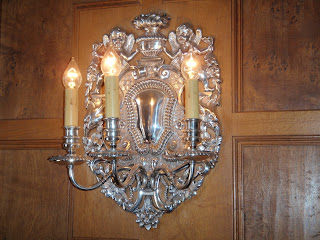
The formal dining room is made of hand-cut wood panels of rare English Pollard Oak. Marland received special permission from King George V to cut the trees from Sherwood Forest. The cast vaulted ceiling was built at bench level and then hoisted in place and attached to steel beams. The specially cast wall sconces are of Sheffield silver and copper.
We arrived at the Standing Bear Museum to find all the wires down and the broken electric poles in the parking lot. Sure enough, the museum was closed due to lack of electrical power.
From there we moved on to the Pioneer Woman Museum, and it was also closed and locked.
It was lunchtime and the girls were hungry, but none of the restaurants in the area had power. Then we learned that power was being restored a block or two at a time, and the work had started from the north end of town, so we moved north until we found a Pizza Hut with its doors open. They were short of staff, and were flooded with people, so there was no ordering from the menu. They were working to keep the buffet table stocked, and it was buffet or nothing. We had traveled 292 miles round-trip to take the girls on an outing, but thanks to the storm, our efforts were not going to plan. We had one more shot, so we headed for the Marland Mansion.


Friday, August 12, 2011
A Puddle!!! Really!!!

Credit: Google pictures
This shower was welcome, but was only symbolic unless we get a lot more rain to follow. The loss just in our local area has to run into the millions of dollars. We feel bad having lost hundreds of dollars in killed landscaping shrubs and our broken house foundation, but farmers cattle ranchers have faired much worse, as have many others. Ranchers have had to sell off most or all of their herds because there is not water for them, and no grass for them to graze on. One rancher we saw interviewed basically lost his life’s work when he had to auction off a herd of cattle that had taken him forty years to build. Bottom line? An extreme draught can cause a lot more problems than not being able to go paddling.
Friday, August 5, 2011
Water Wars

I’m sorry I haven’t had much (anything) going on the water lately. There isn’t any water around to speak of, and we continue to sit at ground zero directly under the heat dome. We’re breaking heat records every day.
I’ve poked fun at the Cimarron being called a river, because it is usually nothing more than a creek. It’s now just a trickle, but the bed does serve to bring a small amount of water down from Kansas and Colorado. There are deer tracks all around the banks, as it’s the only water to be found. We’ve been religious about putting water out twice a day in the birdbath and putting a misting hose on Jean’s pet birds outside each day as soon as the temperature tops 100. In the evening, when the temperature drops to 104, she turns the mist off and puts their food back in their cages so they have a chance to eat before it gets totally dark. Until now, the stream behind our house has never dried up, and it’s the only water around here for birds or wildlife. However, it went dry several weeks ago. We’ve had birds at the bath drinking, bathing, and just congregating and standing in the water. Even bees come to drink. Many of the things we usually see in the summer, like butterflies and hummingbirds, have just disappeared. The squirrels went to the birdbath a couple times, but then took a liking to the watering hose and irrigation system. So far they’ve chewed seven holes in the hoses, which I have to keep splicing. We even put a watering bowl and bath behind the air conditioner for them, but they continue chewing holes in the hoses a foot away. I spent one morning burying the hose, which they dug up the next morning and chomped another hole in. Here in a few minutes I’m going out to take the hose apart and run it through PVC pipe. We’ll see if that slows them down any.
Friday, July 29, 2011
River Access Rights

Credit: Steve Dunleavy
Tuesday, July 26, 2011
Polar Warming: Fact
Probably the greatest thing that distinguishes we humans from other species is not our opposing thumbs as much as our proclivity for arguing---about anything. It is this reason that has had me wrestling for several days over how to present this topic. This is not about politics, although many tend to make anything political. This is about nature and our planet---enjoying it and protecting it.
One of the topics most likely to get an argument going is global warming. Whether you want to blame the issue on political agenda, seasonal or cyclic fluctuation, a conspiracy, mere attempts to gain funding, apocalyptic hysterics, or whatever, with the accumulated evidence built over time, we have to appear insane to deny facts that are as obvious as the sun rising in the east. To find answers to the global warming issue, we need only go to the polar caps. The polar regions are to the earth what physical vital signs are to us and our overall health. For the truth, rather than rely on groups that visit the polar regions for a couple months and leave, or politicians who can gather information and statistics that can be selectively slanted to prove any given point of view, we need to seek out those that have observed polar trends in weather and nature for decades. They are the ones in the position to give the best unbiased report on conditions, trends, and apparent consequences. While scientists and politicians will still argue over the ultimate long-term consequences of global warming, like the sun rising in the east, the obvious facts should be---well, obvious.
In their Oct.,2010, issue, Cruising World printed an article by one of their favorite cruising and writing teams, Deborah Shapiro and Rolf Bjelke, of the 40-foot ketch Northern Light. The article, “Home, Sweet Home,” was about their return to a peninsula on Antarctica that had been home for an entire winter a decade before. Their observations on the changes that have occurred there, which are on-going, are clear, indisputable, and scary, and their words need to reach as wide an audience as possible. When I wrote Cruising World for permission to reprint just the last couple columns of the article, I made the point that I felt paddlers are probably even more closely tied to nature than sailors, and that you too would be interesting in this report. Cruising World sent my inquiry directly to Shapiro and Bjelke, who graciously consented to the reprint.


To give you an idea of their credentials, Deborah Shapiro and Rolf Bjelke have sailed Northern Light since 1976. They have done several circumnavigations, and have spent extended periods in high latitudes, both Arctic and Antarctic, covering 230,400 miles. Between 1982 and 84, they sailed to both the Arctic and Antarctic. In 1992 they wintered-over in Antarctica, and then in 1994-95, they wintered-over in the Arctic. Between 2000 and 2010 they completed two circumnavigations while again visitng numerous parts of Antarctica and the islands of the Southern Ocean. They have written several books, including Letters from the Sea, Northern Light, Time On Ice, and the latest, Pearls Around the White Continent, is nearing completion.
With their permission:
“On a windy, snowy, low-visibility day, we finally reach Hovgaard Island. Standing on a hill next to our winter-over anchorage, I turn 360-degrees to reacquaint myself with the magnificent alpine scenery. As the exhilaration of arrival wears off, it dawns on us how dramatically the landscape has changed. There’s a lot less snow and ice than when we left in 1992. And the snow line is much higher. “Look, Rolf,” I say pointing across the bare rocks. “That pool over there stayed frozen when we were here. And the area around it was always snow covered. We skied here year-round!”
“Rolf doesn’t answer me right away. He closes his eyes and shakes his head slowly in disbelief. Then he remarks softly, “Remember what an issue drinking water was for us? Well, no one needs to melt snow or ice any more?” I touch his arm, and we both turn our gaze to the melt water running in rivulets and streams down the rocks.”
“Neighboring Pleneau Island is also remarkably different. Its south side used to slant toward sea level, and the slant provided ice caves to examine and ice walls to climb. That face is now vertical. Our playground has evaporated, as have the snowcaps on the small adjacent islets. Two ice tongues that slanted away from the top and had provided ski access are now gone. These changes represent the loss of millions of cubic yards of snow.”
“After scouting around the island group, we realize that both animal and bird life have changed substantially. The gentoo-penguin population” (preferring ice-free areas and nesting on bare stone, grass or moss-covered areas) “has exploded. The rookery that covered a corner of the island now rings 50 percent of the coast. And due to less snow cover, gentoos now nest on rocky areas and at higher altitudes than before. In contrast, the cormorant colony has dwindled, and although the few remaining adult birds look healthy, their nests are of remarkably poor quality, compared with those we saw last time. And their chicks are in poor shape. No surprise, they beg and beg for food, yet remain unfed. And the biggest surprise: There’s moss growing on the islands’ northern slopes! It hits us that the Antarctic Peninsula has started to resemble the South Shetlands of 15 years ago.”
“Back then, when we wintered at Hovgaard, we sent observations to various scientists working at Palmer Station. When we now send an email to ecologist Bill Fraser describing the changes in bird populations, he replied that our observations parallel theirs and that, indeed the recent changes in the state of the peninsula are staggering. He sums them up: glaciers retreating, ice shelves disappearing, air and water temperatures up, krill biomass” (the foundation of the food chain) “down, Adelie penguin populations collapsing, cormorant and chin-strap penguin populations down, but gentoo penguin numbers increasing---up to 6,000 percent near Palmer Station. The conclusion? The entire ecosystem along the Antarctic Peninsula is being transformed---from a polar to a subpolar one.”
One of the topics most likely to get an argument going is global warming. Whether you want to blame the issue on political agenda, seasonal or cyclic fluctuation, a conspiracy, mere attempts to gain funding, apocalyptic hysterics, or whatever, with the accumulated evidence built over time, we have to appear insane to deny facts that are as obvious as the sun rising in the east. To find answers to the global warming issue, we need only go to the polar caps. The polar regions are to the earth what physical vital signs are to us and our overall health. For the truth, rather than rely on groups that visit the polar regions for a couple months and leave, or politicians who can gather information and statistics that can be selectively slanted to prove any given point of view, we need to seek out those that have observed polar trends in weather and nature for decades. They are the ones in the position to give the best unbiased report on conditions, trends, and apparent consequences. While scientists and politicians will still argue over the ultimate long-term consequences of global warming, like the sun rising in the east, the obvious facts should be---well, obvious.
In their Oct.,2010, issue, Cruising World printed an article by one of their favorite cruising and writing teams, Deborah Shapiro and Rolf Bjelke, of the 40-foot ketch Northern Light. The article, “Home, Sweet Home,” was about their return to a peninsula on Antarctica that had been home for an entire winter a decade before. Their observations on the changes that have occurred there, which are on-going, are clear, indisputable, and scary, and their words need to reach as wide an audience as possible. When I wrote Cruising World for permission to reprint just the last couple columns of the article, I made the point that I felt paddlers are probably even more closely tied to nature than sailors, and that you too would be interesting in this report. Cruising World sent my inquiry directly to Shapiro and Bjelke, who graciously consented to the reprint.

Rolf Bjelke

Deborah Shapiro
“On a windy, snowy, low-visibility day, we finally reach Hovgaard Island. Standing on a hill next to our winter-over anchorage, I turn 360-degrees to reacquaint myself with the magnificent alpine scenery. As the exhilaration of arrival wears off, it dawns on us how dramatically the landscape has changed. There’s a lot less snow and ice than when we left in 1992. And the snow line is much higher. “Look, Rolf,” I say pointing across the bare rocks. “That pool over there stayed frozen when we were here. And the area around it was always snow covered. We skied here year-round!”
“Rolf doesn’t answer me right away. He closes his eyes and shakes his head slowly in disbelief. Then he remarks softly, “Remember what an issue drinking water was for us? Well, no one needs to melt snow or ice any more?” I touch his arm, and we both turn our gaze to the melt water running in rivulets and streams down the rocks.”
“Neighboring Pleneau Island is also remarkably different. Its south side used to slant toward sea level, and the slant provided ice caves to examine and ice walls to climb. That face is now vertical. Our playground has evaporated, as have the snowcaps on the small adjacent islets. Two ice tongues that slanted away from the top and had provided ski access are now gone. These changes represent the loss of millions of cubic yards of snow.”
“After scouting around the island group, we realize that both animal and bird life have changed substantially. The gentoo-penguin population” (preferring ice-free areas and nesting on bare stone, grass or moss-covered areas) “has exploded. The rookery that covered a corner of the island now rings 50 percent of the coast. And due to less snow cover, gentoos now nest on rocky areas and at higher altitudes than before. In contrast, the cormorant colony has dwindled, and although the few remaining adult birds look healthy, their nests are of remarkably poor quality, compared with those we saw last time. And their chicks are in poor shape. No surprise, they beg and beg for food, yet remain unfed. And the biggest surprise: There’s moss growing on the islands’ northern slopes! It hits us that the Antarctic Peninsula has started to resemble the South Shetlands of 15 years ago.”
“Back then, when we wintered at Hovgaard, we sent observations to various scientists working at Palmer Station. When we now send an email to ecologist Bill Fraser describing the changes in bird populations, he replied that our observations parallel theirs and that, indeed the recent changes in the state of the peninsula are staggering. He sums them up: glaciers retreating, ice shelves disappearing, air and water temperatures up, krill biomass” (the foundation of the food chain) “down, Adelie penguin populations collapsing, cormorant and chin-strap penguin populations down, but gentoo penguin numbers increasing---up to 6,000 percent near Palmer Station. The conclusion? The entire ecosystem along the Antarctic Peninsula is being transformed---from a polar to a subpolar one.”
Monday, July 25, 2011
Josh Underway
Josh is doing a great job so far, and making friends all over the place. Note that I have added his blog (titled Paddle for Wells) to the Favorite Blogs link in the right margin, so you can access his blog directly from here. His fish count is zero, but he has posted some nice pictures that he's shot.
Subscribe to:
Posts (Atom)