Tuesday, January 17, 2012
On Knight's Key
Jim checked in today, Tuesday, January 17, at 2:14 pm EST at Knight's Key. This Key was an important supply port during construction of Henry Flagler's East Coast Railroad. It is about midway down the Florida Keys from Key Largo to Key West and gave Flagler's crews deep-water access to ships laden with building materials. The area suffered severe devastation from a hurricane on October 3, 1906, with many lives lost. Today, one can make a 2+ mile trip from Knight's Key out to Pigeon Key Terminus on foot, by bicycle or by tram. The group Jim is paddling with will spend a day of rest at this point before pushing off to cover the 7-mile open water stretch south to the Lower Keys. Bahia Honda Key will be their next stop. Whoops - after talking to Jim on the phone at 7:30 CST, I have to revise this. The group will be pushing off tomorrow for Bahia Honda where they'll take a one day rest before proceeding southwards. Jim says he expects they'll have to drag the vessels a bit in the morning due to low water. Two of the participants suffered falls on the limestone rocks getting ashore at Knight's Key today, and one of the other participants has chosen to be trucked south to Bahia Honda instead of taking part in the 7 mile open-water paddle tomorrow. The group will stop for lunch and a breather about half-way across. Someone visiting the group this evening said the paddling looked like good exercise. Jim said he commented that it had long passed the definition of exercise and could easily be classified as an endurance run. The entire group will be ready for a day of rest after tomorrow's paddle. Fortunately there is little wind being forecast for that area tomorrow, so hopefully their trip might be a bit easier for that. Don't know if I'd exchange the 15 degrees forecast for our area tonight for that paddle though! Best wishes to everyone. Go safely out there!


Key names
Names of the Florida Keys through which Jim is paddling evoke strong images: Conch, Hog, Knight's, Duck, Grassy, Fat Deer, Vaca (Spanish for cow), Ramrod, Knockemdown, Cudjoe, Sugarloaf, at al, including the romantic-sounding Islamorada. While that last name may be pleasing to the ear, it wasn't so easy on actor Gene Hackman last Friday. He was hit from behind by a pick-up truck while riding a bicycle on the Key. We're happy to report that his injuries weren't serious; he was briefly hospitalized with bumps and bruises. Crawl (Kraal) Key was named for the corrals or pens there which once held sea turtles destined for human consumption. There is now a sea turtle "hospital" in the area, one of very few in the U.S., with facilities and staff trained to rescue, rehabilitate and release injured sea turtles. The city of Marathon encompasses most of Knight's Key, Boot Key, Key Vaca, Fat Deer Key, Long Point Key, Crawl Key, Grassy Key, Hog Key and East and West Sisters Islands. Imagine being the city manager of such a municipality - with all it's coastal allure, literally miles out at sea. Satellite images of the area are surprising to this writer, with numerous homes and facilities in such a fragile, vulnerable place. Key Vaca, by the way, may have been named by or for the intrepid early Spanish explorer Alavar Nunez Cabeza de Vaca who had many incredible adventures beginning with a trip to Florida in the 1500's. An excellent biography of Cabeza de Vaca is available at: www.pbs.org/weta, on the people index. It makes for fascinating reading! Weather conditions for the group with which Jim is paddling call for easterly winds today of 15-20 knots. Following today's paddle, expected to be about 12 miles, the group will have a "lay day" to rest and recuperate before a 7-mile open-water paddle on the next leg. God-speed to all. Be safe out there!
Monday, January 16, 2012
Between Kraal and Fat Deer
Jim checked in at 1:56 EST after a trip of approximately 12 miles from Long Key. The group is spending the night at Curry Hammock State Park on Long Point Key. That key is situated between Kraal or Crawl Key and Fat Deer Key, and has a very nice camping place for the group. For one thing, there is more than one shower. At Coconut Grove Resort, the entire group had to wait in line for one available shower. Jim took advantage of the opportunity today to wash his clothes - while wearing them in the shower - before taking care of normal ablutions. :>) Don't you all wish you could do that??? Have to give this group a lot of credit. Included in the group is a 79-year-old woman who is paddling solo. Her daughter and son are also participants in the trip. They are from Vermont. Jim said one member of the over-all group opted out of the paddle today, choosing instead to be transported by truck to the day's end-point, after his experience with yesterday's weather and sea conditions. Jim was happy that today's weather, although the wind was at 25 knots, led to smaller waves. His knees, though, are really sore from having to brace against the sides of the boat in the seas. Happily, everyone in the group made it in safely today. Weather forecasted for tomorrow is supposed to give them some relief.
CAUTION!
Weather predicted for Long Key and the area the group will be paddling today is for NE winds at 15-20 knots, seas 2-3 feet, with nearshore waters being choppy. Small craft are advised to exercise caution. With some long open water stretches in the offing, a later than usual departure time, and an 11-mile paddle ahead of them, the group is facing some challenges. The later departure time was necessary because of low tide. An earlier, or more usual, send off would have made the group drag their laden vessels across grassy flats for a long distance. Not good for boats or paddlers! God-speed to all of them and may they stay safe!
Sunday, January 15, 2012
Long Key State Park
Today's paddle from the BSA camp at Craig Key (Lower Matecumbe Key?) to the state park on Long Key was only 6.9 miles but brought a few new experiences. Coming south to the bridge between the two keys, the seas were only 2 feet. Just southeast of the bridge the group experienced shoals that mandated getting out and walking their vessels. Jim "found" a sand-filled hole that seemed bottomless and immediately went in up to his mid-section. At least it was sand and not the mud he found in a similar situation last summer off the coast of lower Georgia! After the shoals the group experienced 3-4 foot waves with breaking white caps. One of the kayakers was flipped and lost a bit of gear. A Coast Guard Auxiliary boat was nearby and quickly helped him get upright and retrieve some of his belongings. At that point in the journey, the Tennessee reef goes out 4 miles from the Keys, and Jim estimated the waves offshore were running 10 feet. He said that Ibi was handling quite well except in one instance when the rudder was lifted out of the water, giving him little control. Ibi is a Superior Expedition, decked-over canoe, built by Scott Smith in Michigan, with great carrying capacity. Jim is quite enthusiastic about her handling characteristics, except he wishes he could make faster passages. Still, it's always best to be safe! Winds for tomorrow and Tuesday are forecast to be stronger and more easterly. Will have to wait to see if plans for the group will be changed, as there is a longer open-water course awaiting the group. Go safely out there!
20 years ago
As Jim makes passage toward today's end-point on Long Key, I'm watching his progress via the SPOT link and remembering a passage we made together twenty years ago. At that time we were sailing as representatives of the State of Delaware in the America 500 Quincentennary Rally, tracing Columbus' voyage of exploration to the new world. We sailed our 35-foot sloop to Spain, with stops in Bermuda and the Azores along the way in 1991. We then spent several months in Spain. Following visits to many of the sites where Columbus had lived or visited, we then traced his route to a tiny island in the Bahamas, through Madeira, and the Canary Islands. Along the way we met sailors from all over the world, including some from Finland with whom we still keep in touch. It was an incredible experience and it's hard to believe that our voyage was 20 years ago. The entire trip took over a year, and we sailed over 10,000 blue-water miles. Our navigational devices were certainly much more advanced than those which had been available to Columbus. While on blue water crossings Jim does insist on the time-honored practice of taking celestial sights with his sextant and working out the boat's position manually. We also had a sat-nav on that trip and a good chronometer (a Casio watch!). Still, it was always necessary to be vigilant - to avoid shipping, partially submerged containers, etc.. Also, in some areas, electronic navigational devices are notoriously lacking in accuracy. Today, with Jim in a canoe which is infinitesimally smaller than any previous boat in which he's gone to sea, I'm able to sit in comfort at home and watch his progress in great detail, thanks to a satellite a thousand miles up in space. Jim carries a GPS and the SPOT device with him which gives me much comfort, but as always he also relies on charts, visual line of sight and common sense as well. He's one dedicated person, seemingly with salt water in his bones, in one small boat, out on the briney, doing his thing, and seemingly having a ball. Cheers from land-locked western Oklahoma to all who enjoy being on the water.
Saturday, January 14, 2012
Jimmy Buffet Land
Jim checked in at 1:40 pm today after a paddle of over 12 miles; beginning his run from Windley Key at 7:50 am. The group was "treated" to 20-25 knot westerly winds, and 1-3 foot running seas. Most of the trip was in the lee of land. However, the last mile or so of today's trip was all "uphill," after crossing westward under a bridge and heading back north to the camp site. The group of 68 paddlers stopped for lunch at Indian Key, a very small island, which used to hold a community of shipwrights and carpenters (with possibly some wreckers thrown in the mix). Jim said he had no trouble at all getting to sleep last night, after an 18-mile paddle, despite Jimmy Buffet music blaring from loudspeakers at the resort and palm fronds thrashing about overhead in heavy winds. Tonight's camp will hopefully be a bit quieter, in a Boy Scouts of America base camp at the south end of Craig Key. Tomorrow's paddle with provide somewhat of a challenge, being in open water for over two miles without a land barrier to block the wind. Jim says he's just taking it one day at a time, trying to at least stay in sight of the faster group of paddlers making up part of the contingent. Tomorrow's destination is the south end of Long Key. A piece of inspiritational writing dear to Jim is the following:
Some years ago when I had little or no money, I thought I would sail about and see the oceans of the world.
Whenever I get grim or springfull; whenever I feel like knocking peoples hats off and escaping; whenever it's a dank, drizzly November in my soul, then I know it's time to get to sea again.
Choose any path you please, and ten-to-one it carries you down to water. There's a magic in water that draws all men away from the land, leads them over the hills, down creeks, and streams, and rivers to the sea.
The sea, where each man, as in a mirror, finds himself. Ishmael
To each of you, enjoy the journey!
Some years ago when I had little or no money, I thought I would sail about and see the oceans of the world.
Whenever I get grim or springfull; whenever I feel like knocking peoples hats off and escaping; whenever it's a dank, drizzly November in my soul, then I know it's time to get to sea again.
Choose any path you please, and ten-to-one it carries you down to water. There's a magic in water that draws all men away from the land, leads them over the hills, down creeks, and streams, and rivers to the sea.
The sea, where each man, as in a mirror, finds himself. Ishmael
To each of you, enjoy the journey!
Islamorada
The group will be pushing off early today, Saturday, January 14, from Coconut Grove Resort on Windley Key. All of Windley Key is within the municipal limits of the community of Islamorada. Prior to construction of Henry Flagler's East Coast Railroad down through the keys in the early 1900s, Windley Key was actually two small islands, known as Umbrella Keys. The two islands were filled in during construction of the railroad and the name was changed to Windley Key after a settler. Several extensive stone quarries were worked on the key, yielding fossilized coral in the form of Key Largo limestone. The limestone was used in construction of the rail bed, and in later years to make ornamental features for buildings. The quarries were worked until the 1960s. Jim will write more on this history later. Being a susperstitious sailor of long standing, I'm thankful that the trip yesterday was a safe one. It's believed by most sailors that no voyage should begin on a Friday, and certainly not on Friday the 13th! :>) :>) Hope today is a good day for all.
Friday, January 13, 2012
Update on first day
Just got a phone call from Jim at Coconut Grove Resort, Windley Key. He's paddling the only canoe in a group of 68 vessels. All the other paddlers are in kayaks, including a 20-foot tandem British-made kayak paddled by a husband and wife team. Sixteen paddlers from Michigan are also in the group. Jim said it's hard to keep up with the group, as kayaks are built more for speed than are canoes. He also said he doesn't envy the group organizers, as "herding" paddlers seems to be akin to herding cats. Does paddling a kayak make one independent thinking or do only independent thinkers paddle kayaks????? :>) Jim had a bare 5 minutes to down his lunch before getting back underway shortly after noon, and he got in at Coconut Grove shortly before the offshore tide level gave way to bare grass. The distance covered was 18,9 miles, which Jim paddled in 6 hours, 5 minutes. Not bad Jim!!! Hope his next door tent neighbor doesn't mistake the full moon for the sun and start noisily breaking camp at 4:30 am tomorrow as he did last night. I think everyone in the group deserves a good night's rest after a long day. He's enjoying the group adventure and looking forward to a more leisurely 12-mile paddle tomorrow. God speed!
John Pennekamp Coral Reef State Park
This Florida State Park, at mile marker 102.5 on the Overseas Highway (US1), is located on Key Largo. It offers opportunities to explore mangrove swamps and tropical hammocks as well as a coral reef. There is a 30,000 gallon saltwater aquarium. Glass bottom boat tours and snorkeling trips to the reef provide lots of opportunities to view sea life in-situ. Additionally, there are two man-made beaches for swimming and snorkeling. About 100 feet offshore of one of these are some remnants of an early Spanish shipwreck, easily viewed by snorkelers. An interesting place!
Checked in
Jim checked in via the SPOT at 2:48 EST at a point just south of the Windley Key Fossil Reef Geological State Park. He's approximately 18 miles from today's start at Pennekamp Coral State Park on Key Largo. I'm sure everyone will be ready for some rest after an 18-mile open water paddle. R&R (not the Navy version) are sure to be in order!
Underway
Aanyone wishing to follow Jim's paddle progress can check out the link to the right: Follow Ibi's SPOT Track. This neat application gives real time positions updated approximately every 10 minutes and can be viewed as a map with street names, as a satellite view (really cool) or as a hybrid map. Will make postings as Jim is able to check in, understanding he's concerned about saving cell phone batteries since the group will be tent camping. He does carry extra batteries for the SPOT unit.
Thursday, January 12, 2012
miles to go
Jim checked in yesterday for this newest adventure. He was 1952.7 miles from home when he called. Anyone who knows him will not find that precise measurement surprising. At the moment he's on a bus, headed back to Key Largo to the Pennecamp Coral State Park where the group will begin their 110-mile paddle south to Key West. The entire group checked in yesterday and spent the night about one mile north of Key Largo at a lodging house. A skipper's meeting is scheduled for this evening. Jim said there are various rumors about the weather they are expected to experience, but he's relying on official weather forecasts. After years of blue water sailing he's sure to keep a good eye on the weather. The group is to break camp at first light tomorrow and be ready to push off at 7AM. The first leg is going to be a challenge for everyone - 18 miles of open salt water paddling. Good luck and God speed to all!
Wednesday, January 11, 2012
Rolling to the Keys
Jim sends a happy high-five as he sets out today driving to the southern terminus of his trip in the Florida Keys. He enjoyed an 8-mile paddle in the Peace River yesterday, with flat waters and calm wind. He's now looking forward to exploring the Keys with about 70 other paddlers. Participants in this seven day open water paddle will be leaving their vehicles at the southern end of the trip and be shuttled back to the northern entry point. Jim said he'll be thinking about the 7-mile bridge in the Keys as he drives over it, wondering what it will be like to paddle back underneath it. Together the two of us have driven over and sailed under many bridges, here and abroad, but never this particular bridge. Fair winds and gentle seas are my wish for everyone participating in this waterborne exploration of the Keys. Go safely!
Tuesday, January 10, 2012
Salt water paddling today
Jim is paddling the Peace River near Punta Gorda today. You can follow him along via Follow Ibi's SPOT Track link on the right side of the blog. He was enjoying near 90-degree weather there yesterday, poolside, with a couple of friends. Must be nice. The birds and I were shivering in 40 degrees of cloudy overcast here in NW Oklahoma. We're keeping the home fires burning!
Monday, January 9, 2012
Jim made the road trip from St. Johns County down to Punta Gorda today and is staying for two days there with friends who moved down from Delaware. He'll be out paddling on the Peace River tomorrow. You can keep up with his travels via Follow Ibi's SPOT Track link on the right side of the blog. Jim said he's getting some good photographs as he goes along and will share them with everyone on the blog when he returns home. Have a happy everyone!
Sunday, January 8, 2012
On The Road - 1
I left NW Oklahoma for the first leg to visit a couple of our friends in North Florida. The first day was 12.5 hours at the wheel for 655.8 miles. The night was spent at a motel in Vicksburg.
On day 2, I completed the trip from Vicksburg to North Florida, and another 13 hours at the wheel for 670.8 miles. I had hoped to make the legs roughly equal, but was surprised to see there was only 14 miles difference between the two. I encountered a lot of fog, first near Hattiesburg, MS, and then crossing Mobile Bay, AL. I was surprised to find the fog inland was actually denser than on the bay.
Saturday, the 7th, was an R&R day. In the afternoon, we drove to St. Augustine and stopped at Carmelo's for pizza. For those who know St. Augustine, the old Florida Railroad administration offices are now dormitories for Flagler College. Carmelo's is right across the street. Imagine that, a pizza parlor and grill across from the dorm complex! Location, location, location. We got two huge 20" pizzas with the idea of keeping the leftovers for dinner. They were so big, that by evening, we were still too full to eat more. The next day when I paddled the St. Johns River, I took a couple of those immense slices for lunch. Keeping the boat stable is one thing. Balancing a big slab of pizza on one's leg while paddling, so the saucy slice doesn't slip off into the bilge water, requires a somewhat different skill set, and more attention.
On day 2, I completed the trip from Vicksburg to North Florida, and another 13 hours at the wheel for 670.8 miles. I had hoped to make the legs roughly equal, but was surprised to see there was only 14 miles difference between the two. I encountered a lot of fog, first near Hattiesburg, MS, and then crossing Mobile Bay, AL. I was surprised to find the fog inland was actually denser than on the bay.
Saturday, the 7th, was an R&R day. In the afternoon, we drove to St. Augustine and stopped at Carmelo's for pizza. For those who know St. Augustine, the old Florida Railroad administration offices are now dormitories for Flagler College. Carmelo's is right across the street. Imagine that, a pizza parlor and grill across from the dorm complex! Location, location, location. We got two huge 20" pizzas with the idea of keeping the leftovers for dinner. They were so big, that by evening, we were still too full to eat more. The next day when I paddled the St. Johns River, I took a couple of those immense slices for lunch. Keeping the boat stable is one thing. Balancing a big slab of pizza on one's leg while paddling, so the saucy slice doesn't slip off into the bilge water, requires a somewhat different skill set, and more attention.
St. Johns Jog
Follow Jim's SPOT location today - on the St. Johns River for the day. Alligators? Waterfowl? Nostalgia? Check it out via the link on the right-hand side of the blog site, Follow Ibi's SPOT track.
Thursday, January 5, 2012
On the Road Again
Finally out the door and enroute to Key Largo for the Florida Keys Challenge. Again, you can follow on SPOT if you wish, by clicking the link in the right margin. Jean may put a few short updates on the blog, and when I return, I'll have the full account and pictures. Cheers, jim
Wednesday, January 4, 2012
Great Salt Plains

Great Salt Plains and Lake
The water level in the lake has just gotten back up to its normal conservation level. Like most lakes in the state, to varying degress, it was mostly dry all summer. The added brownish picture in the upper left of the aerial photo was taken later in the day, it appears. The whole area should be salt white. The area has a very gradual gradient, making the lake cross section about like a cedar shake---long and thin. The water is so shallow, I would guess you could wade three-fourths of the lake. There are, however a couple upsides. The lake is on a major waterfowl and bird migratory route. Over 300 species of bird life are reportedly found here. Half of the lake, the shallowest area, is closed to any watercraft most of the winter to provide a quiet resting and feeding area for waterfowl. The salt plain is so large I understand it is visible from space, and it provides one of only two spots on earth where unique selenite crystals can be found. Digging for these is a popular pass time, and many people have sought these treasures in the salt plain. Unfortunately, a group of Boy Scouts dug up a bomb. Then someone remembered the area used to be used as a bombing range. It was closed for about a year until the area was scanned and ruled safe.


While I went to the lake to get some paddling exercise, Jean finished a baby quilt called a sheep and rail fence pattern. The border is a cable pattern. It is a beautiful job that the picture unfortunately doesn’t do justice to.
As for the lake, I managed another ten miles in light air, and bright sunshine.
Tuesday, January 3, 2012
Insomnia

Abby
If you have periodic trouble sleeping, I found Melatonin to work wonders. I was introduced to it on ship. It is a natural extract, so you’re not pumping strange chemicals through your system, is non-prescription, and of importance to us on board ship, it causes no problem with the Coast Guard. The greatest thing I liked is it worked without causing a stupor or adversely affecting performance. Part of this may be because the directions call for two tablets, and we always only used one, and it still worked. I could sleep soundly, but still rouse immediately if an alarm went off or someone was knocking at the cabin door, and then get up and perform normally. There is the usual liability warning on the label about operating machinery, but I never experienced a problem with myself or anyone else using it. Like any sleep aide, it is for limited use and not to be combined with any other medication.
Monday, January 2, 2012
Back on the Canadian

One of the more interesting sluice-gates I think I've seen.
Controlling the Canadian River's water level
in the Stinchcomb Wildlife Refuge.

There was good water level in the lower reaches of the river,
but you could see where it had dropped about 3 ft. since the last heavy rain.

By the time we were about 4 miles up the river, the sand banks and
log jams got much larger and the water much shallower.
Sunday, January 1, 2012
Canadian River/Stinchcomb

Historic Route 66 Bridge over Canadian River

Canada Geese on the Canadian
This trip was on the Canadian River at the Stinchcomb Wildlife Refuge. This is located in Yukon, a suburb on the west side of Oklahoma City. I went all the way up the river until I was paddling as much sand as water, searched three branches off the river into the wetlands areas, and came about at 2pm. I saw a lot of herons, but they were so skittish I wasn’t able to get close enough for a photo. A few geese and mallards were more attainable after several attempts.


I also didn’t see any beaver, but certainly saw their work with several trees taken down, and dozens girdled. In all, I was on the water five hours and managed 11.1 miles.
Saturday, December 31, 2011
The Last Word of 2011

Oklahoma Sunset.
Taken on the way back from Kaw Lake Thursday.
Today was supposed to be a paddling day, but a frontal passage is scheduled for around noon, which will transform the wind from breezy to screaming. From 1 pm on we should have winds up to 45-50 mph., making it not worth the two hours drive to the nearest water. I’m trying to work the shoulders a bit for the Florida Keys Challenge. In lieu of paddling, I’ll spend as much time as possible today on the Total Gym.
Best wishes to all, jim
Friday, December 30, 2011
Canu Canoe?

I appreciate any gift I receive, but I got a sweatshirt last Christmas with a pattern that I wasn't a great fan of. It sat in my office for a year, unworn, while I tried to decide how best to handle the dilemma. I didn't want to hurt the giver's feelings, but I couldn't see myself wearing it. So now a Christmas later, I decided to alter it a bit. All I needed was to make up a design and borrow some of my wife's acrylic paints. And here you have it...a canoehead sweat shirt, a paddling promotion, and all in a couple of my favorite colors. Win--win--win.
Wednesday, December 28, 2011
A Paddler's Special Card

This was really special, and I think you'll enjoy it as well. My wife did a handmade Christmas card for me that I know took several days. This is all hand drawn and painted. The orb the mermaid is reclining against is an iris pattern made of four different foils that are cut in 32 pieces and laid in a swirling pattern that is quite intricate. Then she wrote a poem that I think we can all relate to, but which I thought was very special.
He must come back a better man
Beneath the summer bronze and tan,
Who turns his back on city strife
To neighbor with the trees;
He must be stronger for the fight
And see with clearer eye the right,
Who fares beneath the open sky
And welcomes every breeze.
The man who loves all living things
Enough to go where Nature flings
Her glories everywhere about,
And dwells with them awhile.
Must be, when he comes back once more,
A little better than before,
A little surer of his faith
And readier to smile.
He never can be wholly bad
Who seeks the sunshine and is glad
To hear a songbird's melody
Or wade a laughing stream;
Nor worse than when he went away
Will he return at close of day
Who's chummed with happy birds and trees
And taken time to dream.
Tuesday, December 27, 2011
On The Run

Credit: Google
On The Run: An Angler’s Journey Down the Striper Coast
By David DiBenedetto (235pp., Pub. By William Morrow of Harper-Collins Publishers, NY,2003)
I’m not a fisherman. I worked on fishing boats for several years, served as mate, even ran as relief skipper, but working fourteen fishing trips a week doesn’t make one a fisherman any more than driving a car 10,000 miles a year makes one a mechanic. So I even asked myself why I was reading a fishing book. In the end, if I was reading it as a fisherman, I would probably have taken slightly more pleasure from it, but only by a small degree. After all, it’s the water that ties us all together---fisherman, cruiser, sailor, paddler. We all respond in the same way to the wind and waves, the sound of rushing, cascading water, the distinct scent in the air, the soft, pastel sunrises and sometimes gaudy splashes of color in the evening twilight over a broad uninterrupted horizon. There was plenty to identify with and find pleasure in even for a non-fisherman.
The author started in the Bay of Fundy between Maine and Nova Scotia. For three months he followed the fall migration of the striped bass or rockfish as it traveled south to the Outer Banks of North Carolina. Part of the story was about the fish, its life, trials for survival, and what makes it unique in its lure for fisherman. The rest of the story was about the fishermen themselves and how they travel thousands of miles, go weeks on end with virtually no sleep, and risk life and limb to pursue a fish that more and more have learned to respect enough that they merely hook and release most of the fish.
Talk to any fisherman, and sooner rather than later the tale will be about the BIG ONE. Well, as of 2003, the big one was 78 lbs. 8 oz. Between sweepstakes winnings and tackle manufacturer endorsements, the fish made it into the Guinness Book of World Records as the world’s most valuable game fish at $3,200 a pound. You would think such a prize would make the fisherman a folk hero. Instead it brought him more ill will, personal attacks, and squabbles over money than he could have ever imagined, and nearly ruined his life. When asked how he would handle it if he caught another one like it or bigger, he said he’d pull it up far enough to take its picture, and cut the line.
Whether you are an avid fisherman, or don’t even like the taste of fish, if you enjoy the water and being around it, you’ll enjoy this book.
Sunday, December 25, 2011
Merry Christmas

From our family to yours, best wishes for a safe, enjoyable, and wonderful Christmas. This is one of our favorite tree ornaments, and one of the first shots with the new camera.
Saturday, December 24, 2011
Gift of Camp Chow

If I don't do anything else for awhile, I'll be doing some fine dining. My wife got me 25 freeze-dried meals from Mountain House and Alpine Aire Foods. Included were granola with milk and blueberries, turkey, chicken, blueberry pancakes, potatoes with cheddar and chives, shrimp alfredo with sundried tomato, and chicken gumbo. That's some fantastic chow!
By the way, I should add that if you've never used the prepared freeze-dried meals before, note that the pouch says it contains two servings. Not! Unless you are a very finicky eater, half a pouch won't do it, especially with the caloric output of paddling.
Friday, December 23, 2011
Florida Keys Challenge

I borrowed this picture from the PaddleFlorida.org site, but when I get back, I should have plenty of my own to share with you. Plans are being completed for the Paddle Florida Keys Challenge. This is a 115-mile paddle along the length of the Florida Keys between January 12-22. There will be camping on a different key each evening with entertainment and a hot meal. If you'd like to see an overview of the trip, there is one available at http://www.paddleflorida.org/keys12/keys.htm. I thank Gus Bianchi for bringing the trip to my attention, and this will give me a chance to do a face-to-face with someone I've been corresponding and "Facebooking" with.
Monday, December 19, 2011
From A Wooden Canoe

Credit: eBay books
From A Wooden Canoe: Reflections on Canoeing, Camping, and Classic Equipment
By Jerry Dennis, Illus. by Glenn Wolff. (204pp, St. Martin’s Press, New York, 1999)
Saturday, December 17, 2011

Thursday, December 15, 2011
Great Bear Rainforest

Credit: Ecosummer Expeditions
This 44 min. video is a must see. It presents some of the most beautiful photography from British Columbia, and includes the Great White Bear, not an albino, but a white Black Bear. The work was done by the International League of Conservation Photographers. The film brings a message, but some wonderful wildlife. Be sure to play full screen for the greatest enjoyment.
http://vimeo.com/19582018
The Long Road Back

Now I know everyone under age 60 will be going, “Oh, what rubbish.” All I know is, it is what it is, and I am willing to try anything to get back to where I need to be. I’ve been sick for the last two MONTHS, if that answers why I’ve been able to do so much reading. I’ve been too sick to do anything else. I started with a cold. After a week it turned to sinusitis. A week later, that turned to a viral infection. A week later I started feeling much better and needed to escape from the house. That’s when I made the run at trying to make an Arkansas River trip with Scott Richard. Crash and burn! The one night sleeping out in the cold knocked me right back on my heels and started the whole cycle all over again. I just can’t bounce back like I used to. I can no longer just tough it out, so I decided to make a more gradual recovery through conditioning. If I had made some outdoor trips during the fall, I would have been fine, but I missed the whole season change. People wonder why wild birds that don’t migrate are able to tolerate such extreme conditions during the winter. According to an avian veterinarian, it’s not the temperature or weather as much as sudden changes that do them in. If they have a couple months to acclimate along with the gradual change of the seasons, they can tolerate much greater extremes. I missed that whole conditioning period. Keep putting the food out for the birds, however. Temperature tolerance doesn’t mean they don’t still have problems finding food when everything is dead or covered with ice and snow.
Jean says I’m crazy, but I’m trying to condition myself gradually in much the same way they do. Feeling well once again, I’ve started sleeping every other night in our unheated garage. After a few nights there, I’ll move to the tent. I have a couple trips I’d like to take in the not too distant future that will be impossible if I can’t tolerate being outdoors in cold or bad weather. Besides outdoor acclimation, it gives me the advantage of being able to experiment more with alternative sleeping arrangements with bags, base layers, pillows, etc. Yup, I’m at that age when I can’t survive without a good pillow. Most agree that you can survive almost anything if you can still get quality sleep.
It also just offers the opportunity of being just a few feet closer to nature. Three nights ago a huge owl moved tree to tree as it serenaded me through the night. Last night the noise of a light rain made me enjoy sliding a bit deeper in the bag as I was lulled to sleep. Crazy or not, it’s still nice to get out of the artificial environment of the house.
Monday, December 12, 2011
Great Heart is Five Stars

Illus. Credit: All About Canoes
There are two chapter titles that really describe this book’s story. The prologue is “The Last Blank Spot on the Map of North America,” and Chapter 11 is “Up Against It For Sure.”
It was 1903, and while a few trappers and Native Americans had tried to trap bits of the interior, Labrador’s interior was mostly unknown. If you could find an Indian to draw you a map, what was available just represented dotted lines giving vague ideas of a couple lakes and rivers. Leonidas Hubbard, Dillon Wallace, and George Elson endeavored to make a trip through Northeastern Labrador from Rigolet to George River Post at Ungava Bay. “Up Against It For Sure” is the best way to describe the entire trip. Their first real goal was Michikamau Lake, but they were suffering from starvation by the time they reached the lake, and the decision was made to turn back as heavy snow and temperatures fell. Before it was over they had eaten some unimaginable stuff to stay alive. They put one spoonful of flour in a pan of water to make soup for three. They found a caribou skeleton and boiled the maggot covered hooves in water to make soup and cut the desiccated hide into strips and boiled it until they could chew it. They staggered and fell while trying to portage, forded streams in ice water as chunks of ice tried to knock them off their feet. If you want to know how far the human body can go, here’s a story that’s hard to put down. It’s probably one of the most human stories I’ve ever read. Hubbard didn’t make it back. Wallace later returned to bring his body out by sled and transport it to Haverstraw, NY, where he was laid to rest on the west bank of the Hudson River.
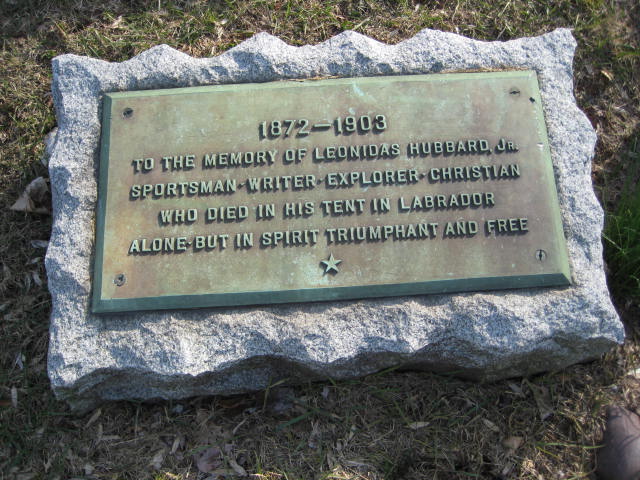
Photo by Cindy (?) Click to enlarge.
Mina, his wife, returned to Labrador and made the trip Leon had planned, later writing a book and going on the lecture tour. She later moved to England and married, but had Leon disinterred and moved to England to be near her, while placing a bronze plaque at his grave site. Wallace also returned to make the trip that had failed. He later became involved with youth, wrote 26 adventure books aimed at young readers, and was instrumental in the establishment of the Boy Scouts of America. You really need to read this book if you like to canoe and camp in the wilderness.
Thursday, December 8, 2011
National Paddlers' List
http://www.kayakandcanoeguidebooks.com/kayakclubs.htm
Janice Green posted this on facebook, and I thought you might like to retain it as a permanent resource. It is a national listing of paddling clubs by state. Paddling.net has a club list under 'community', but unless the city or state name is part of the club's name, there's no way to ascertain its location without doing an internet search on each one, so this is a nice improvement. This is especially important if you're traveling and want to hook up with some paddlers in an area you are visiting or traveling through. Our thanks to Janice for this.
Janice Green posted this on facebook, and I thought you might like to retain it as a permanent resource. It is a national listing of paddling clubs by state. Paddling.net has a club list under 'community', but unless the city or state name is part of the club's name, there's no way to ascertain its location without doing an internet search on each one, so this is a nice improvement. This is especially important if you're traveling and want to hook up with some paddlers in an area you are visiting or traveling through. Our thanks to Janice for this.
Tuesday, December 6, 2011
Alaska Paddle
The first address I put up wasn't a direct link. This one should be.
http://www.youtube.com/watch?v=8dDAGu96BAw
This is a long video (2 hrs. 37 min.) of an Alaska trip from Vancouver north. The audio is not always great, but it's a wonderful account and fantastic scenery. Enjoy!
http://www.youtube.com/watch?v=8dDAGu96BAw
This is a long video (2 hrs. 37 min.) of an Alaska trip from Vancouver north. The audio is not always great, but it's a wonderful account and fantastic scenery. Enjoy!
Sunday, December 4, 2011
Nahanni Journals

Illustration courtesy Michigan State University
In his forward, Justin Trudeau writes, “In this rapidly urbanizing civilization, we have lost our balance. Our current environmental crisis stems from the fact that we act as if we are not a part of the world, but somehow outside of it. …Our food comes from supermarkets, our water from taps, and our electricity from power lines. As our weather grows more extreme, we watch from within our comfortable climate-controlled homes and shake our heads, and promise ourselves that we’ll definitely make an effort to try to recycle a little bit more.” And that’s our tie to nature. A plastic world, in which we live a plastic life, and hope we can become closer to nature by recycling more plastic.
Patterson’s journal writing satisfied two needs. As an educated man he simply took pleasure in words, whether reading the books he carried or being able to share his experiences through his narrative. The journals also helped guard him from loneliness. He knew his story would eventually be shared with his mother and his fiancée. The writing made him feel he was speaking directly to them. Those familiar with Bill Mason’s Waterwalker will immediately recognize this dichotomy. They both enjoyed the adventure, the absence of constraint, the lack of any schedule or deadline, the sense of being on one’s own and one with nature rather than a mere spectator of it, but they were alone. To stave off loneliness, they both needed to feel they were sharing their experience with those they cared for. Whether on a flat rock ledge next to the moving water or next to a fire as the sun set, they dedicated time to trying to keep their loved-ones close to them by creating something they could take back and share---Mason by his film and painting, and Patterson by his written description of his day’s struggles and experiences. A third justification for the journals was their use in later writing The Dangerous River. There are some differences between the journal account and that in the book. The book is a more readable and polished narrative, but the journals are more honest.
Friday, December 2, 2011
A Picture's Worth a Thousand Words
A blog is of little value without good illustrations to accompany the stories, so I needed a camera. Paddling brings you into some beautiful, but also some very tough and demanding environments---water, sand, mud, and the likelihood of getting dropped or knocked about among your other gear. Paddling.net has good recommendations on a number of different types of cameras. Not all are intended to survive going swimming with you, but that is an important consideration in a canoe or kayak. I initially decided on the Olympus Stylus 1030-SW. It is waterproof, dustproof, shockproof, freezeproof, and lifeproof. They even had a video of the camera being driven over by the wheels a truck, and then using it to take pictures.

It is 10.1 mega pixels, auto or manual operation, outstanding macro capability, zoom lens, through the lens exposure compensation, and a long list of other capabilities. For a camera that is waterproof, and small enough to slip in the pocket of your PFD and thus always at the ready, it’s hard to beat. I’ve used it a couple years now, and find no fault with its abilities, except on one count. It is not intended to compete with a long-lens camera, and therefore leaves you without the ability to capture most wildlife.
I’ve had a few people compliment some of my pictures and encourage me to expand my capability. They’re undoubtedly being most gracious, but I’ve taken the encouragement to heart. The next problem would be the most appropriate selection of gear to meet my needs. I’d lose the waterproof advantage, but wanted to gain the advantages of SLR (single lens reflex) ability to format, focus, and meter directly through the lens. For the most part, what you see is what you get, in other words. I lacked the expertise to know what camera and lens would give me good wildlife capability, especially while taking pictures from the uncertain platform of a canoe. While searching links at Paddling.net, I found John Van Den Brandt, of Wild Wind Images.
He’s a professional photographer, and one of his specialties is wildlife photography from a canoe. I didn’t know if he would take the time to entertain my inquiry, but he was both cordial and supportive. He recommended a Canon 60D or a Canon Rebel, with a 300-mm F4 IS (image stabilization) down to a lens of 220-mm. with IS. He also recommended B&H Photo as a very reliable outlet that is used by many professionals. I wanted to add zoom capability, so I got the Canon EOS 60D digital SLR with a Sigma 18-250-mm IS (Sigma calls it OS for object stabilization) with auto-focus ability. Then comes the next challenge. I don’t remember his exact words, but Mr. Van Den Brandt pointed out ‘it’s not the wand that makes the magic, but how the magician wields the wand.’ So, I have some work to do. I thank him sincerely for his guidance, and offer it here for anyone else that may benefit from it.

I’d also like to recommend you check John Van Den Brandt’s website, Wild Wind Images. You’ll enjoy the outstanding pictures, and they’re available for purchase. He also has a 2012 calendar available with some wonderful images that would make great Christmas presents. If you enjoy wildlife photography, go to http://www.wildwindimages.com/
For B&H, check http://www.bhphotovideo.com/

It is 10.1 mega pixels, auto or manual operation, outstanding macro capability, zoom lens, through the lens exposure compensation, and a long list of other capabilities. For a camera that is waterproof, and small enough to slip in the pocket of your PFD and thus always at the ready, it’s hard to beat. I’ve used it a couple years now, and find no fault with its abilities, except on one count. It is not intended to compete with a long-lens camera, and therefore leaves you without the ability to capture most wildlife.
I’ve had a few people compliment some of my pictures and encourage me to expand my capability. They’re undoubtedly being most gracious, but I’ve taken the encouragement to heart. The next problem would be the most appropriate selection of gear to meet my needs. I’d lose the waterproof advantage, but wanted to gain the advantages of SLR (single lens reflex) ability to format, focus, and meter directly through the lens. For the most part, what you see is what you get, in other words. I lacked the expertise to know what camera and lens would give me good wildlife capability, especially while taking pictures from the uncertain platform of a canoe. While searching links at Paddling.net, I found John Van Den Brandt, of Wild Wind Images.

I’d also like to recommend you check John Van Den Brandt’s website, Wild Wind Images. You’ll enjoy the outstanding pictures, and they’re available for purchase. He also has a 2012 calendar available with some wonderful images that would make great Christmas presents. If you enjoy wildlife photography, go to http://www.wildwindimages.com/
For B&H, check http://www.bhphotovideo.com/
Thursday, December 1, 2011
Welcome Aboard Port Canaveral

1,436 miles from Port Canaveral!
Wednesday, November 30, 2011
"Nothin' says lovin'...."

…Like somethin’ from the oven.” Boy, you should have smelled these when they were baking. Two scratch loaves of bread, one banana nut and one orange peel, just came from the oven. We immediately grabbed a steaming cup of coffee and sampled the banana nut. Goooood! While at the local grocery for flour, Jean found a box of Tortuga Caribbean Rum Cake. A taste of the islands. What could be better?…but wait. Reading the label can be a good habit, or not. The Tortuga Rum Cake comes from Grand Cayman, British West Indies, or A LICENSED MANUFACTURER. So sadly the closest this cake may have come to the Caribbean may have been St. Louis, or China. Well, we know where the homemade bread came from.
Tuesday, November 29, 2011
Spray Skirt Maintenance
I’ve heard some refer to my expedition canoe as a canak. Like a kayak, it is decked with a cockpit, even though the cockpit is 90-inches long. It also uses a spray skirt for rain or rough water protection. The skirt fully encloses the cockpit, running around and under the high cockpit coaming. Aluminum arches elevate the skirt to cover gear and also to insure the water runs off rather than puddling in the skirt. A sleeve with a Velcro closure is all the way forward to receive a sail mast, and a long heavy zipper runs almost from the mast sleeve to the waist opening to facilitate getting in and out of the boat, or for access to binoculars, camera, or lunch lying in the boat.
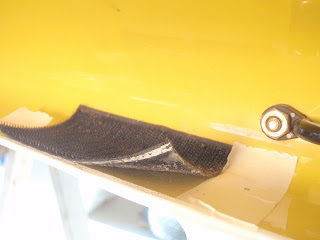 When putting the skirt on, it is run around the cockpit and is held in place with self-adhesive Velcro pads under the lip of the coaming until the elastic cinch cord pulls the skirt tightly around the cockpit. These Velcro pads required a bit of maintenance after water, dirt, and sand gradually ruined the adhesive and lifted the edges. After cleaning around the pads and outlining them with masking tape to keep glue from getting smeared everywhere, I used Weldwood contact cement for the repair. The problem is the directions require that both surfaces being bonded are 65-deg. or more for 24-hrs. before the repair and 72-hrs. after. That obviously isn’t going to happen until next April, so I’ve tried to make up for the temperature deficit by allowing more time for drying. We’ll have to see how that works. Anyhow, this is what it looks like when in place.
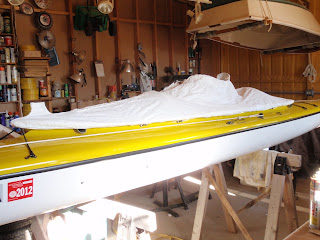
Once the paddler is in the boat, the skirt pulls up under the arms and is tightened around the chest. The elastic cord and zipper both allow for quick escape in the event of a capsize. I can attest that the skirt works great. I had some pretty good waves coming across Escambia Bay in Florida. Several waves that otherwise would have gone into the boat rolled up the deck, up over the spray skirt, and hit me in the chest. It was a rather tough introduction to a new boat that I was just beginning to feel at one with, but it all worked and kept me and the boat dry.


Once the paddler is in the boat, the skirt pulls up under the arms and is tightened around the chest. The elastic cord and zipper both allow for quick escape in the event of a capsize. I can attest that the skirt works great. I had some pretty good waves coming across Escambia Bay in Florida. Several waves that otherwise would have gone into the boat rolled up the deck, up over the spray skirt, and hit me in the chest. It was a rather tough introduction to a new boat that I was just beginning to feel at one with, but it all worked and kept me and the boat dry.
Saturday, November 26, 2011
Whiskey Jack
I’m in the middle of reading the Nahanni Journals. They’re really interesting and reveal a whole different way of life. Patterson talks about many of the flora and fauna he encounters, and one that attracted my attention, being totally unfamiliar with it, was the Whiskey Jack. It is also called the Gray Jay, and favors higher latitudes and altitudes---Russia, Norway, Tibet and Canada, but also dips down into the American Rockies.

Of course the Whiskey Jack was also adopted as the name of a beautiful canoe paddle made in Montana. They are handcrafted, and they say, like snowflakes, no two are exactly the same.

Another thing that attracted my attention was when Patterson was coming back south out of the Northwest Territories in 1927. He had made it to Fort Nelson worn and tattered, and after a huge meal had spread his bedroll out on the floor of the Hudson Bay dinning room. They had a wireless, and I would never have guessed that he’d be laying there in the wilds of British Columbia listening to dance music coming from Atlantic City. Too cool!

Of course the Whiskey Jack was also adopted as the name of a beautiful canoe paddle made in Montana. They are handcrafted, and they say, like snowflakes, no two are exactly the same.

Credit: WhiskeyJack Paddles
Another thing that attracted my attention was when Patterson was coming back south out of the Northwest Territories in 1927. He had made it to Fort Nelson worn and tattered, and after a huge meal had spread his bedroll out on the floor of the Hudson Bay dinning room. They had a wireless, and I would never have guessed that he’d be laying there in the wilds of British Columbia listening to dance music coming from Atlantic City. Too cool!
Tuesday, November 22, 2011
Across The Top Of The World

Illus. credit: Perseus Academic
Across The Top Of The World: The Quest For The Northwest Passage
By James P. Delgado (202pp., 1999, Checkmark Books, New York, NY)
The name for the Arctic comes from the Greek “arktos” (bear) because it lies beneath of constellation for the Great Bear. The normal seasonal temperature extremes, summer to winter, range between 50-deg. down to 60-deg. below zero. Polar ice ranges in thickness from 2 to 14 feet thick.
The kayak date of origin is unknown, but may date as far back as 2,000 B.C. The frames were made of anything that could be lashed or pegged together, such as driftwood and bone. To cover it required five caribou or nine seal skins waterproofed with seal oil, and are normally recovered yearly.
I’d strongly recommend this book, especially for those with no prior reading on the Arctic. It is heavily illustrated with paintings, drawings, and photography of actual events. There’s even the exhuming of one of Franklin’s men during an archeological expedition. Buried in the permafrost, he is completely preserved as if he just laid down for a rest with his eyes open a few minutes ago rather than over a century and a half ago. This book will give you as clear an understanding of the Arctic, as well as the hardships endured in exploring it, as you’ll get without making the trip yourself. You can follow every step from John Cabot’s voyage in 1497 to the first successful submarine transit of the Northwest Passage by the USS Seadragon in 1960.
Saturday, November 12, 2011
Trip Becomes Day-Paddle
I had been dragging around here sick for three weeks, and I needed to get out of here and on the water. The river trip was planned, and feeling normal for a couple days, I decided to make a run at it. I met Scott Richard at his house after driving the length of the state, planning to spend the night camping in his back yard so we could make an early start the next morning. It wasn’t long before my mistake became apparent. I was ready to go, but my body wasn’t. The temperature dropped to 34, and the cold air burned my throat and lungs. The chills started half-way through the night, sleep was impossible, and by morning I felt horrible.
When we prepared to leave at 5:30 a.m. for the car shuttle, I told Scott I was beginning to doubt if I was going to last, but maybe I’d feel better if I could just get some food on my stomach. We stopped for breakfast, and it was shortly apparent that wasn’t going to solve my problem. After a short discussion, we decided to do a day-paddle and save the trip for another time. That’s the bad news, and I apologize to those who may have planned to join us along the route and whose schedules I may have messed up.

Old Verdigris channel at Rt. 66 bridges.
The good news was that it was a beautiful night. The sky was devoid of any clouds, and the cold, crisp, clear air made the full moon brilliant. Scott had told me of three coyote packs in the woods behind his house, and I could clearly make out two of them during the night. One came obviously close enough to be just beyond the utility shed I was camped by.
We launched from Rogers Point on the Verdigris River just east of Catoosa, OK. We started up the old river channel only to find it totally blocked. They were setting new bridge spans on the Rt. 66 bridges, and since the river was too shallow to get barges up there with cranes on them, they totally filled the river with rock and fill-dirt to run the cranes across. I trust once the spans are set, the fill will be removed to prevent flooding.

Scott Richard and his wood kayak.
We paddled up the dredged section of the Verdigris, which is part of the McClellan-Kerr Arkansas River Navigation System. We turned into the Port of Catoosa, which has the distinction of being the most inland port in the United States. Going in only as far as the sign warning it was a secure port and recreational boats were restricted from access, we took a couple pictures and came back out, making the turn and continuing up the Verdigris to the first rapids. The autumn colors in the trees aren’t as bold as further north, probably because of the on-going draught conditions in Oklahoma, but they were probably the best we will see this year.

Port of Catoosa, NE of Tulsa.

Autumn colors along the Verdigris.
From the Verdigris we paddled up Bird Creek and followed the old oxbow back out to the river, seeing deer, pileated woodpeckers, blue herons, and hundreds of turtles covering every piece of wood to soak up the sun.

Rock ledges entering Bird Creek.
It was an enjoyable four-hour day-paddle, and like the turtles, the sun and climb of the mercury to 64-deg. was making me feel better, but during the four-hour drive home, I went back down with the sun. Today I’m back on another regimen of antibiotics. Traveling 476.6 miles to do a 7.9 mi. paddle, and aborting the planned trip, it wasn’t the best executed plan by a long shot, but at least we got the bottoms of our boats wet.
Tuesday, November 8, 2011
Source to the Sea

Will and Zak have started a trip down the Colorado River from its headwaters to Mexico, or as their blog says, from Source to the Sea. As you can see from this photo from their trip, some of the scenery is breathtaking, and for a bit of variety, the trip started on snowshoes. I thought you might enjoy this, and have added a link to the Favorite Blogs section in the right margin. We can all join in cheering them on.
Storm Delays Trip 24-Hrs.

Look at all that red and purple!
As we prepared for the start of our paddling trip, it seemed the weather would be the most likely to upset our plans. I remarked the best ways to get rain were silver iodide seeding, tribal rain dances, and planning a paddling trip. We desperately needed rain, but it looked like this would be torrential downpours in the bands over which it was to track with tornadoes and flash floods.
Monday, November 7, 2011
Going Paddling
Ibi and I will be taking off tomorrow for roughly six days. You can follow the trip by clicking "Follow Ibi's SPOT" in the right margin.
Saturday, November 5, 2011
Messing About on the River
To give credit where due, I found this video on the Doryman blog. It's great. You'll enjoy it. Also, if you haven't checked out the Doryman blog, please do so. There's a link in the right margin. If you love boats at all, you'll find what pleases you there---beautiful boats, hand crafted boats, antique boats, character boats, and everything else. The lyrics in this video are really cute. I've added them below, but while researching them, found several slight variations. Play the video in full screen.
http://vimeo.com/search/videos/search:yaquina%20river%20halloween/st/38ff9e07
or http://vimeo.com/31180687
Messing About On The River
(Tony Hatch/Les Reed, Josh Macrae)
When the weather is fine then you know it’s a sign,
For messin’ about in the river.
If you take my advice there’s nothing so nice
As messin’ about in the river.
There are long boats and short boats and all sorts of craft.
And cruisers and keel boats and some with no draft,
So take off your coat and hop in a boat,
Go messin’ about in the river.
There are boats made from kits that’ll reach you in bits
For messin’ about in the river.
Or you might like to skull in a glass fiber hull
Just messin’ about in the river.
There are rudders and tillers and anchors and cleats,
Ropes that are sometimes referred to as sheets,
With the wind in your face there’s no finer place,
Than messin’ about in the river.
There are skippers and mates and rowing club eights,
All messin’ about in the river.
Capstans and quays where you tie up with ease,
While messin’ about in the river.
Outboards and inboards and dinghies you sail,
The first thing you learn is the right way to bail,
In a one-man canoe you’re both skipper and crew
Just messin’ about in the river.
There are bridges and locks, and moorings and docks,
When messin’ about on the river.
There’s a whirlpool and weir that you mustn’t go near,
While messin’ about in the river.
There are backwater places all hidden from view,
And quaint little islands just waiting for you,
So I’ll leave you right now. Go cast off your bow,
Go messin’ about in the river.
http://vimeo.com/search/videos/search:yaquina%20river%20halloween/st/38ff9e07
or http://vimeo.com/31180687
Messing About On The River
(Tony Hatch/Les Reed, Josh Macrae)
When the weather is fine then you know it’s a sign,
For messin’ about in the river.
If you take my advice there’s nothing so nice
As messin’ about in the river.
There are long boats and short boats and all sorts of craft.
And cruisers and keel boats and some with no draft,
So take off your coat and hop in a boat,
Go messin’ about in the river.
There are boats made from kits that’ll reach you in bits
For messin’ about in the river.
Or you might like to skull in a glass fiber hull
Just messin’ about in the river.
There are rudders and tillers and anchors and cleats,
Ropes that are sometimes referred to as sheets,
With the wind in your face there’s no finer place,
Than messin’ about in the river.
There are skippers and mates and rowing club eights,
All messin’ about in the river.
Capstans and quays where you tie up with ease,
While messin’ about in the river.
Outboards and inboards and dinghies you sail,
The first thing you learn is the right way to bail,
In a one-man canoe you’re both skipper and crew
Just messin’ about in the river.
There are bridges and locks, and moorings and docks,
When messin’ about on the river.
There’s a whirlpool and weir that you mustn’t go near,
While messin’ about in the river.
There are backwater places all hidden from view,
And quaint little islands just waiting for you,
So I’ll leave you right now. Go cast off your bow,
Go messin’ about in the river.
Wednesday, November 2, 2011
Works of Thoreau
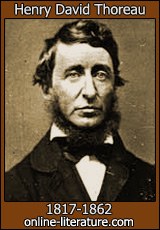
Portrait: The Literature Network
Walden and From the Maine Woods are, of course, familiar at least in name to anyone with even the scantiest acquaintance with American literature. Even Thoreau’s discourse on Civil Disobedience is being quoted by the Occupy Wall Street Movement. Included in this collection of writings also are From Cape Cod, Wild Apples, Life Without Principle, Autumnal Tints, and A Winter Walk. I find his writing interesting, and even identify with some of his principles, but still occasionally find some of the discourse tedious. It’s as though he is sitting alone with a continuous mental stream of thoughts, and every thought goes onto the page without editing or consideration of its value. Although I admit I might find myself in the same position if I was locked away in a small cabin in the woods for two years. (On the other hand, it may be that I’m presently sick and feeling miserable, and perhaps looking more to be entertained than enlightened.) The parts I found most interesting, and the ones likely most interesting to those who love the outdoors, are the chapters on the pond, winter and summer, and woods. You can share his feeling of transcendence into nature as he describes in detail the impressions made by the wildlife he encounters, snowfall, trees, even the ripples in the sand on the lake bottom or air bubbles under the ice.
His thoughts on economy in living were most interesting on the backdrop of our disposable, wasteful, narcissistic, Kardashian society. While not adjusted for inflation, at a time (1845) when land in New England could be purchased for $8.08/acre, he found he could live off of 27-cents a week for groceries, and by working for six weeks at manual labor, could earn enough to cover all of his living expenses for the remainder of the year. Here’s one I’ve always considered true. “And when the farmer has got his house, he may not be the richer but the poorer for it, and it be the house that has got him.” “Most men appear never to have considered what a house is, and are actually though needlessly poor all their lives because they think that they must have such a one as their neighbors have.” “It makes little difference whether you are committed to a farm or the county jail.”
Subscribe to:
Posts (Atom)